

A pinhole leak behind a Tacoma kitchen wall can cost more than a new roof. Water travels sideways, downward, and into cavities nobody opens until something starts to smell wrong. By then the subfloor has gone spongy and the drywall carries a tide line, something I’ve seen firsthand pulling back cabinets on these jobs. Selling that house in Washington is still very doable, and our neighbors do it every single month. The route you pick decides what you keep.
How to Sell a House with Water Damage in Washington
Dry it out, repaint, list in April, and take a clean offer. That plan holds right up until the buyer’s inspector lifts the crawlspace hatch and his meter lights up. In a state where rain runs from October into May, I’ve noticed inspectors here hunt for moisture first and everything else second.
Selling a water-damaged house starts with honesty on paper. Washington sellers of one-to-four-unit residential property complete a Seller Disclosure Statement, the document everybody calls Form 17, under chapter 64.06 RCW. It asks flat out about flooding, standing water, drainage problems, and material damage from floods. Your answers rest on what you know, not on an investigation the law forces you to run, and in the houses I’ve bought, skipping that step was often the first regret sellers mentioned. The environmental questions can’t be waived by a buyer, even in an as-is sale.
Delivery timing is written into the statute too. Sellers hand over Form 17 no later than five business days after mutual acceptance unless both parties agree otherwise in writing, and the buyer gets three business days after that to rescind without penalty.
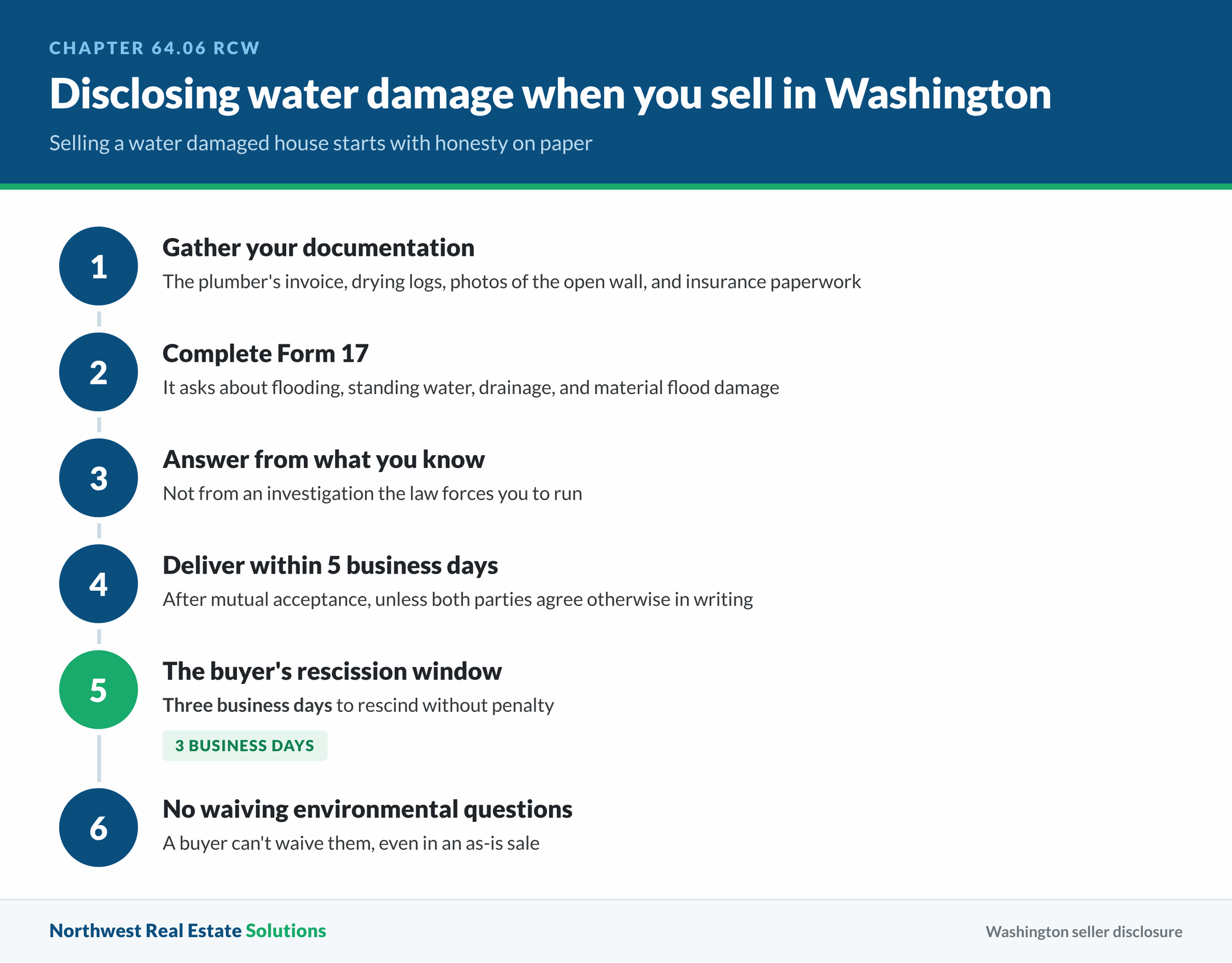
That rescission window is exactly why I push sellers to disclose early and in detail.
A buyer who learns about the 2019 washing machine flood on day one negotiates. A buyer who learns about it on day twenty walks, and then your listing wears a “back on market” tag that every agent in the county notices. Gather what you have before you do anything else: the plumber’s invoice, the restoration company’s drying logs, photos of the open wall, and any insurance claim paperwork. Documentation turns a scary unknown into a priced known, and priced knowns sell.
You’re really choosing between three honest paths here. Repair the damage and list at full retail. List as-is and let the market discount it. Or sell direct to a cash buyer who prices the damage into the offer and closes without a lender in the room. Each one fits a different seller, and anyone who tells you one answer works for everybody is selling something.
Can Water Damage Make a Washington Home Unsafe to Sell?
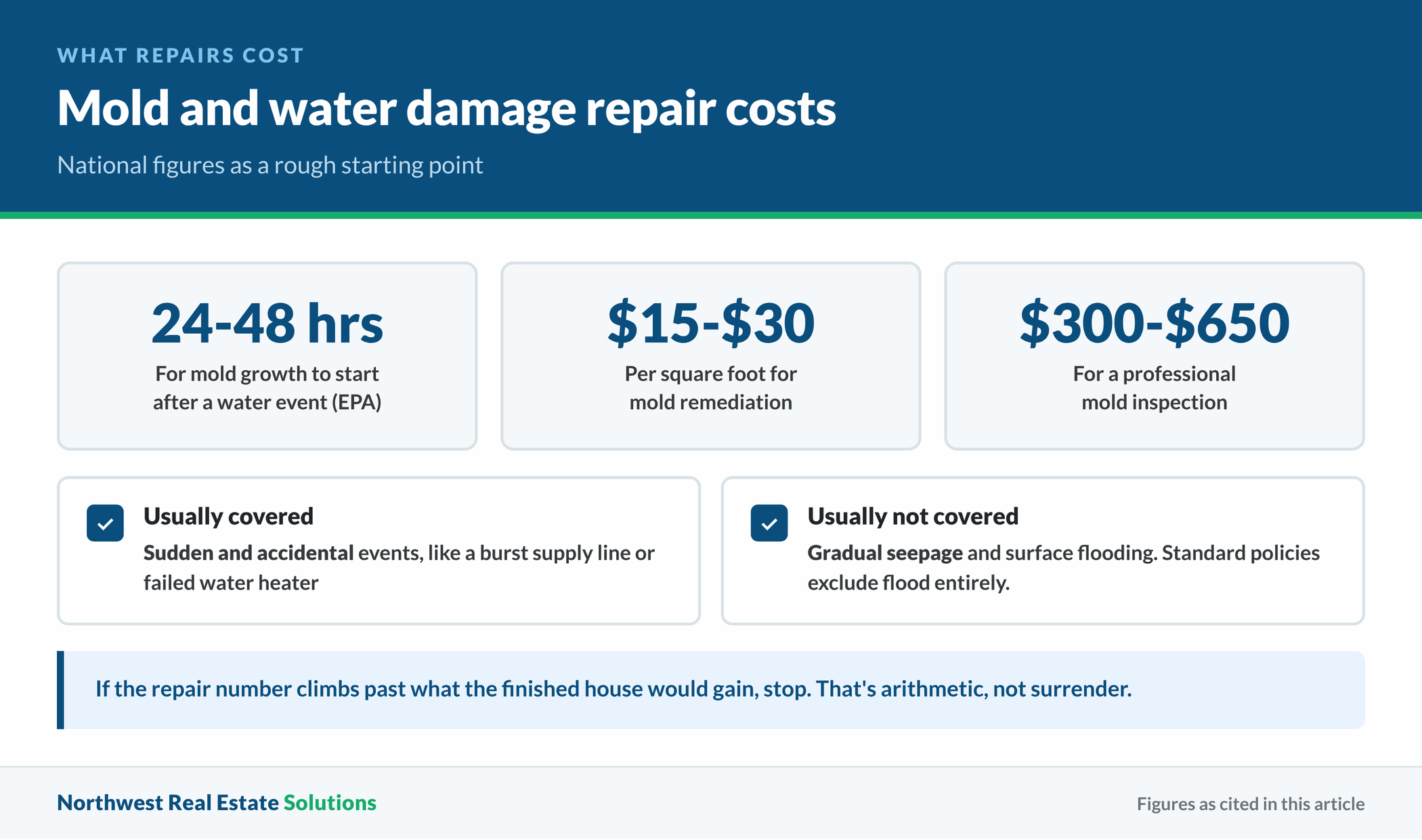
What’s really keeping you awake is whether the house is safe for anybody to be in. The EPA puts mold growth starting within 24 to 48 hours of a water event, and our climate is generous to spores. A leak I’ve seen sit all winter under a bathroom floor isn’t a cosmetic problem anymore.

Unsafe and unsellable aren’t the same thing, though. Washington has no law barring you from selling a house with rot, mold, or standing water in the basement. What changes is your buyer pool. Conventional lenders get twitchy about active moisture; FHA and VA appraisers can flag peeling paint, visible fungal growth, or a wet crawlspace and require correction before funding. Lose financed buyers, and you’re left with cash buyers and investors.
Serious hazards deserve serious handling. Compromised floor joists, a sagging ceiling, and saturated electrical boxes: get a professional out before anyone tours the property. If the house is tenant-occupied, habitability duties under Washington’s landlord-tenant rules don’t pause because you’ve decided to sell.
Buyers forgive a lot of things. A persistent damp odor isn’t one of them, because it signals a problem they can’t see the edges of.
What Does Water Damage Do to Your Washington Home Sale Price?
Buyers discount water damage far beyond what the repair actually costs every time.
The gap between repair cost and buyer discount is where sellers lose money. Somebody sees a stained ceiling and mentally subtracts twenty thousand dollars, even when a contractor would fix it for a fraction of that. Fear prices worse than estimates do.
You use context to judge whether an offer is fair. According to NWMLS-sourced data calculated September 30, 2026, Washington’s statewide median sold price over the prior twelve months sat at $625,000, with a rolling 90-day median of 28 days on market and a 98.9% sale-to-list ratio. Clean houses are closing near asking. Damaged ones aren’t part of that average.
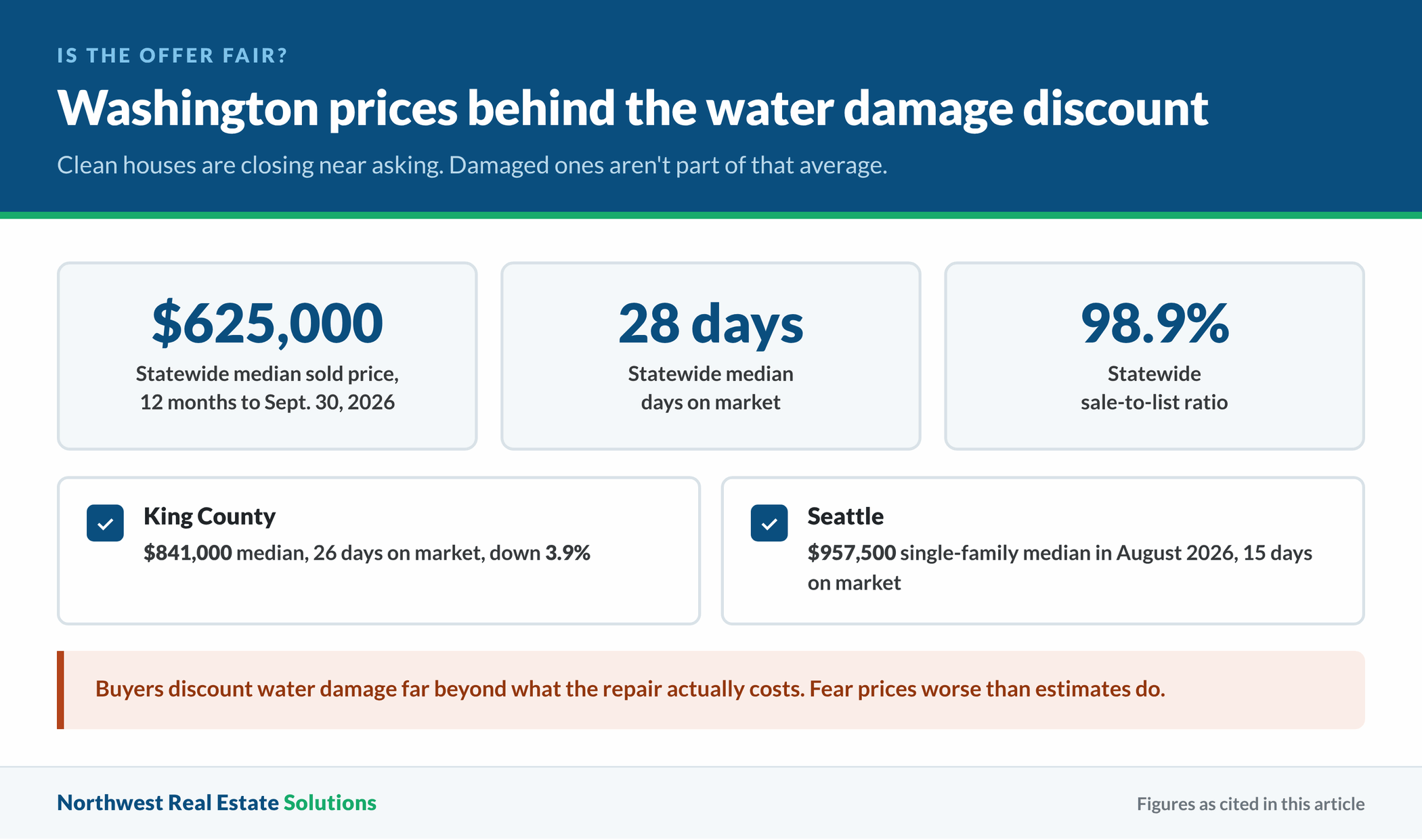
King County told a sharper story in the same report: an $841,000 median sold price, 26 median days on market, and a 3.9% decline from a year earlier. Softening prices gives buyers more leverage to press on the condition.
City numbers run higher still. In Seattle, NWMLS figures for August 2026 put the single-family median at $957,500, with a 15-day median days on market citywide. A water-stained house in Ballard or Wedgwood still has real value under the problem. What it doesn’t have is the competing-offer dynamic that moves clean listings.
So what’s the damaged-house discount in practice? On smaller, documented problems, buyers typically want the repair bid plus a cushion for the unknown. On bigger ones, especially anything with mold on the disclosure, offers drop toward investor math: after-repair value minus the renovation budget minus a profit margin. Neither of those is an insult. They’re just two different formulas, and knowing which one you’re inside of keeps you from feeling cheated. When an offer lands under your appraisal, see whether you can sell your house for less than appraised value in Washington State.
Should You Repair Water Damage Before Selling Your Washington Home?
A seller near Olympia got three bids on a laundry-room leak that had crept under the hall flooring. The low bid and the high bid were four thousand dollars apart, and the middle contractor couldn’t start for eleven weeks.
That spread is the whole problem with repair-before-selling. You’re betting a known expense against an unknown return on a timeline you don’t control.
These national figures give you a rough starting point to work from. Water damage restoration averaged $3,867 in 2026 according to cost data tracked by Angi in May 2026, with most projects landing between roughly $1,400 and $6,400. HomeGuide’s 2026 figures put mold remediation at $15 to $30 per square foot and a professional mold inspection at $300 to $650. Whole-house contamination runs into five figures fast.
Repairs make sense in a narrow set of cases. The damage is contained, the cause is fixed, the house is otherwise in good shape, and you have both the cash and the patience. Fresh drywall and new flooring in an otherwise solid Vancouver rambler can return more than they cost.
Partial repairs are where I watch people lose money. Half-finished work reads as a cover-up to an inspector, and a buyer who suspects concealment stops trusting anything else on your disclosure.
Check your homeowners insurance before you spend a dime. Sudden and accidental events, a burst supply line, or a failed water heater are commonly covered by home insurance; gradual seepage and surface flooding generally aren’t, and standard policies exclude floods entirely. Insurance claims take time, adjusters ask questions, and a claim on file becomes information you disclose, something I’ve watched slow down a sale more than once. Running the claim is usually still worth it when the cause qualifies. If your claim is still open, here’s whether you can sell your house with a pending insurance claim.
If the repair number climbs past what the finished house would gain, stop. That’s arithmetic, not surrender.
Signs It’s Time for a Cash Sale on Your Water-Damaged Washington Home
Before: a Spokane Valley duplex with a cracked drain line, two contractor bids, and an owner driving 90 minutes each way to meet them. After: closed in nineteen days, no repairs, no tenants to relocate on a schedule.
Some situations just don’t reward patience. I look for these factors when telling a homeowner that a cash sale is genuinely the better math.
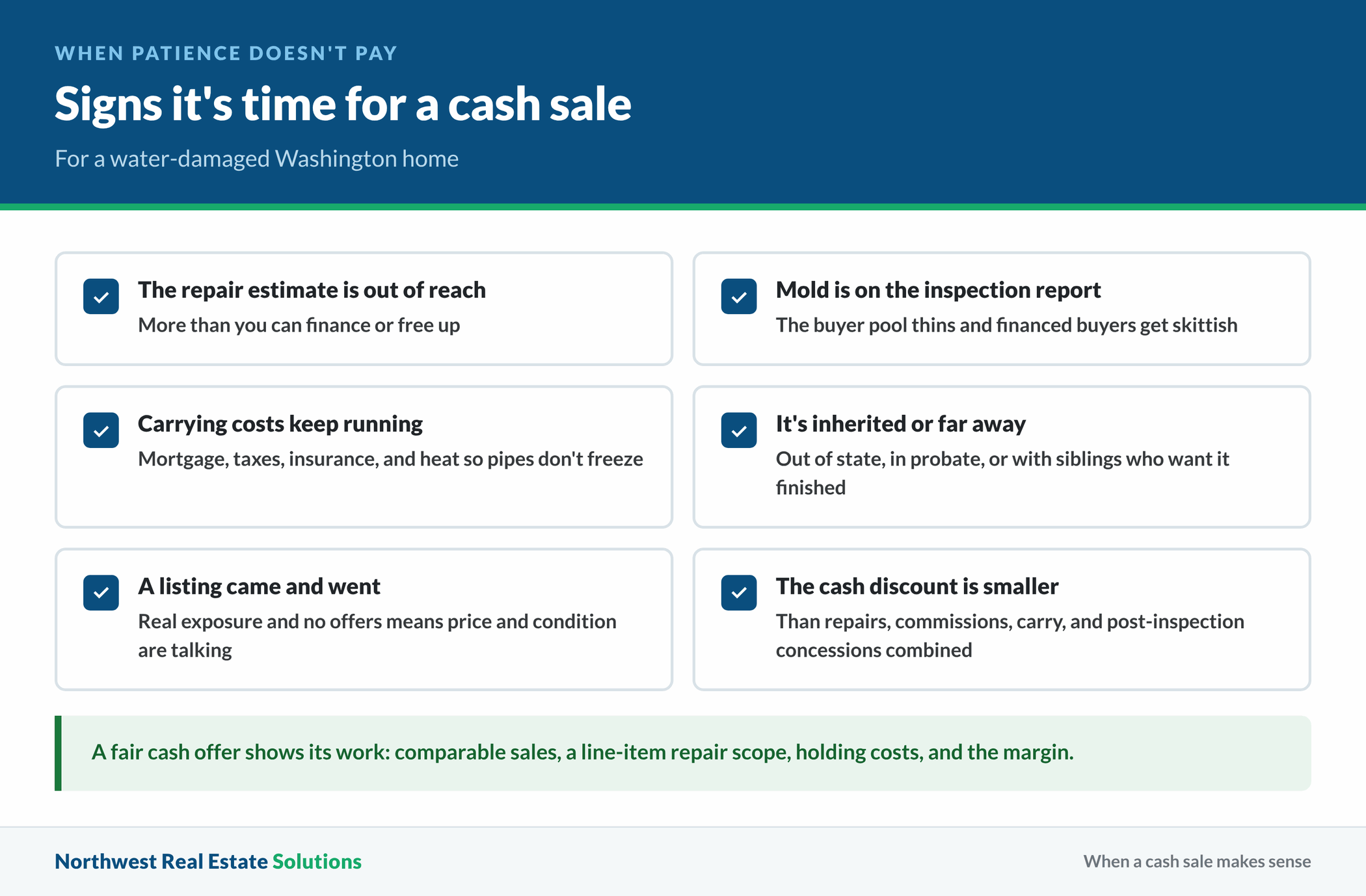
Your repair estimate exceeds what you can finance or free up. Borrowing against a damaged house is hard, and credit cards at a renovation scale are a trap.
Mold showed up on an inspection report. Once mold growth is documented, the buyer pool thins immediately, financed buyers get skittish, and mold inspections start multiplying.
You’re carrying costs on a property that isn’t producing anything: mortgage, taxes, insurance, utilities to keep the heat on so pipes don’t freeze in Chelan or Yakima winters. Every month of carry is a real-dollar reduction in what you net.
The house is inherited, out of state, or tangled up in probate, and you have siblings who want this finished. Distance multiplies every problem on a damaged property.
A listing already came and went without offers. When a property sits with real exposure and nothing happens, price and condition are talking to you.
Owners ask me whether an investor offer leaves money on the table, and sometimes it does. A homeowner with time, cash, and a contractor they trust should list. For everyone else, the discount on a cash offer is often smaller than the combined cost of repairs, commissions, months of carry, and the concessions a retail buyer extracts after inspection. At Northwest Real Estate Solutions, we’ll put that number in front of you without a listing agreement attached.
How Do I Sell My Washington House As-Is to a Cash Buyer?
“Cash buyers lowball.” Some do, and you should walk away from those. A fair cash offer shows its work: comparable sales in your neighborhood, the repair scope with line items, the holding and resale costs, and the margin. If a buyer won’t show you the math, you’ve learned what you needed to know in five minutes.

The mechanics are simpler than sellers expect. You share the property details and the damage history. The buyer walks the house, usually within a day or two, looking at the crawlspace, the roofline, the foundation, and the extent of the water intrusion. An offer follows, typically same-day or next-day.
No appraisal. No lender underwriting. No repair addendum coming back at you two weeks in.
From there it’s a purchase and sale agreement, earnest money to escrow, a title search, and a closing date you help pick. Washington closings run through escrow with a title company, and you pay Washington’s real estate excise tax out of your proceeds at closing. Most cash transactions close in two to four weeks, and I’ve closed in under ten days when a seller needed it.
Your disclosure duty rides along with you in a cash sale. Form 17 still applies to most residential transfers, and a professional investor wants that disclosure complete because it protects both sides later.
Vet your buyer the same way you’d vet a contractor. Proof of funds, a local track record, references from sellers they’ve closed with, and no assignment games where your contract gets shopped to a stranger. Northwest Real Estate Solutions works across Puget Sound and beyond, buying properties in whatever condition the water left them.
Does a cash sale cost you something? Yes. It costs you the retail premium in exchange for speed, certainty, and zero repair risk.
How Do I Sell My Washington House As-Is with an Agent?
An as-is listing on the NWMLS does not remove the buyer’s inspection contingency, and that contingency is where most as-is sales come apart. “As-is” signals your intention not to repair. It doesn’t bind a buyer who finds something worse than advertised and decides to renegotiate or terminate.
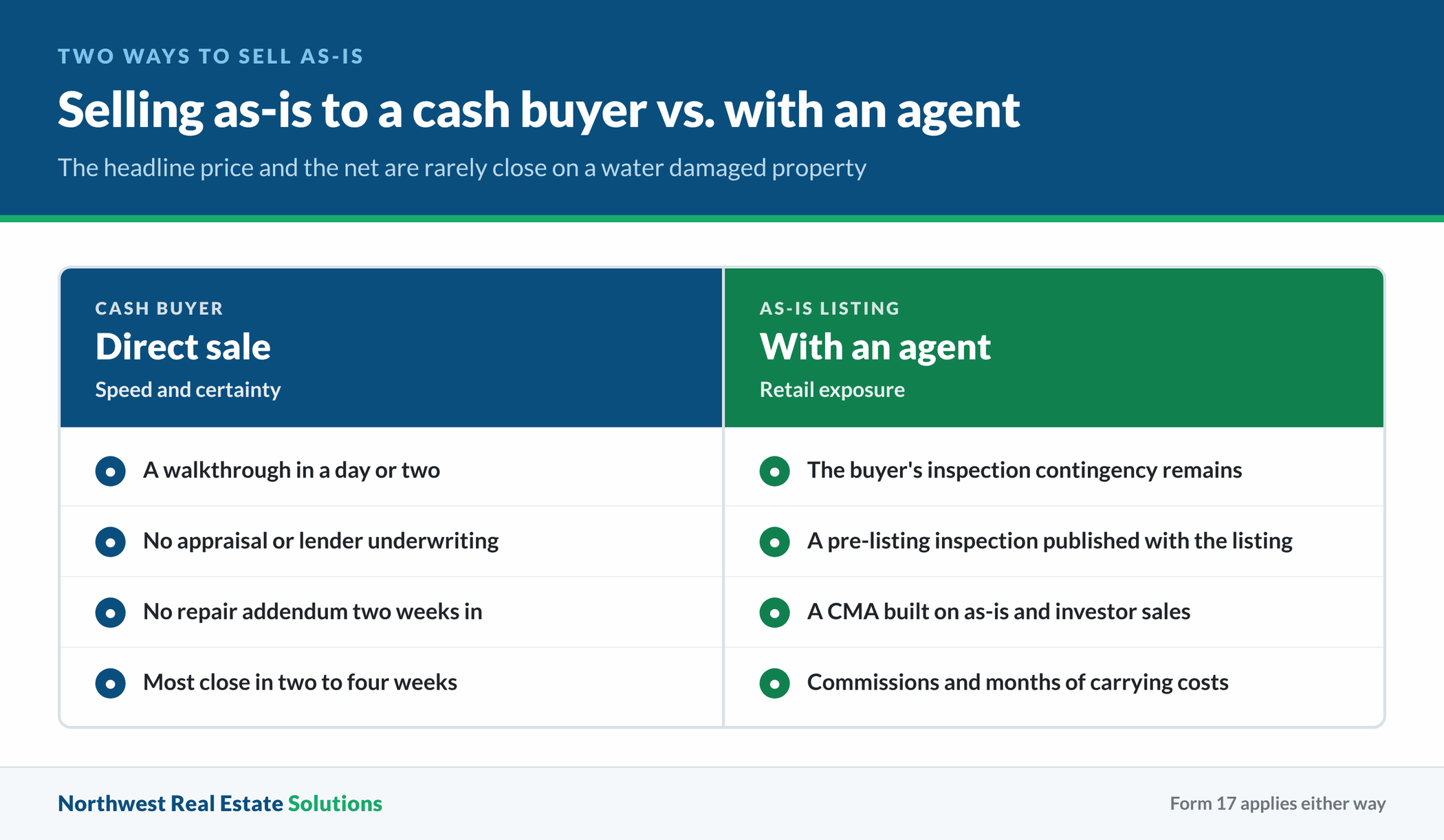
Plan for it. The smartest as-is sellers I work with order their own pre-listing inspection, publish the report with the listing, and price against it. Buyers who see the bad news upfront make fewer surprise demands later.
Your choice of real estate agent matters more here than on a clean house. You want a broker who’s sold damaged property, not just marketed pretty ones. Ask for a comparative market analysis that pulls as-is and investor sales in your area, not just renovated comps. A CMA built on turnkey homes will set a price no buyer will meet.
Pricing in a softer market takes discipline. Pierce County posted a $570,000 median sold price with a 99.5% sale-to-list ratio and 25 median days on market in that same September 30, 2026 snapshot, up 0.9% year over year. Pierce held value while King County slid. Your agent should know which direction your specific submarket is moving before setting a number.
Expect a narrower buyer pool and more showings that lead nowhere. Marketing should target investors, flippers, and contractor-buyers alongside traditional purchasers.
Commissions, a longer market time, mortgage payments while you wait, and post-inspection concessions all come out of your proceeds. Run those against a cash offer before you sign the listing agreement, because the headline price and the net are rarely close on a water-damaged property.
What Are the Pros and Cons of Selling a House as Is in Washington?
Sitting at a kitchen table, what I usually say is this: it’s not about which option is best, but which problem you’d rather have.

Selling as-is buys you out of the renovation business. No contractor scheduling, no permit trips to the county, no discovering that the leak traveled further than the plumber thought. You skip the cash outlay, you move faster, and you stop the bleeding on carrying costs.
What you trade away is the premium a finished house commands. As-is pricing also narrows your audience, and a smaller audience means less competition pushing your number up, especially since some financed buyers simply can’t get a loan on the property, which shrinks the field again.
Disclosure obligations stay exactly where they were. Selling as-is in Washington doesn’t release you from telling buyers what you know about water intrusion or mold, and a seller who hides a known defect invites legal trouble that outlasts the closing.
There’s an emotional side people underrate. Living in a damaged house during a drawn-out listing, keeping it showing-ready with a dehumidifier running in the basement, wears people down in a way that doesn’t show up on any spreadsheet.
You should take preventive measures for whatever you own next: gutters cleared before the fall rains, a crawlspace vapor barrier, and a water alarm under the washer. For the house you have now, you’re facing a simpler decision than it feels. Price the damage honestly, pick the exit that fits your actual circumstances, and stop paying for a problem you’ve already decided not to solve.
Frequently Asked Questions
Does a Real Estate Agent Have to Disclose Water Damage to Buyers?
Your broker has a duty to disclose material facts they know about the property, but the statutory disclosure form is yours, not theirs. The form is a statement from the seller, and Washington law makes clear it isn’t a warranty from any licensee involved. If your agent knows about a past flood or an active leak and stays quiet, that’s their exposure, not a shield for you. Practically speaking, most brokers in this state will push you to over-disclose rather than under-disclose, because the cost of a thorough Form 17 is a lower offer and the cost of a thin one is a lawsuit.
Can I Keep the Insurance Money and Sell the House Unrepaired?
Usually yes, if the claim is settled and your lender isn’t holding the funds. Mortgage servicers often put large claim checks into escrow and release them in draws as repairs get done, which means walking away with the money may not be an option until you satisfy the lender or pay off the loan at closing. Tell your buyer what was claimed and what was never fixed. A settled claim that produced no repair is exactly the kind of detail that shows up later in a CLUE report.
How Much Does Water Damage Lower a Home’s Value in Washington?
It depends on whether the water is gone or still arriving. A dried, documented one-time event with a clean moisture reading might cost you a modest adjustment. Active intrusion, failed drainage, or mold behind the drywall gets priced closer to the full repair estimate plus a risk discount, because the buyer is absorbing the unknown. In markets like Tacoma and Everett, I’ve seen the same square footage trade twenty percent apart on condition alone.
Can You Sell a House with Mold in Washington State?
You can. Washington doesn’t ban the sale, but you still have to answer the Form 17 questions honestly. Mold narrows your buyer pool more than almost any other defect, mostly because lenders and insurers get nervous, which is why these houses so often sell to cash buyers.
We Buy Water-Damaged Houses in Portland and Southwest Washington
Portland is our home market, and Clark County sits right across the Columbia from it. RMLS put Portland metro inventory at 3.8 months in August 2026, up from 3.5 months a year earlier. With more clean listings to choose from, buyers on both sides of the river have even less patience for a house with a moisture problem.
We’re cash home buyers in Portland, and we buy in Southwest Washington too. North of Vancouver, we buy houses in Salmon Creek. A little farther out, we’re investor home buyers in Battle Ground. You can see every area on our “We Buy Houses in Washington” page.
Get a Cash Offer on Your Water-Damaged House
If you’re weighing a repair bid against just being done with it, it costs nothing to see what a straightforward cash offer looks like next to your other options. Reach out whenever you’re ready, ask whatever you need to ask, and take the number home to think about it. No pressure, no cleanup, no showings.
If the drying logs, repair bids, and mold questions are more than you want to manage, Northwest Real Estate Solutions can buy the house as the water left it. We’ll walk it, show you how we priced the damage, and give you a cash offer in writing to compare with your repair and listing numbers.
Have more questions first? Check out other frequent questions. When you’re ready, fill out our quick contact us form or use the short form below.
Helpful Washington Blog Articles
- How to Sell a House in Probate in Washington
- Selling a House to a Family Member in Washington
- Capital Gains Tax After Selling a House in Washington
- Selling A House with Delinquent Property Taxes in Washington
- Do All Heirs Have to Agree to Sell Property in Washington
- Do I Need a Lawyer to Sell My House in Washington?
- Sell a House That Failed Inspection in Washington
- Who Pays Closing Costs When Selling a House in Washington
- How to Sell a House with a Squatter in Washington
- Appraisal-Required Repairs in Washington
- Can I Sell a House with a Quitclaim Deed in Washington?
- Sell a House with Water Damage in Washington
- How to Sell an Apartment in Washington
- The Difference Between a Title and a Deed
- How Long After Closing Do Home Sellers Actually Receive Their Money