

A missing stair handrail can stall a closing for two weeks. Not because the buyer minds the stairs, but because the lender does, and the appraiser wrote it into the report. I’ve bought houses from Spokane’s South Hill to the Kitsap Peninsula, and the repair list that lands after the appraisal kills more sales than a low valuation ever does. The number leaves sellers bracing. Then a water heater strap, some peeling paint, and a soft spot in the subfloor hold up everything.
What Is an Appraisal and Why Does It Matter in Washington?
Get this part wrong, and your buyer’s loan dies days before closing, your house goes back on the market wearing a scarlet “price reduced” tag, and the next buyer assumes something’s deeply wrong with it. That’s the real cost. Not the repair bill.
An appraisal is a state-licensed appraiser’s written opinion of your home’s market value, ordered by the lender, paid for by the buyer, and used by underwriting to decide how much money to release. On conventional and government-backed loans alike, the appraiser also reports condition. If the property doesn’t meet the lender’s standards for safety and soundness, the appraisal comes back “subject to” repairs, and the loan sits frozen until those items are fixed and verified.
Usually the order routes through an appraisal management company, which is why nobody on your side gets to pick the appraiser or lean on them. A call to arrange access goes to the listing agent, the appraiser walks the property, and the report goes back to the lender. You, the seller, aren’t entitled to a copy. The buyer is. So if the first you hear about a condition issue is a panicked text from your agent, that’s normal, and it’s also why you want to know what’s on your own property before a stranger with a clipboard does.
Sellers must time Washington’s current market more carefully than during the frenzy years. According to Northwest MLS data compiled at the end of September 2026, the statewide median sold price was $625,000, and the typical sold home spent 28 days on market, with sellers closing at about 98.9 percent of the list. Buyers have options again. When a repair list adds three weeks to a contract and the buyer’s rate lock is burning, some of them just leave.
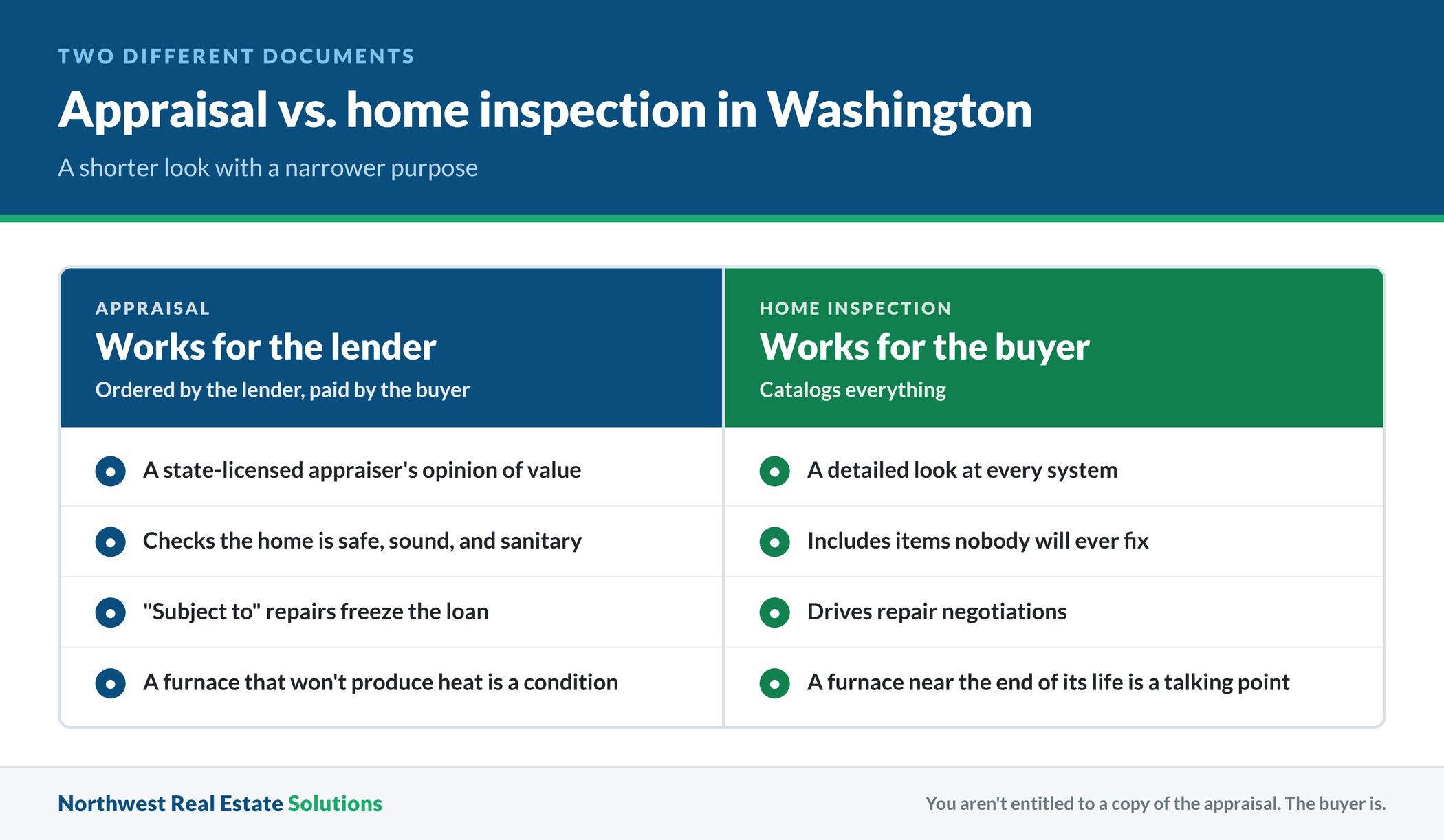
Your appraisal isn’t a home inspection. It’s a shorter look with a narrower purpose, and the two documents flag different things. An inspector works for the buyer and catalogs everything, including items nobody will ever fix. An appraiser works for the lender and only cares whether the collateral is safe, sound, and sanitary enough to secure a loan. A furnace near the end of its life is an inspection talking point. A furnace that won’t produce heat is an appraisal condition. If you’re wondering whether you can sell a house as-is without an inspection in Washington, we’ve covered that too.
What Does a Home Appraiser Look for in Washington?

King County’s median sold price sat at $841,000 as September 2026 closed out, roughly 3.9 percent under the prior year. At that price point, an underwriter reads every comment in the report. Value comes first: comparable sales within a reasonable radius, square footage, lot, age, condition rating, and whatever the local market rewards. A view of Rainier helps. A busy arterial doesn’t.
Condition is the second job. On FHA assignments, the appraiser is required to observe the attic and the foundation area; at minimum, a head-and-shoulders look into each. In Western Washington that crawl space visit matters, because our rain finds every failed gutter and every clogged footing drain.
Which means access is your job before the appointment. Move the storage tubs off the crawl space hatch. Clear the closet under the stairs where the attic scuttle hides. Unlock the garage, the shed, and the gate to the backyard, and make sure the dog is somewhere else. An appraiser who can’t get eyes on an area doesn’t guess; they note that it couldn’t be observed, and underwriting treats an unobserved area as an open question. A second trip and a second fee result from something a ten-minute cleanup would have solved.
Things that draw a pen out of the appraiser’s pocket around here: moss-choked composition roofs in Kitsap and Thurston counties, rot at the base of cedar siding, standing water under a Rainier Valley bungalow, buried oil tanks in older neighborhoods, and knob-and-tube wiring in homes built before the war. East of the Cascades, the list shifts toward failed well components, irrigation damage, and heat sources that aren’t permanent.
HUD is in the middle of rewriting how this gets described. In a September 2026 proposal posted to its drafting table, the agency would retire the old Minimum Property Requirements language in favor of a single Property Acceptability Criteria framework. Condition ratings would be judged on their own terms rather than against the neighborhood.
Most Common Appraisal-Required Repairs in Washington
The appraiser doesn’t decide what you have to fix. The lender does. An appraiser notes a deficiency, the report comes back conditioned, and underwriting chooses whether to enforce it, waive it, or escrow for it. Sellers who argue with the appraiser are arguing with the wrong person.
Peeling, chipping, or flaking paint on a home built before 1978 tops the list on government-backed files, since HUD treats any deteriorated surface as a lead hazard until proven otherwise. Roof condition runs a close second; HUD’s property standards look for a covering with at least two years of life left, no active leaks, and flashing that’s doing its job. Exposed wiring in a living space gets written up every time. So does an inoperable water heater or a missing temperature and pressure relief valve.
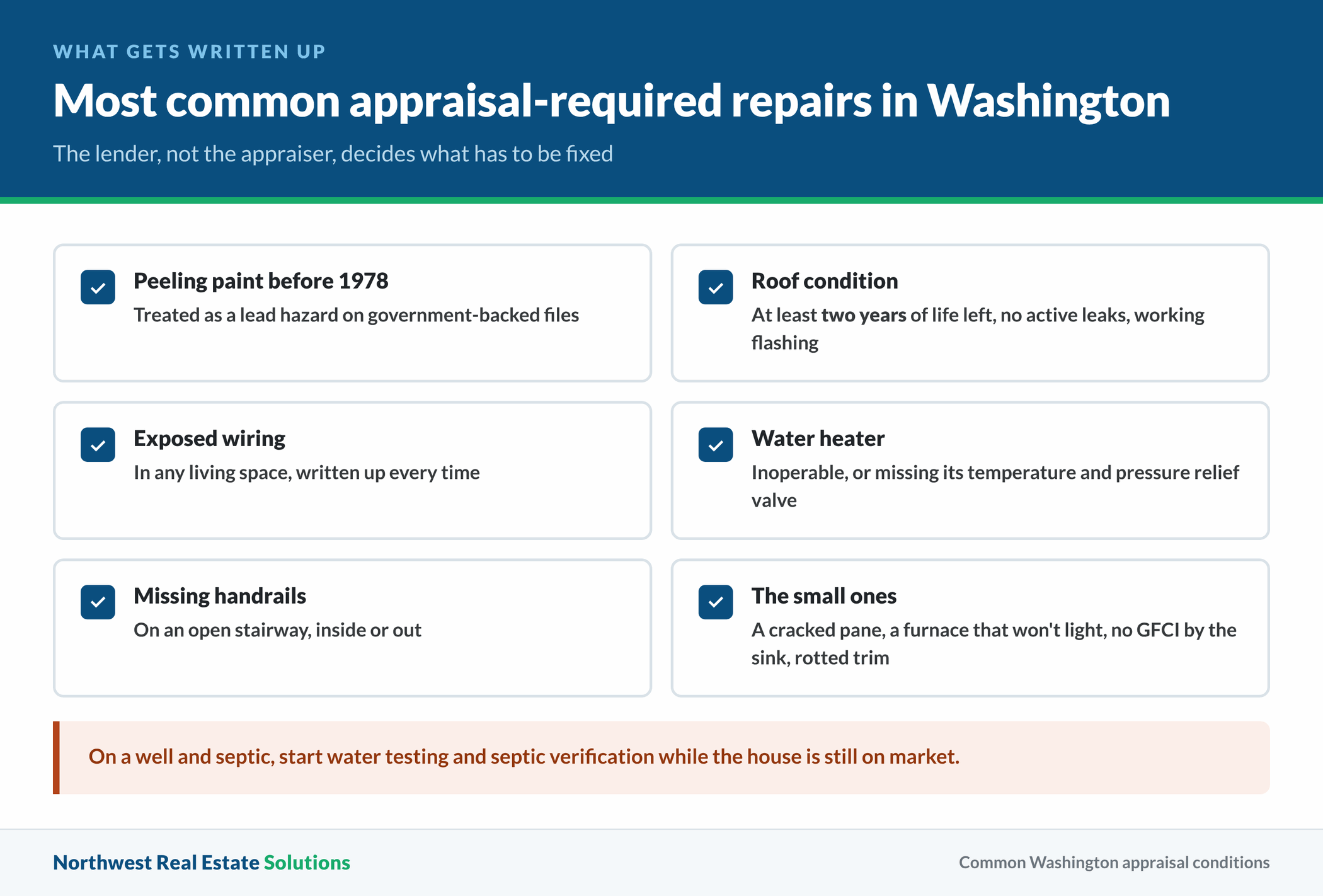
Then come the small ones that infuriate people: no handrail on an open stairway, a cracked windowpane, a furnace that won’t light, a toilet that won’t flush, a GFCI outlet missing beside a kitchen sink, and rotted trim at a door threshold.
Rural files add their own category. A home on a well and septic brings water quality testing and septic verification into the picture, and those tests take time nobody budgeted for. If your drainfield hasn’t been pumped or inspected in recent memory, start that process while the house is still on the market, not after a report comes back conditioned.
FHA vs Conventional vs Cash: Appraisal Repair Requirements by Loan Type
A seller in Olympia took an FHA offer over a cash offer because the number was higher. Five weeks later she’d replaced a water heater, scraped and repainted two window sills, and paid a reinspection fee to keep that loan breathing.
FHA runs the tightest ship, and everything flows from HUD Handbook 4000.1, which lenders follow line by line. Utilities have to be on and testable the day the appraiser walks through, so a vacant house with the power shut off almost guarantees a return trip, something I’ve seen delay closings by weeks. If you’ve already moved out and shut off service, turn it back on before the appointment and leave it on until the file clears.
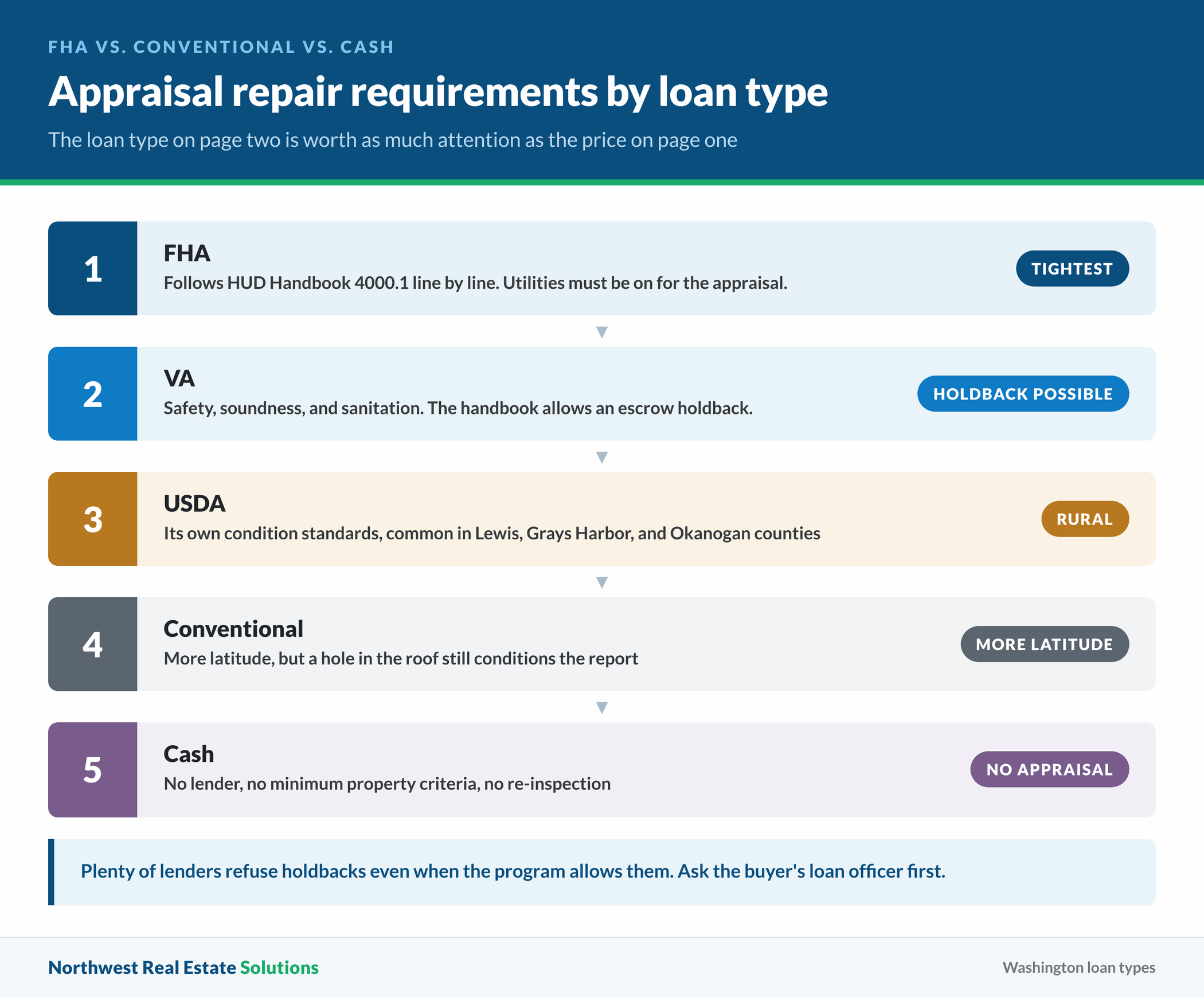
VA appraisals judge safety, structural soundness, and sanitation. The handbook actually allows a lender to hold funds in escrow so certain repairs finish after closing, though every item must be completed and the escrow funds disbursed before VA will guarantee the loan. Plenty of lenders refuse that path anyway. That’s their overlay, not the government’s rule. Ask the buyer’s loan officer directly whether their shop allows holdbacks before you assume one is available.
You’ll run into USDA financing more often than usual in Lewis, Grays Harbor, and Okanogan counties, and it carries its own condition standards. Conventional mortgage loans give appraisers more latitude, but “more latitude” isn’t the same as none. A conventional appraiser who sees a hole in the roof still conditions the report.
Cash removes the appraisal from the equation entirely. No lender, no minimum property criteria, no reinspection. That’s the whole reason as-is buyers can close on houses no FHA loan would ever touch. When you’re comparing two offers that look close on price, the loan type on the second page is worth as much attention as the number on the first.
Who Pays for Appraisal-Required Repairs in Washington?
Repair obligations don’t go to the seller automatically under the standard Washington purchase agreement. It handles inspection negotiations, financing contingencies, and timelines, then leaves appraisal-conditioned repairs to be worked out between the parties once the report lands. So the obligation falls on whoever blinks first.
In practice the seller usually pays because the seller wants the sale and has the equity to work with. But FHA policy specifically permits the buyer to cover appraiser-required repairs, with the repair cost added to the sales price before the mortgage amount gets calculated, provided the sales contract or an addendum names the borrower as the party paying. Buyers with cash reserves sometimes prefer that to losing the house, and I’ve seen that save a sale at the last minute.
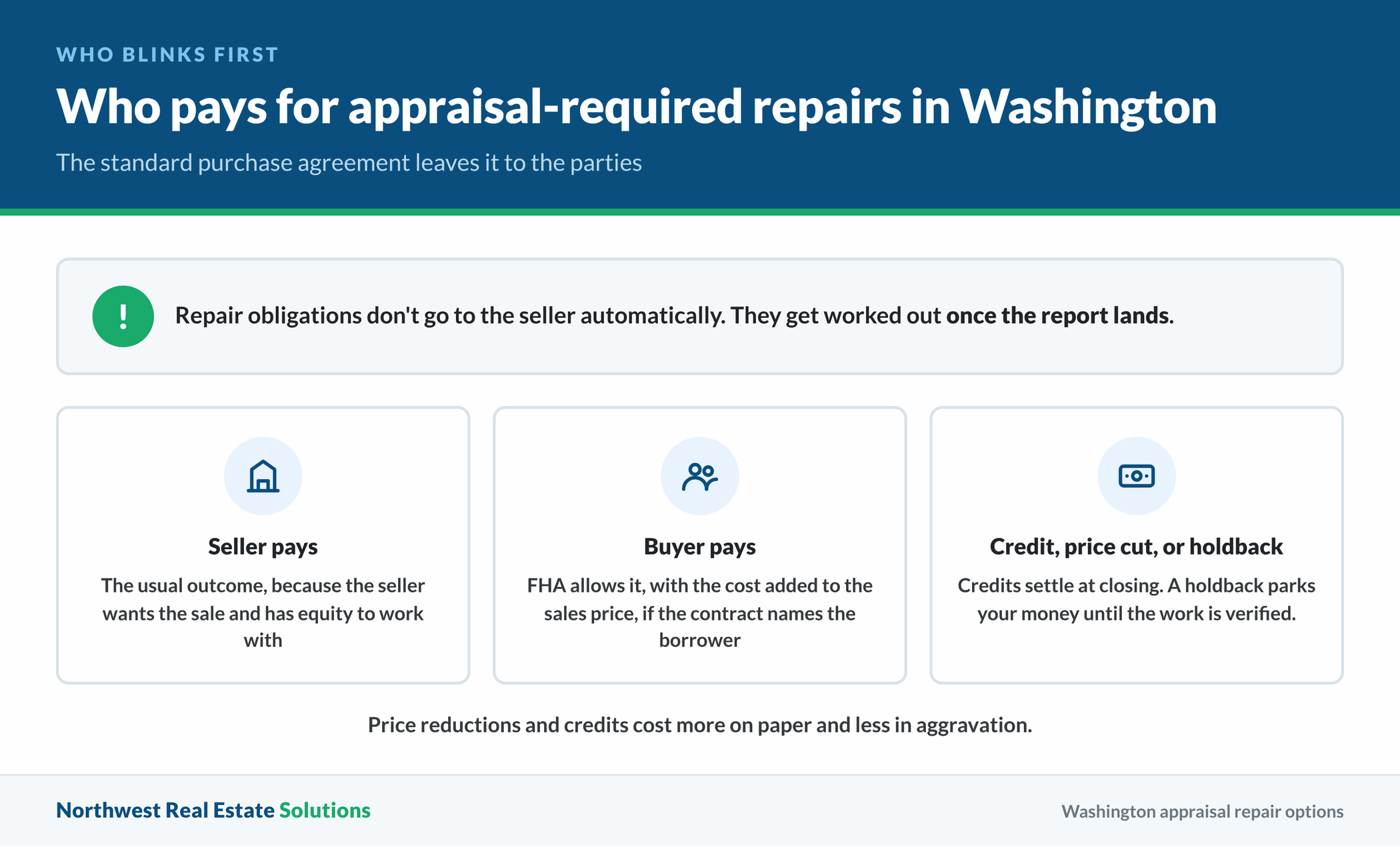
Three other paths exist. A price reduction in exchange for the buyer taking on the work. A closing cost credit. An escrow holdback where the lender keeps money back at closing, often more than the contractor’s offer, and releases it once the work passes inspection.
The holdback has a catch worth understanding. The money is yours, but it’s parked, and you don’t see it until the work finishes and somebody verifies it. If the contractor runs long or the verification gets scheduled badly, that’s your cash sitting still. Price reductions and credits settle at the closing table and end the conversation. They cost more on paper and less in aggravation.
Which one serves you depends on your equity, your timeline, and how badly the buyer wants the property. Sellers juggling a probate, a relocation, or a tenant who won’t allow access often find the math doesn’t support any repair at all, and that’s when a direct offer from a company like Northwest Real Estate Solutions becomes worth comparing against the listed price.
How Much Do Appraisal-Required Repairs Cost in Washington?
“Is this going to eat the whole check?” Usually not. The appraisal itself runs roughly $300 to $600 for an FHA assignment, and a re-inspection costs a fraction of that.
The repair itself is where Washington gets expensive. Our labor market is tight, licensed contractors in the Puget Sound corridor book out weeks ahead, and a roofer in October has no reason to squeeze you in. A handrail is a Saturday morning. Scraping and repainting lead-era siding with a certified crew is a different animal, and so is replacing a failed furnace in a 1940s house with ductwork nobody’s touched since.
You need to give carrying cost its own line in your math. Snohomish County’s median sold price was $705,500 at the end of September 2026, down about 5.6 percent year over year, and in a softening county every extra month of mortgage, insurance, taxes, and utilities comes out of a shrinking number. Pierce County held up better over the same stretch at $570,000, up roughly 0.9 percent.
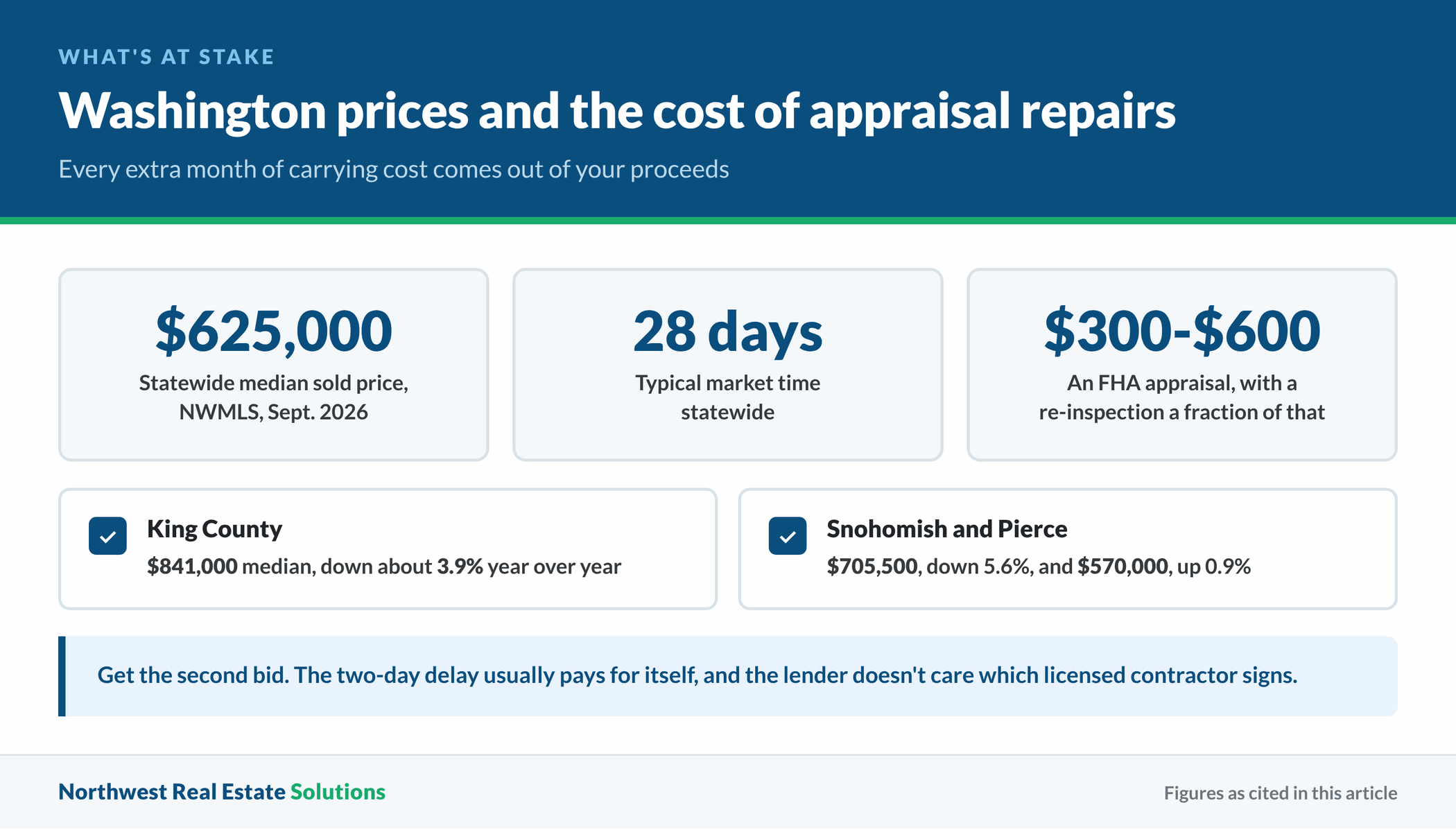
One pattern I keep seeing: sellers approve a repair list without getting three bids, then discover the first contractor’s price was the outlier. Get the second bid even when you’re in a hurry. The two-day delay usually pays for itself, and your lender doesn’t care which licensed contractor signs the invoice.
When you call for bids, read the appraiser’s exact wording to the contractor. Tradespeople are trained to solve the underlying problem, which often means a bigger scope than the lender actually requires. The report may call for the deteriorated paint surface to be stabilized, not for the whole house to be repainted. Scope is to the condition, not to the ideal, a distinction I’ve had to explain to more than one contractor over the years.
What Documentation Is Needed After Appraisal Repairs in Washington?
Before: a cracked furnace heat exchanger, a conditioned appraisal, and a buyer’s lender refusing to clear to close. After: a licensed HVAC contractor’s dated invoice, four photographs, a permit number, and a completion report from the original appraiser.
Paperwork, not good intentions, releases the loan. Underwriting generally wants proof the work was done by someone qualified, proof of what was done, and independent verification that the deficiency no longer exists. A receipt from a hardware store and your word don’t clear a condition.
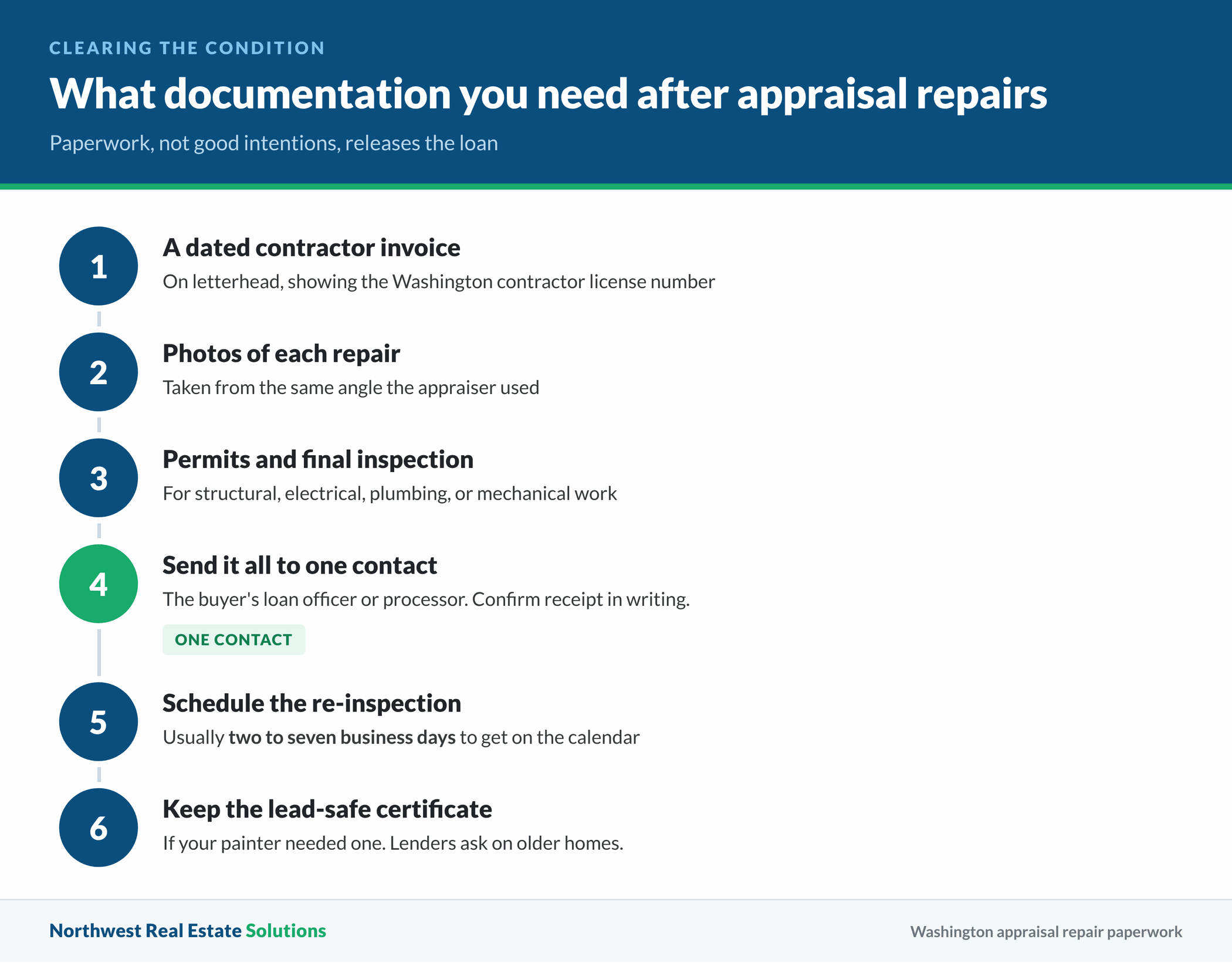
Keep invoices on company letterhead showing the license number, which Washington contractors are required to carry and display. Photograph each repaired item from the same angle the appraiser used. If the work touched structure, electrical, plumbing systems, or mechanical equipment, pull the permit through your city or county building department and keep the final inspection record. I’ve seen a Seattle job and a Yakima job follow completely different local procedures.
Send every document to one contact instead of scattering it around. The documentation goes to the buyer’s loan officer or processor, who passes it to underwriting and orders the re-inspection. Sellers who email photos straight to the appraiser or hand paper to their own agent usually find out a week later it never reached the file. Confirm receipt in writing and ask what else underwriting wants, because the second request is common.
The re-inspection usually brings the original appraiser back out for a shorter visit focused only on the flagged items. On some files a HUD-approved inspector can perform it instead. Either way, schedule it the day the work finishes rather than the day before closing, since appraisers in busy markets aren’t always available on 24 hours’ notice.
One more thing worth saving: the lead-safe certification, if your painter needed one. Lenders ask for it on older homes.
How to Prevent Appraisal-Required Repairs Before Listing Your Home in Washington

For years I told sellers to skip pre-listing prep and let the appraisal decide, and that advice cost several of them their first buyer.
Walk your own property with a lender’s eyes before anyone photographs it. Open stairways need handrails. Water heaters need a relief valve with a proper discharge pipe. Every habitable room needs a working heat source, which matters in Bellingham and Wenatchee alike. Loose outlets, bare wire splices in the garage, and a furnace that hasn’t been serviced since the Obama years all read as risk to an appraiser.
Do the walk twice, once inside and once outside, and take notes on your phone as you go. Outside, look at the roof from the street and from the back fence. Check the siding where it meets the ground. Make sure handrails on exterior steps are solid when you lean on them. Inside, run every faucet, flush every toilet, turn on the heat even in August, and open the electrical panel to see whether anything looks improvised.
A pre-listing home inspection costs real money, and I still recommend one on any house over fifty years old, having watched sales wobble late when sellers skipped this step. You’ll learn what the buyer’s home inspector will find, and you get to fix it on your schedule instead of under a contract deadline. Washington’s seller disclosure statement obligates you to share what you know, so handle problems early and disclose them plainly.
Speed matters too. In Seattle, the single-family median hit $957,500 in NWMLS data for August 2026, with Redfin clocking a 15-day median market time citywide in its September 2026 data. Homes that move that fast are the ones already in clean condition.
Not everyone can front repair money. When the work exceeds what you can reasonably fund, pricing for condition beats pretending the condition isn’t there, and an as-is conversation with a local buyer costs nothing.
Selling As-Is Instead of Making Appraisal Repairs in Washington

An as-is conversation usually starts the same way: the seller already knows the house won’t pass, and they’re tired of pretending otherwise.
Sell your house as-is for cash, and the appraiser never enters the picture. No lender orders a valuation, so no condition report exists to condition anything on. The deferred maintenance gets priced into the offer up front instead of ambushing you at day 25 of escrow.
That tradeoff is real money. A cash buyer prices in the roof, the failing septic, the knob-and-tube, and usually a margin on top. What you get back is certainty and a closing date you choose. For an inherited house in Spokane that needs $40,000 of work nobody in the family wants to manage from out of state, that math tends to win. For a well-kept Tacoma rambler that needs a handrail and a GFCI outlet, it almost never does. When several relatives inherit a house together, it helps to know the rules on selling inherited property in Washington.
When you do compare offers, compare net to net. Put the retail price next to agent commission, the repair bids, the months of carrying cost, and the odds that the first buyer walks. Then put the cash number next to a closing date. One of those columns is a range, and the other is a figure.
Be honest about which house you own. If the repair list is three items a handyman finishes in a morning, fix them and sell on the open market. If the list includes structural settling, a failed drainfield, or fire damage, the financed buyer pool shrinks to almost nothing anyway. You’re really choosing between a slow retail sale at a discount or a fast cash sale at a discount.
Frequently Asked Questions
Can a Buyer Waive Appraisal-Required Repairs in Washington?
The buyer can waive their own inspection contingency, but they can’t waive the lender’s conditions. If the appraiser flags safety or habitability items on an FHA, VA, or USDA loan, those get fixed before funding regardless of what the buyer is willing to accept. Conventional loans give you more room, since many come back unconditioned.
Who Pays for Appraisal Repairs, the Buyer or the Seller?
It’s negotiable, and Washington contracts don’t assign it by default. Sellers usually pay because they want the sale to close, but buyers sometimes cover the cost when they’re motivated or when the seller genuinely has no cash. On VA loans, certain fees can’t be charged to the veteran buyer, which shifts more toward the seller.
How Long Does a Reinspection Take After Repairs Are Done?
The visit itself is short, often under 30 minutes. Getting it scheduled is the slow part, typically two to seven business days in most Washington markets, longer east of the Cascades where appraiser coverage is thinner. Budget a week and you’ll rarely be surprised.
What Happens If I Refuse to Make the Repairs?
The buyer’s loan doesn’t fund, and the contract usually terminates, with the earnest money question depending on which contingencies are still live. You’re then relisting a property with a known appraisal history, and the next financed buyer will likely hit the same wall.
We Buy Houses in Portland, Southwest Washington, and Across the State
Portland is our home market, and Clark County sits right across the Columbia from it. RMLS counted 2,440 new listings across the Portland metro in August 2026, down 1.5 percent from a year earlier. Sellers on both sides of the river are competing for the same pool of buyers, and a house carrying an appraisal repair list starts that race behind.
We’re cash home buyers in Portland, and we buy houses in Southwest Washington too. Across the river, we buy houses in Vancouver. North of there, we’re cash home buyers in Battle Ground. You can see every area on our “We Buy Houses in Washington” page.
Skip the Appraisal Repair List With a Cash Offer
If you’re staring at a repair list that doesn’t pencil out, it costs nothing to see what an as-is number looks like next to your retail option. We buy houses across Washington in any condition, and if the better move is fixing two things and listing it, we’ll tell you that too. Reach out when you’re ready to compare.
A cash sale has no lender, so there’s no appraisal to condition and no re-inspection to schedule. Northwest Real Estate Solutions will walk the house as it sits and give you a cash offer in writing. Put it next to your repair bids and a financed buyer’s timeline, then choose the path that fits.
Have more questions first? Check out other frequent questions. When you’re ready, fill out our quick contact us form or use the short form below.
Helpful Washington Blog Articles
- How to Sell a House in Probate in Washington
- Selling a House to a Family Member in Washington
- Capital Gains Tax After Selling a House in Washington
- Selling A House with Delinquent Property Taxes in Washington
- Do All Heirs Have to Agree to Sell Property in Washington
- Do I Need a Lawyer to Sell My House in Washington?
- Sell a House That Failed Inspection in Washington
- Who Pays Closing Costs When Selling a House in Washington
- How to Sell a House with a Squatter in Washington
- Appraisal-Required Repairs in Washington
- Can I Sell a House with a Quitclaim Deed in Washington?
- Sell a House with Water Damage in Washington
- How to Sell an Apartment in Washington
- The Difference Between a Title and a Deed