

A one-bedroom condo near Capitol Hill and a four-bedroom house in Wedgwood aren’t competing for the same buyer. They’re barely in the same market. In August 2026, NWMLS figures put the condo and townhome median in Seattle at $606,325, according to a market snapshot compiled from NWMLS and Redfin data, with single-family homes sitting at $957,500. Same city, two different worlds of pressure. If you own an apartment unit in Washington and you’re thinking about selling, the advice your neighbor gave you after selling her house in Arlington probably doesn’t transfer. I’ve bought a lot of these units. Let me walk you through how I’d think about yours.
Should You Make an Investment Before Selling?
A seller down the hall gutted her kitchen last spring and still got told to drop her price. I’d push back on that advice. In a condo or apartment building, buyers price three things hardest: the association’s financial health, the view, and the floor plan. New quartz doesn’t change any of them.
Paint, modern light fixtures, and a deep clean will return more than they cost almost every time. A full kitchen remodel in a building with a thin reserve fund will not. I’ve watched sellers sink five figures into cabinets, then lose the buyer anyway over a pending roof assessment nobody mentioned until the resale certificate landed.
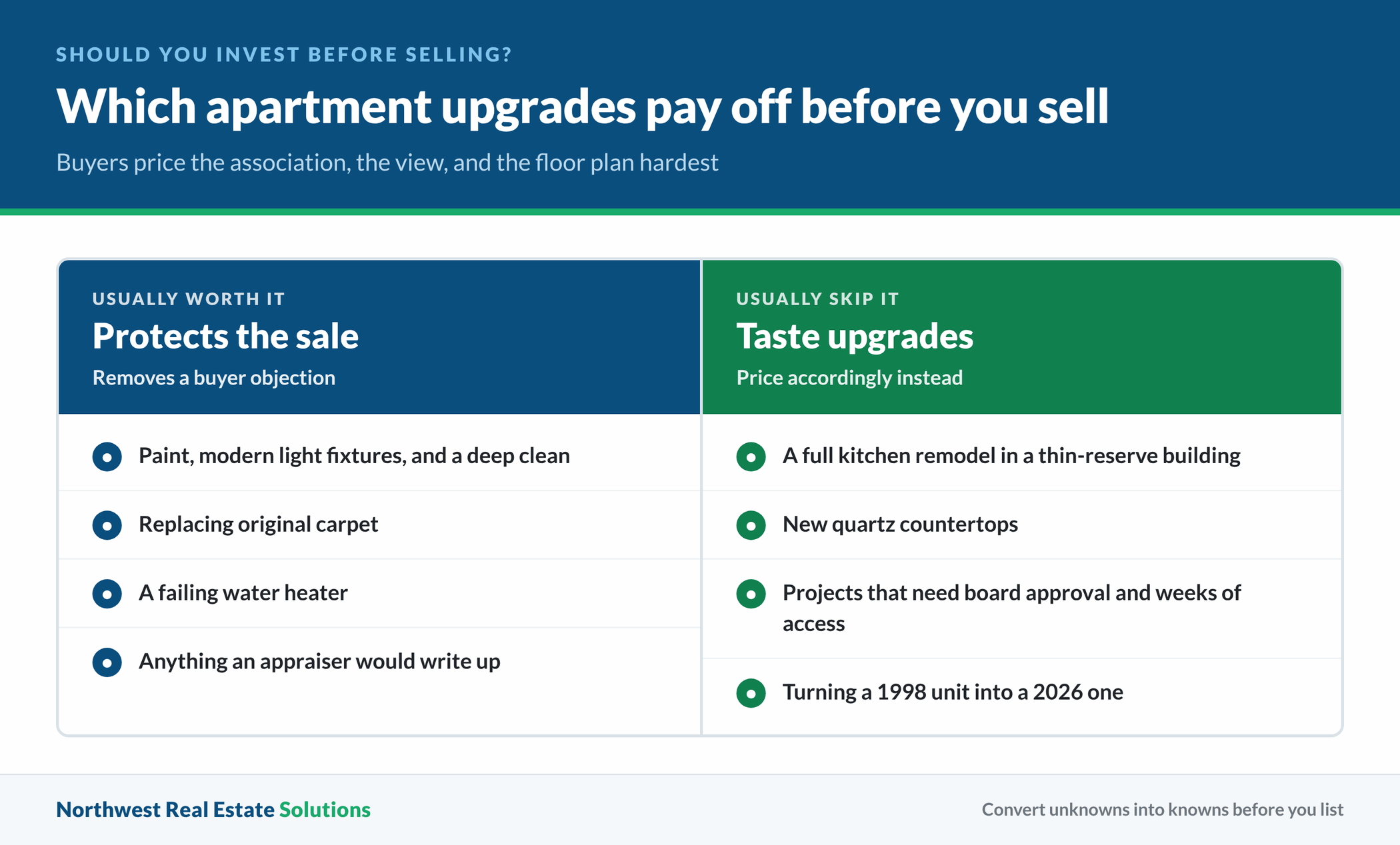
Where does investment pay? Flooring, if yours is original carpet from a decade ago when mauve was a choice. A failing water heater, because that’s a safety flag on an inspection report. Anything a lender’s appraiser will write up as a condition issue, since that threatens financing for the buyer most likely to pay you retail.
That’s the calculation a lot of sellers skip. Renovation isn’t free money; it costs cash you may not have, plus weeks you may not want to spend coordinating contractors who can only access the building between nine and four on weekdays. Elevator reservations, loading dock rules, and HOA work-hour restrictions: a two-week bathroom job in a single-family house can stretch to six in a mid-rise.

Before you commit to anything, check your governing documents for what requires board approval. Plenty of associations want written sign-off before you touch flooring, plumbing fixtures, or anything that penetrates a wall, and some require proof of contractor insurance naming the HOA. Learning that after your tile guy has already shown up turns a weekend project into a letter from the management company, and I’ve had that letter land in my own mailbox. Get two bids in writing, then ask yourself whether the work removes a buyer objection or just satisfies your own taste.
Walk your unit the way a stranger would, too. Most buyers form an opinion in the entry hallway: the smell, the light, and whether the place feels cared for. A burned-out bulb, a sticky slider, and a bathroom fan that rattles do more quiet damage than dated countertops.
My rule of thumb is simple. If the repair protects the financing or removes a scary-looking defect, do it. If it’s a taste upgrade, skip it and price accordingly. Buyers discount cosmetics by roughly what the work costs; they discount unknowns by much more than it costs. Your job before listing is converting unknowns into knowns, not turning a 1998 unit into a 2026 one.
What’s the Best Pricing Strategy for a Washington Home That Needs Repairs?
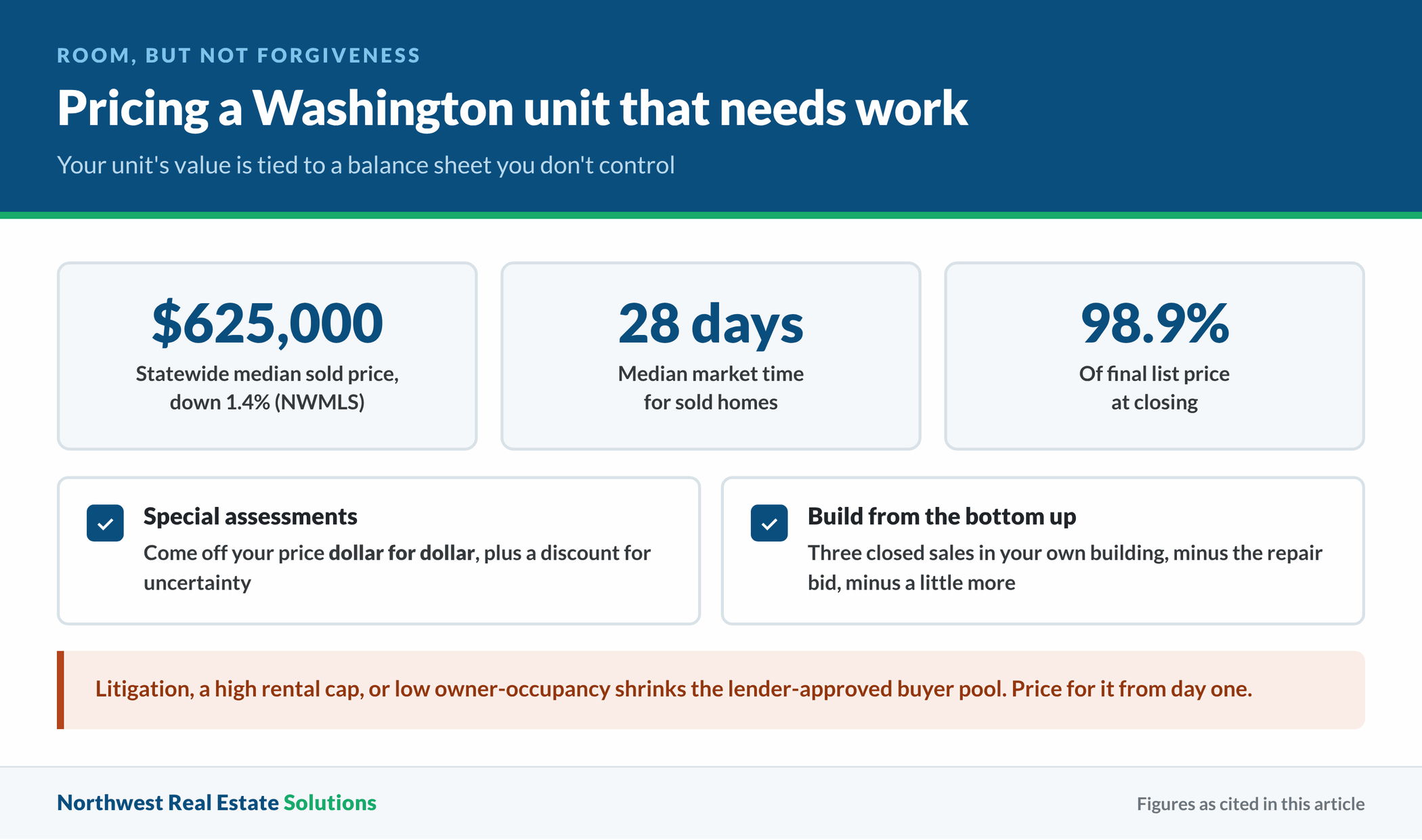
A pending special assessment comes off your price dollar for dollar, and then buyers take more off on top for the uncertainty. That’s the piece rarely mentioned in pricing advice written for houses. Your unit’s value is tied to a balance sheet you don’t control.
Statewide, the market gives you room but not forgiveness. As of September 30, 2026, Washington’s median sold price was $625,000, down 1.4% year over year, with sold homes spending a median of 28 days on market and closing at 98.9% of final list price, per NWMLS-sourced data. Properly priced property sells, while wishful property sits and then sells for less.
Here’s the mistake I see constantly: sellers advertise “as-is” and then price as though it’s already fixed. Buyers read that as a seller who hasn’t accepted reality, and they move on to the next listing rather than negotiate with someone they expect to be difficult.

Build your price from the bottom up instead. Start with three closed comparable sales in your own building or complex, not the neighborhood. Subtract the contractor’s bid for the work. Then subtract a little more, because a buyer taking on the project wants a reward for the risk and the inconvenience of living through it.
You’ll need to dig a bit to find those comps. Ask your broker to search by address rather than by map radius, then adjust for the things that actually move price inside a building: floor level, which direction the windows face, whether the stall is deeded or assigned, and whether the unit sold with in-unit laundry. Two identical floor plans on opposite sides of the same hallway can trade at meaningfully different numbers, and nobody outside the building understands why.
Would you rather clear a known number in three weeks or chase a bigger number for four months with carrying costs eating the difference?
Two prices exist for every unit that needs work: the retail price after someone else fixes it and the price a buyer pays to take the problem off your hands. Both numbers are real, and pretending the second doesn’t exist is how listings go stale. Getting a straight as-is baseline from a direct buyer such as Northwest Real Estate Solutions costs you nothing and gives you a floor to measure every other offer against. If you’re weighing that second number, here’s whether you can sell your house below market value in Washington.
One more pricing note specific to apartment units. If your building has a litigation history, a high rental cap, or a low owner-occupancy percentage, conventional lenders get nervous. Fewer qualified buyers means less competition, and that belongs in your price from day one rather than in a reduction six weeks later.
How Do You Market a Fixer-Upper in Washington?
Hide the damage in your photos and you’ll spend a month collecting showings that end in polite silence. Buyers show up, see what the camera angle concealed, and leave feeling tricked. Then they tell their real estate agent, who tells other agents, and your listing picks up a reputation before it’s had a fair run.
Shoot it honestly instead. Wide, bright photography of what’s good: the light at 10 a.m., the sound view from the balcony, the storage unit, and the parking stall. One clear photo of the problem area, captioned plainly. Serious investors sort for exactly that kind of listing, and they’ll call faster when they can see what they’re buying.
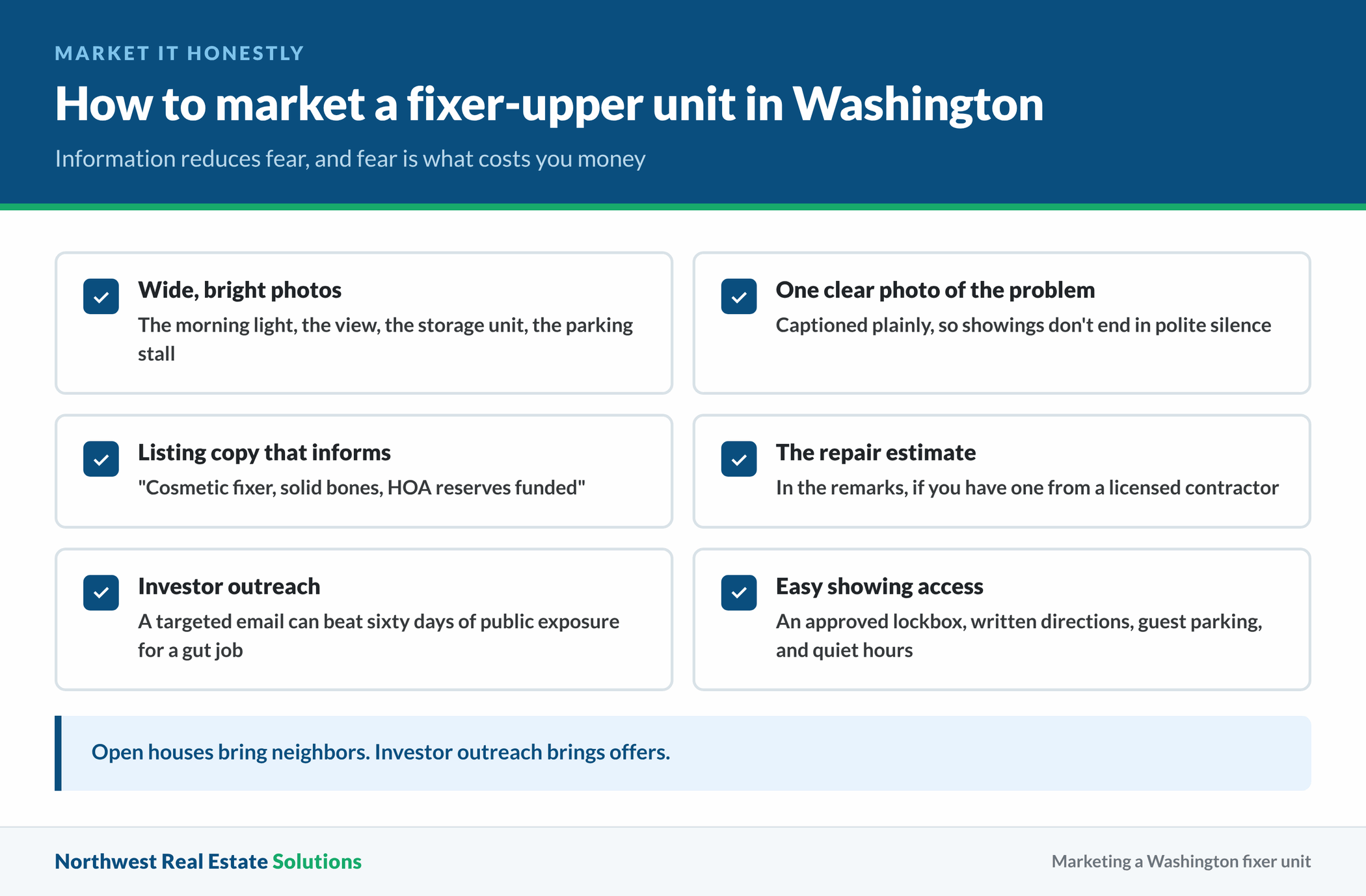
Listing copy does heavy lifting here. “Cosmetic fixer, solid bones, HOA reserves funded” tells a buyer more in eight words than three paragraphs about the charming neighborhood ever will. Put the repair estimate in the remarks if you have one from a licensed contractor. Information reduces fear, and fear is what costs you money.
You should care where you market as much as how. The Multiple Listing Service reaches the broadest pool through the NWMLS, and syndication pushes your unit to the big portals automatically, which makes sense for a unit a retail buyer can finance. For a gut-job unit in a building with lending complications, a targeted email to local investors often produces a better net than sixty days of public exposure.
Access is its own marketing problem in a secured building. If agents have to be buzzed in, hunt for guest parking, and wait on a key from the front desk, some of them simply book something easier. Sort that out before the first showing: a lockbox placed where the association allows it, written directions on how to reach the unit, and a note about where visitors park. Tell your broker what the quiet hours are, too, so showings don’t start with a complaint from the unit below.
Timing deserves a mention. Seattle’s median days on market ran about 15 days in August 2026, which tells you well-presented listings still move quickly in the core. Mortgage rates hovering near 7% in September 2026 have made buyers pickier, not absent. They’re comparing more properties and negotiating harder on condition.
Have you asked your listing agent how they plan to reach cash buyers specifically? Most marketing plans for a fixer are identical to the plan for a turnkey condo in Kirkland, and that’s a mismatch. Open houses bring neighbors. Investor outreach brings offers. Our guide on how to attract buyers for distressed property in Washington goes deeper on that.
Be straight in the marketing about what’s already disclosed. Washington sellers have real obligations here, and a surprise at inspection kills more sales than a known defect ever will.
Should You List High or Spark a Bidding War in Washington?
Can’t I just list high and come down later?
You can. It usually costs you. Days on market is public information in the MLS, and buyers treat an aging listing as a negotiation invitation. The reduction gets read as weakness, and the eventual offers come in under where a sharp initial price would have landed you.

Pricing slightly below the comparable sales to generate competition works, with conditions. It works when your unit shows well, when the building’s documents are clean, and when the local market has enough buyers to actually produce multiple offers, which I’ve watched play out on sales I’ve made myself. Pierce County fits that profile right now: a $570,000 median sold price as of September 30, 2026, with a median of 25 days on market and prices up 0.9% from a year earlier.
It doesn’t work when your property has a visible flaw. Price a unit with water damage below market, and you don’t get five offers; you get five lowball offers from people who think you’re desperate. Competition requires a product buyers can agree on.
Washington has settled into roughly four months of supply statewide, which is a balanced market by most standards. Balanced markets reward accuracy. Underpricing to start a frenzy is a strategy borrowed from 2021, and I think sellers who use it today are gambling with real money.
My preference, and plenty of real estate brokers will disagree, is pricing at the number a sober appraiser would defend. Then hold it. Listings priced right attract the buyers who can close, and those buyers make cleaner offers with fewer contingencies.
If you do end up with more than one offer, resist the urge to grab the highest number reflexively. Ask which buyer has been fully underwritten rather than prequalified, how much earnest money they’ll release early, and whether their lender has already looked at your building. A slightly lower offer from a buyer whose financing is solid beats a top number that unravels during review, so you’re not sent back to market with three weeks of days on market attached.
People often forget the third path. A direct cash offer isn’t an auction, but it comes without appraisal risk, financing fallout, or a repair addendum showing up ten days before closing. When I talk with sellers who’ve already had one sale collapse, certainty is worth more to them than another $8,000 of theoretical upside. At Northwest Real Estate Solutions, we buy for exactly that tradeoff, and a seller should at least know both numbers before choosing.
Run the comparison honestly: top-dollar listing price minus commissions, minus concessions, minus three more mortgage payments, versus a direct offer closing in two weeks. The gap is often smaller than it looks on paper.
What Legal and Contract Rules Apply When Selling a Washington Home?
Sellers get hurt by paperwork far more often than by price.
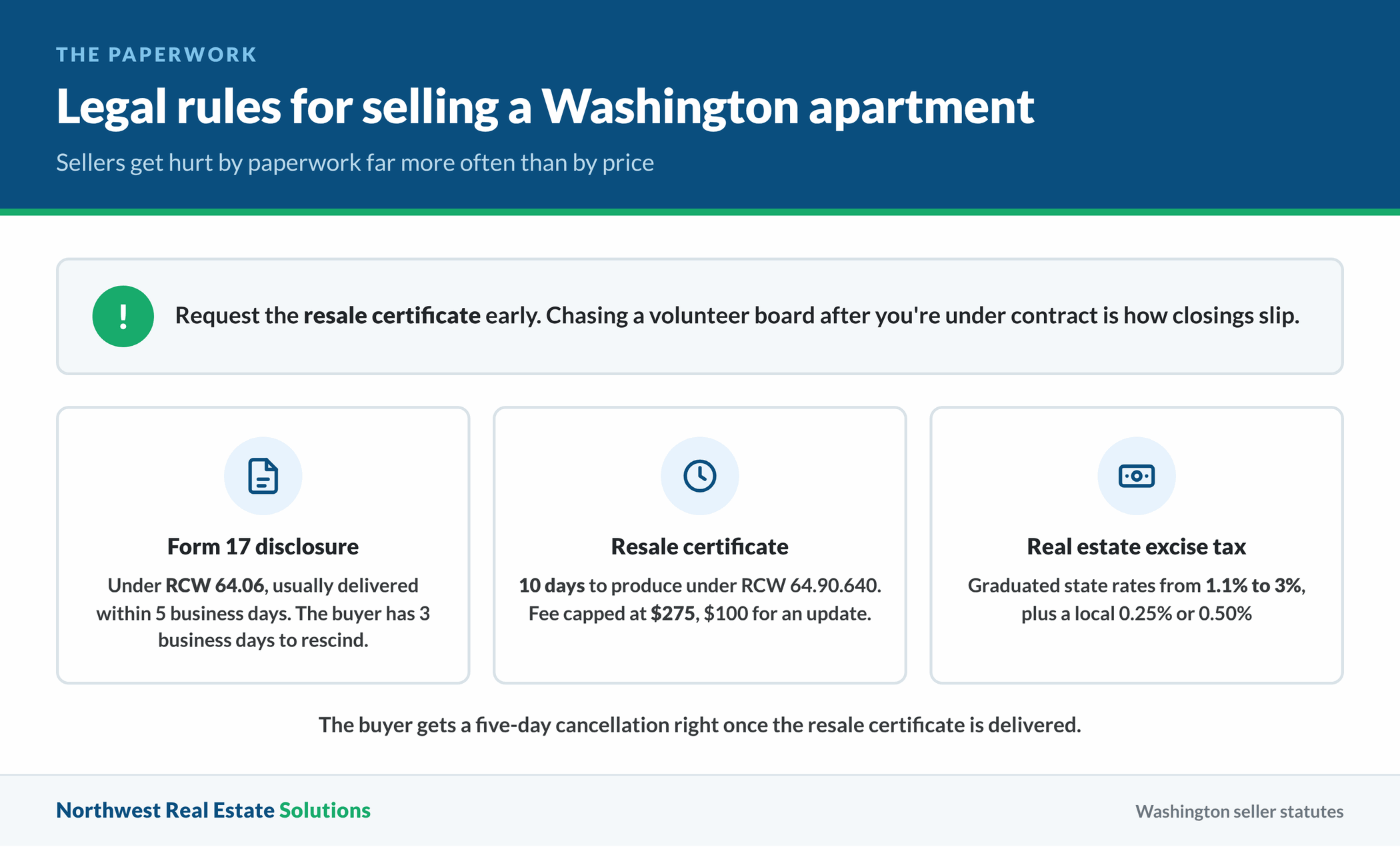
Washington requires most residential sellers to complete a seller disclosure statement, the document everyone calls Form 17, under RCW 64.06. A summary from a Washington law firm confirms that condominium units fall squarely inside the requirement. Delivery generally happens within five business days of mutual acceptance, and the buyer then has three business days to rescind after receiving it. A handful of exemptions exist, listed in RCW 64.06.010, including certain estate and foreclosure transfers, and I’ve seen sellers assume they qualify when they don’t.
Answer it from actual knowledge. You’re not required to inspect your own home to fill it out, and “Don’t know” is a legitimate answer when it’s true. Guessing to look helpful is the dangerous move; an attorney can tell you how your specific facts fit the statute if any question gives you pause.
Practical habits help here. Keep a dated copy of exactly what you delivered and what you attached to it, including any contractor invoices or past repair records you referenced. If something changes while you’re under contract, tell your broker immediately rather than deciding on your own that it’s too minor to matter. And if you’re signing on behalf of a parent’s estate or a trust, confirm with your attorney who has authority to sign before the paperwork goes out, because a signature from the wrong family member creates a title problem that surfaces at the worst possible moment.
Selling a unit adds a second document. Washington associations must furnish a resale certificate to a requesting owner, and RCW 64.90.640 gives them ten days after a proper written request to produce it. Under that statute, the preparation fee is capped at $275 for the initial certificate and $100 for an update, and the buyer gets a five-day cancellation right once it’s delivered. Older condominiums created under the Condominium Act follow RCW 64.34.425, which runs on a similar ten-day timeline.
Request it early. The certificate pulls in budgets, reserve information, assessment status, and insurance details, and chasing a volunteer board through a ten-day window after you’re already under contract is how closings slip.
Then there’s the tax every Washington seller pays at closing. The real estate excise tax applies to the sale price, not your profit, and the Department of Revenue publishes the graduated state rates: for sales through the end of 2026, 1.1% on the portion up to $525,000, 1.28% from there to $1,525,000, 2.75% up to $3,025,000, and 3% above that. Those thresholds step up on January 1, 2027, to $551,000, $1,551,000, and $3,051,000. Cities and counties add their own local piece, commonly 0.25% or 0.50%, and escrow calculates and remits the whole thing.
Legal counsel isn’t mandatory for a Washington closing. For an inherited unit, a title cloud, or a dispute with the HOA, a lawyer’s two-hour review is cheap insurance.
How Does the Washington Housing Market Vary by City?
A pricing rule that works in Bellevue can collapse by the time you reach Everett. The counties aren’t moving together, and the spread is wide.
King County remains the price leader. As of that same late-September 2026 reading, King’s median sold price stood at $841,000 with 26 median days on market, down 3.9% from a year earlier. Bellevue, Redmond, and Kirkland sit at the top of that range, where tech employment and school reputation keep demand steady even as prices soften at the margins.
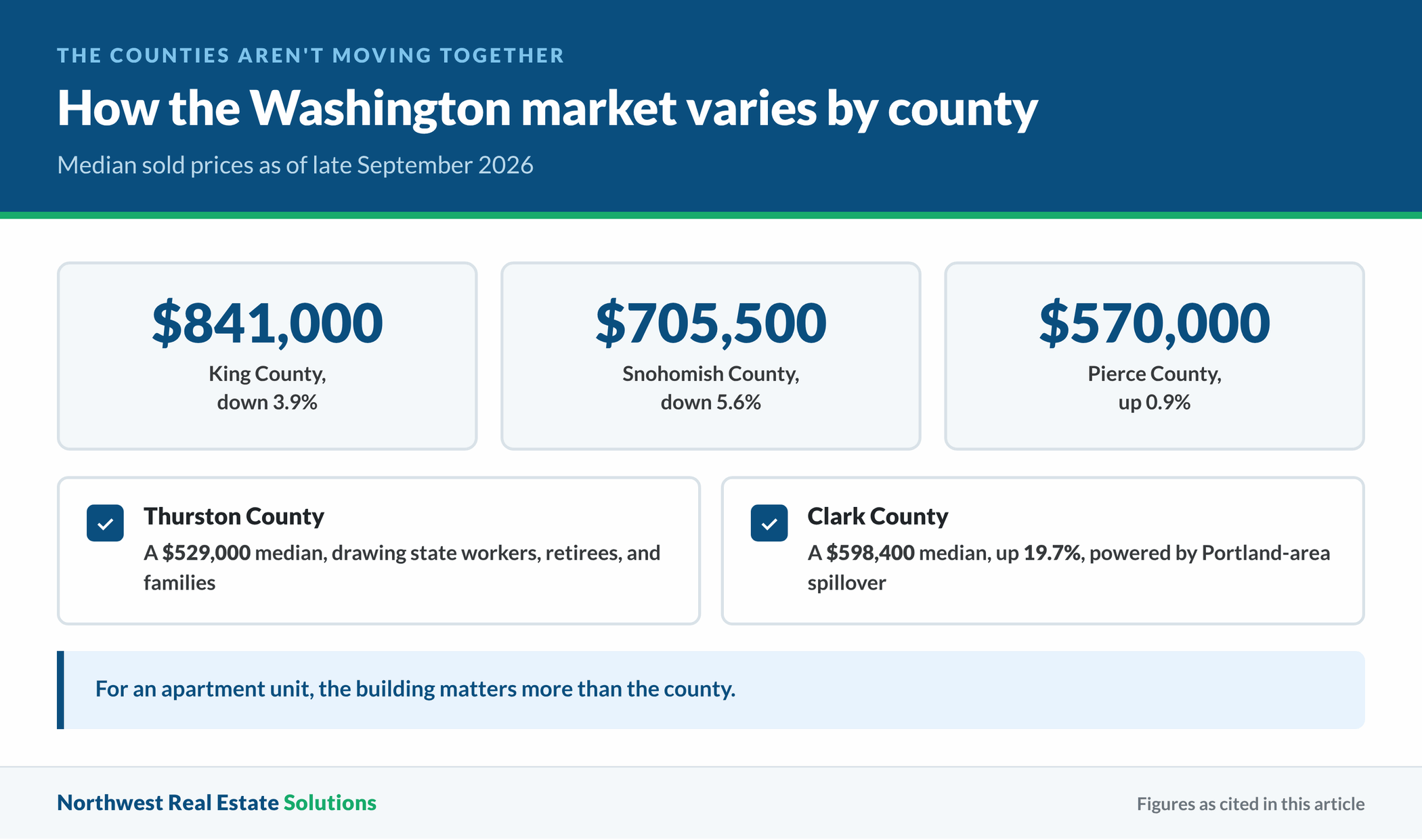
Snohomish County came in at a $705,500 median, down 5.6% year over year, covering everything from Lynnwood’s transit-adjacent condo stock to the more rural stretches north toward Arlington. South Seattle and Tacoma attract the price-sensitive buyer pool, and units there tend to draw more investor interest than owner-occupant interest.
Thurston County’s median ran $529,000, a different buyer entirely: state workers, retirees, and families priced out of the north end. Over in southwest Washington, Clark County posted a $598,400 median in a late-September 2026 county breakdown, up 19.7% from the prior year, powered largely by Portland-area spillover.
Eastern Washington runs on its own clock. Spokane carries more months of supply than the Puget Sound counties, so listings there need sharper pricing and longer patience.
Does your real estate broker price from county data or from your building’s own sales history? For an apartment unit, the building matters more than the county. Two complexes four blocks apart in the same Everett zone can differ by $60,000 a unit based purely on HOA dues, parking, and reserve funding.
Buyers run the dues through a mortgage calculator right alongside principal and interest so that line item gets scrutinized hard. A unit with high monthly dues competes against cheaper carrying costs down the street, and the fix isn’t lowering your price so much as explaining what the dues buy: water, heat, insurance, a staffed lobby, a funded reserve. Spell that out and the number stops looking like a penalty.
Zoning shapes things quietly too. A unit near a planned light rail station or inside an upzoned corridor carries land-value expectations a comparable unit two miles away doesn’t. Developers watch those maps closely, and in older buildings, a redevelopment inquiry to the association can reset what every owner’s property is worth.
How Do You Sell an Apartment in Washington?
Let me tell you what the next thirty days look like, because the order matters more than people expect.
Request the resale certificate first, before you do anything else. It takes the longest, it’s outside your control, and its contents may change your pricing. While you’re waiting, pull together your documents: CC&Rs, recent budgets, the reserve study, meeting minutes, your dues statement, and any assessment notices.
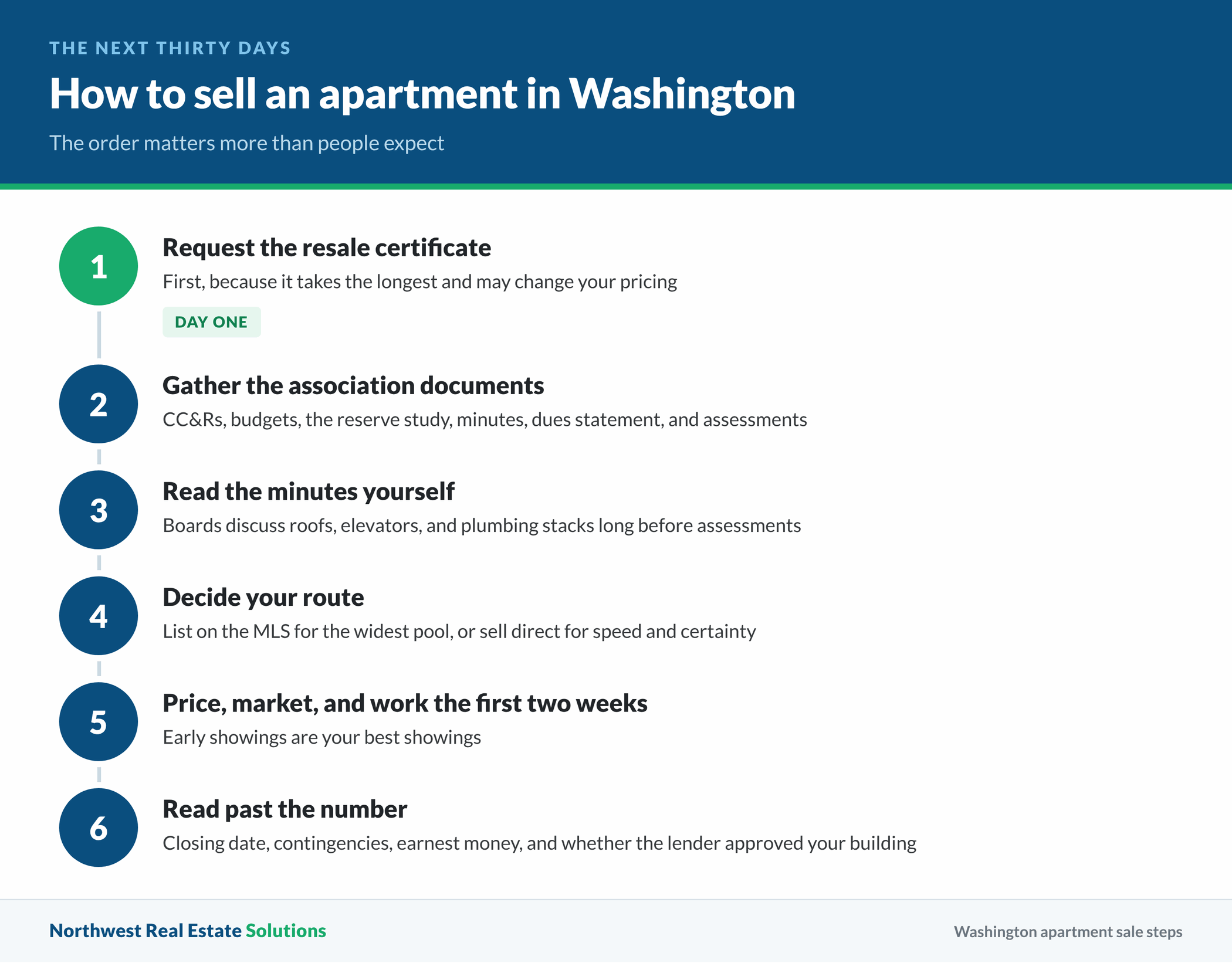
Read the minutes yourself rather than just forwarding them. Boards discuss roofs, elevators, plumbing stacks, and insurance renewals long before any of it becomes a formal assessment. I’ve seen those minutes flag trouble years ahead. Whatever you learn there is better learned now than during a buyer’s review period. If something in the packet worries you, call the management company and ask directly where the project stands.
Then decide your route. Listing with a real estate agent on the MLS gives you the widest buyer pool and the highest likely gross price, in exchange for showings, repairs, commissions, and a closing timeline that depends on someone else’s lender. Selling direct to an investor trades some gross price for speed and certainty, with no repairs and no financing contingency.
Neither is the right answer universally. A clean, updated unit in a well-funded Redmond building should go on the market. An inherited unit with deferred maintenance and three heirs in three states is a different problem and a different solution.
Price it, market it honestly, and work the first two weeks hard. Early showings are your best showings. When offers come in, read past the number: closing date, contingencies, earnest money, and whether the buyer’s lender has approved your building.
That last point trips up more condo sales than anything else. Ask the buyer’s loan officer early whether they’ve reviewed the association’s questionnaire and insurance certificate and whether anything in the budget or the owner-occupancy numbers gives them pause. A lender who hasn’t looked yet isn’t a problem; a lender who refuses to give an answer is.
If you want a no-obligation as-is number to weigh against a listing estimate, Northwest Real Estate Solutions will give you one without a sales pitch attached.
Frequently Asked Questions
Do I Have to Pay Capital Gains Tax When I Sell My House in Washington State?
Washington’s capital gains excise tax specifically exempts the sale of real estate, as the Department of Revenue’s own exemption study confirms, so there’s no state capital gains bill on your unit. Federally, you may exclude up to $250,000 of gain as a single filer or $500,000 filing jointly, provided you owned and lived in the home at least two of the five years before selling. Gain above that is taxable at federal rates, and the excise tax covered earlier in this article is a separate charge entirely. A CPA can confirm how the rules apply to your numbers.
What Decreases Property Value the Most?
For an apartment unit, nothing hurts worse than a troubled association: underfunded reserves, a pending special assessment, active litigation, or a low owner-occupancy ratio that scares off conventional lenders. After that comes anything structural or water-related, since moisture damage in a shared building raises questions nobody can answer in one showing. Deferred maintenance, odors, and an unpermitted remodel also pull your price down. Cosmetic dating hurts the least, which is why I rarely tell sellers to renovate before listing.
How Much Does It Cost to Sell a $400,000 Home?
Budget somewhere between 6 and 9 percent of the sale price if you list traditionally. Agent commissions are the biggest slice, followed by the state and local excise tax described above, escrow and title fees, the association’s certificate charge, and whatever credits you negotiate after inspection. On a $400,000 sale, that’s roughly $24,000 to $36,000 before any repairs. Selling direct to a cash buyer removes the commissions and repair costs, though the offer price reflects the property’s current condition.
What Is the Hardest Month to Sell a House?
December and January are the slow stretch across Washington. Buyer traffic thins out around the holidays, weather keeps people off the road in the Cascades and the Gorge, and listings that sit through winter accumulate days on market that buyers notice in the spring. That said, the buyers who shop in January tend to be serious, motivated, and often relocating for a job start date. A well-priced unit sells in any month; an overpriced one waits until spring no matter when you list it.
Can I Sell My Apartment If I Still Owe on the Mortgage?
Yes, and most sellers do. The payoff comes out of the proceeds at closing, and escrow handles the wire to your lender directly. The only complication is owing more than the unit is worth, which happens occasionally with units bought at the top of the market in buildings that have since taken on assessments. In that case you’re looking at bringing cash to closing or negotiating a short sale with your lender, and either path is worth discussing before you list rather than after.
We Buy Condos and Houses in Portland, Southwest Washington, and Beyond.
Portland is our home market, and Clark County sits just across the Columbia from it. RMLS put Portland metro inventory at 3.8 months in August 2026, up from 3.5 months a year earlier. More listings on both sides of the river give buyers room to pass on a unit with assessment or lending questions.
We’re cash home buyers in Portland, and we buy in Southwest Washington too. Across the river, we’re investor home buyers in Vancouver. A little farther north, we buy houses in Ridgefield. You can see every area on our “We Buy Houses in Washington” page.
Sell Your Washington Apartment As-Is for Cash
If you’d like a straight read on what your apartment would bring in today’s market, including an as-is cash number and a rough sense of what a traditional listing might net after costs, reach out and we’ll walk through both. No obligation, no pressure, and no follow-up campaign if the timing isn’t right. Sometimes the most useful thing is simply knowing your options before you decide anything.
If your unit needs work, your building has assessment or lending questions, or you’d rather skip showings in a secured building, we can buy it as it sits. We’ll review the unit and the association documents and give you a cash offer in writing. Compare it to your net from a listing and decide what works for you.
Have more questions first? Check out other frequent questions. When you’re ready, fill out our quick contact us form or use the short form below.
Helpful Washington Blog Articles
- How to Sell a House in Probate in Washington
- Selling a House to a Family Member in Washington
- Capital Gains Tax After Selling a House in Washington
- Selling A House with Delinquent Property Taxes in Washington
- Do All Heirs Have to Agree to Sell Property in Washington
- Do I Need a Lawyer to Sell My House in Washington?
- Sell a House That Failed Inspection in Washington
- Who Pays Closing Costs When Selling a House in Washington
- How to Sell a House with a Squatter in Washington
- Appraisal-Required Repairs in Washington
- Can I Sell a House with a Quitclaim Deed in Washington?
- Sell a House with Water Damage in Washington
- How to Sell an Apartment in Washington
- The Difference Between a Title and a Deed
- How Long After Closing Do Home Sellers Actually Receive Their Money