

A half-year tax bill skipped in 2023 can put a mortgage-free house on a county auction list before the end of 2026. A warning only comes in the mail. County treasurers here don’t bend the three-year rule, and no judge has to agree the debt is real before the file lands in superior court.
Most homeowners I sit down with about delinquent property taxes in Washington aren’t careless with money. They inherited a rental nobody in the family wanted. A divorce froze the account that used to cover the bill. Or the loan got paid off, the escrow account closed with it, and the statement started going to a taxpayer address that was three moves out of date.
You can sell a house with back property taxes in Washington. Closing proceeds pay the county the same way a mortgage lender gets paid. What follows is how the process really runs, which deadlines are fixed by statute, and where sellers quietly lose money by waiting too long.
How Does a Tax Foreclosure Sale Work in Washington?
December 3, 2026. The Snohomish County Treasurer’s annual delinquent tax foreclosure auction runs that day, held online through Bid4Assets. Back in May of this year, the county filed its 2026 certificate of delinquency with the Superior Court. Any parcel with the full year 2023 or earlier still unpaid landed on that list, and you can read the schedule yourself on the Snohomish County Treasurer’s foreclosure page.
Every county in the state runs this same machine, just on its own calendar.
Under RCW 84.64, real property carrying taxes three or more years delinquent is subject to tax foreclosure. Not “may be.” Is. After three years from the date of delinquency, the treasurer issues a certificate of delinquency to the county and files it with the clerk of the superior court, and the prosecuting attorney forecloses the lien in the county’s name. There’s no bidder buying your debt at that stage. Paper itself is held by the county.
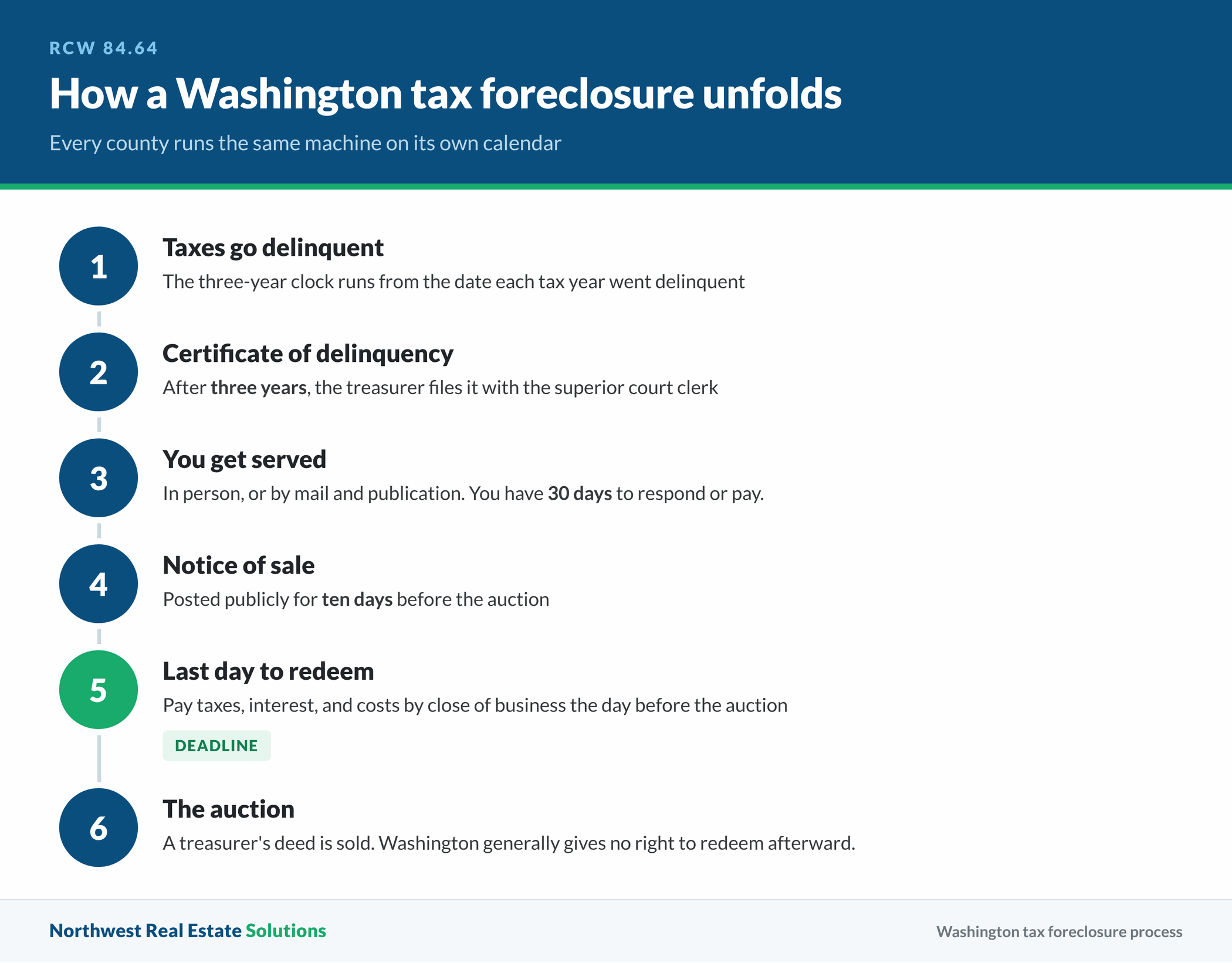
Once the lawsuit exists, you get served. Service happens in person or by mail and newspaper publication, and you’ve got 30 days to respond to the action or pay what’s owed. A notice of the sale also gets posted publicly for ten days before it happens. People miss these notices constantly, usually because the mailing address on the parcel record belongs to a deceased parent or an old rental management company.
If you’re reading this and you genuinely don’t know where you stand, stop and find out before you do anything else. Every county treasurer in Washington has a parcel lookup on its website. You need the parcel number, which appears on any tax statement, on your deed, and on the assessor’s property search if you only have the street address. Each tax year will appear separately in the lookup, showing what’s owed on each, and usually a flag when a parcel has entered the foreclosure process. Screenshot it or print it. Then, separately, check the mailing address the county has on file for you and fix it if it’s wrong. That one correction has saved more houses than any clever strategy I know of.
Worth tattooing on your forearm is the redemption window. You can pay the taxes, interest, and costs and stop the sale at any point up to the close of business the day before the auction. One day. After the gavel falls, that door shuts for almost everyone. Washington generally gives no right to redeem after a tax foreclosure sale goes through, which is a harsher rule than many states use.
I’ve seen sellers get tripped up by blog posts written for the wrong jurisdiction, since timelines differ county to county. Thurston County, for instance, files its foreclosure lawsuit in Superior Court around the first week of June and holds its auction once a year in January over the internet. The current Thurston sale is scheduled for January 11 and 12, 2027. Public notice runs in the Nisqually Valley News in late August or early September. Clark County says it plainly on its site: everything owed, including interest, penalties, and foreclosure costs, has to be paid in full before the scheduled auction date to stop the sale. Their real property foreclosure page is one of the clearer ones in the state.
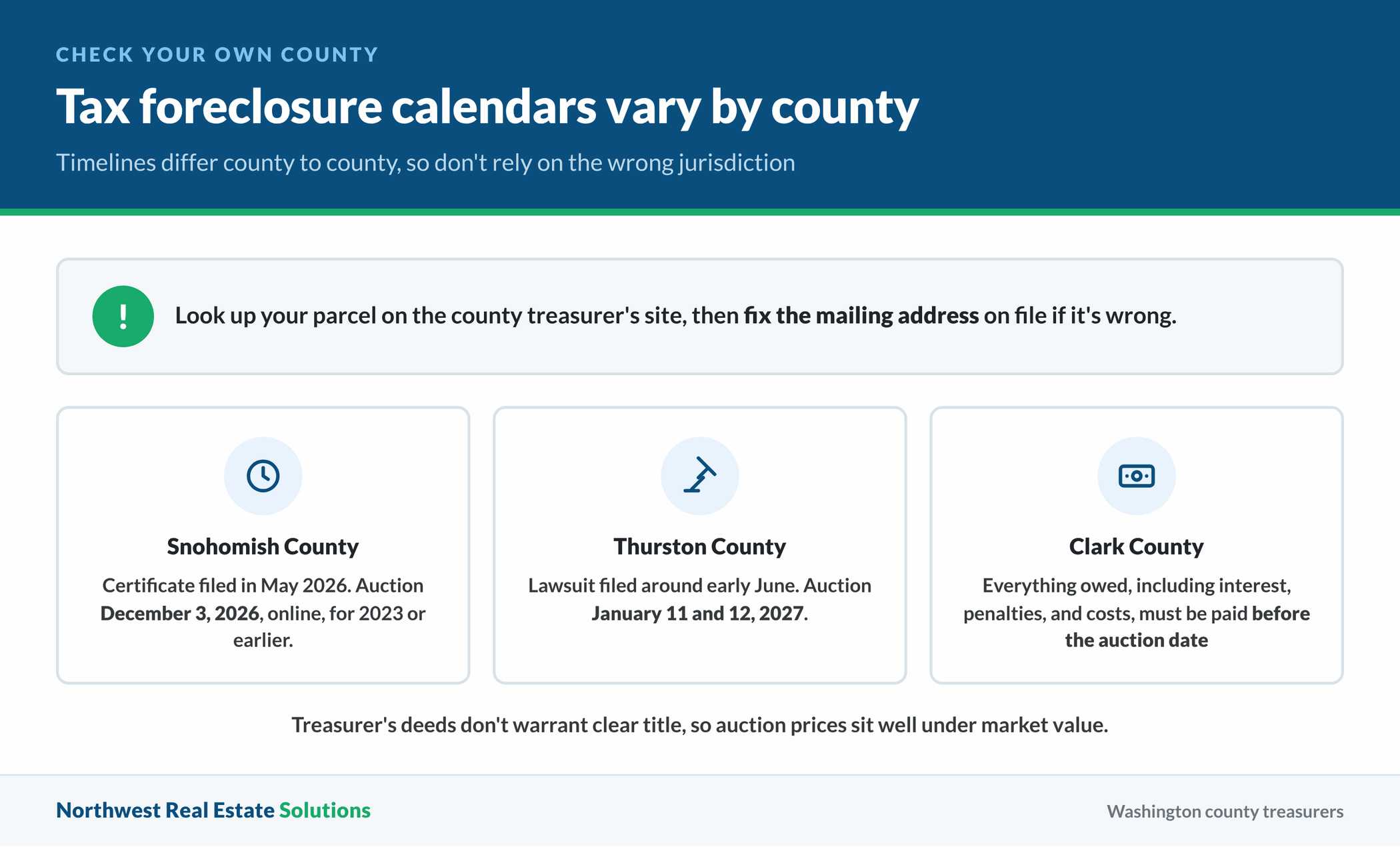
What goes up for bid is a deed, not a lien certificate. Treasurer’s deeds issued at these sales do not warrant clear title, and counties openly tell bidders to investigate the property before the auction. Auction prices tend to sit well under market value for this reason. Buyers are pricing in risk they can’t fully see.
Think about the gap for a second. The statewide median sold price in Washington sat at $625,000 as of September 30, 2026, down 1.4% from a year earlier, according to Northwest MLS data. A minimum bid at a county auction covers back taxes, interest, and foreclosure costs. Nothing more. The spread between those two numbers is your equity, and it goes to a stranger with a bidder number if you let the sale happen.
Selling before the auction instead of hoping something changes is the whole argument. A sale on the open market, or a direct sale to a buyer who pays the county at closing, hands you the difference. The auction hands you a receipt.
I’ve watched owners wait until the last three weeks because they thought a letter from the prosecuting attorney meant the county wanted the house. It doesn’t. Treasurers want the revenue, and they’d rather take your check than run a lawsuit.
One more practical note about the mail. The envelopes that matter in this process don’t look dramatic. A certificate of delinquency notice looks like a statement. A summons looks like a form letter with a case caption at the top. Sellers routinely set them on the counter with the junk mail and open them a month later. If you’re at the stage where legal documents are arriving, open everything the day it comes, write the date you received it on the first page, and keep the whole pile in one envelope. When you eventually call the treasurer, an escrow officer, or an attorney, the first question will be some version of “what have you received and when,” and being able to answer precisely shortens every conversation that follows.
What Happens to Your Mortgage During a Tax Foreclosure in Washington?
Your mortgage lender can pay your delinquent property taxes without asking your permission first. State law lets any party holding a recorded interest in the land pay the taxes, interest, and costs before the sale, then take a lien for whatever it laid out. Servicers do this routinely to protect the collateral behind the loan.
So the back taxes don’t disappear. They move. The balance jumps from the treasurer’s ledger to your loan, often as an escrow advance that reshapes your monthly payment overnight.
Homeowners with an impound account rarely end up three years behind, because the servicer pays the county twice a year out of collected funds. Delinquency usually shows up in three situations: the loan was paid off and nobody set up a reminder, the borrower waived escrow at origination, or the property changed hands through an estate and the new owner never got on the county’s mailing list.

Here’s where two separate foreclosure tracks can run at once. The county’s tax foreclosure moves through superior court on the schedule described above. Your lender’s foreclosure on the deed of trust runs under a different chapter of state law entirely, on its own timeline, with its own notices. One can finish while the other is still pending. If you’re behind on both, call your servicer’s loss mitigation department and ask for the exact dates in writing, because those deadlines are the ones that will actually govern your situation.
When you make that call, be specific about what you want. Ask for a reinstatement quote, which is what it takes to bring the loan current, and a payoff quote, which is what it takes to retire the full balance. They’re different numbers, and sellers confuse them constantly. Ask whether the servicer has already advanced any taxes and, if so, how that advance is being recovered. Ask for the name and direct extension of whoever you’re speaking with, and ask them to send everything by mail or secure message rather than reading it to you over the phone. Loss mitigation departments hand files between representatives, and a written record is the only thing that survives that handoff.
Rates make this heavier than it used to be. Mortgage rates were hovering near 7% in mid-September 2026, so homeowners carrying a 3% loan from a few years back have an enormous incentive to protect that note. Losing a cheap mortgage to a tax sale is the kind of financial damage that follows a family for a decade.
If the lender advances the taxes, expect a letter, a recalculated escrow payment, and sometimes a shortage spread over twelve months. If the lender doesn’t advance them, you’re the only one standing between the parcel and the auction list.
Selling solves both tracks at the same time. A title company orders a payoff from the lender and a certificate of taxes due from the treasurer, then wires both from closing proceeds. The first mortgage gets satisfied, the county gets made whole, the liens get released, and whatever’s left comes to you. I’ve closed plenty of files where the seller had two delinquent years and a loan sixty days past due, and the escrow officer handled both payoffs on the same settlement statement without drama.
One caution about condominium owners: dues and special assessments add a third payoff to that stack, and some associations are aggressive about recording liens. Pull your account balance from the HOA management company before you price anything.
Landlords have a parallel headache. If the house is tenant-occupied, the tenant’s rights don’t evaporate because you’re behind on taxes, and a buyer will want to know the lease terms, the deposit amount, and where that deposit is being held. Gather the lease, the deposit accounting, and the rent ledger at the same time you gather your tax and loan documents. A clean file makes an occupied property sellable; a vague one makes buyers assume the worst and price accordingly.
Can You Set Up a Payment Plan for Back Property Taxes in Washington?
“Can I just send the treasurer a few hundred dollars a month until this is cleaned up?”
I hear that question more than any other, and the answer is a qualified yes. RCW 84.56.020 lets county treasurers, at their own discretion, enter into payment plans with taxpayers on delinquent property taxes. Plans require a signed contract, and they typically carry a monthly payment processing charge. Discretion is the operative word. The treasurer can say no.
There’s also a cutoff that catches people too late in the game. Mason County’s treasurer explains it this way: an application for a delinquent tax installment plan has to be in place twelve months before that tax year hits the three-year mark. Wait past that point, and the statutory foreclosure track takes over. Call your own county treasurer to confirm how they apply it, because administrative practice varies even where the statute doesn’t.
Applying is less intimidating than it seems. In most counties it’s a short form, a conversation about what you can realistically pay, and a signature. What gets a plan approved is a proposal that actually retires the balance rather than nibbling at it, and a taxpayer who shows up before the file is already with the prosecuting attorney. Bring your parcel number, be honest about your income, and ask the treasurer’s office what payment amount they’d consider reasonable for your balance rather than guessing low and getting turned down. If they approve you, set the payment on automatic transfer the same day. A missed installment on a signed contract is not a minor administrative slip, and nobody is going to call and remind you.
Interest keeps running the entire time. Since January 1, 2023, delinquent taxes on residential real property with four or fewer units per taxable parcel accrue interest at 9 percent per year, computed monthly. All other property accrues interest at 12 percent. Single-family homes, duplexes, and manufactured homes on their own parcels are covered.
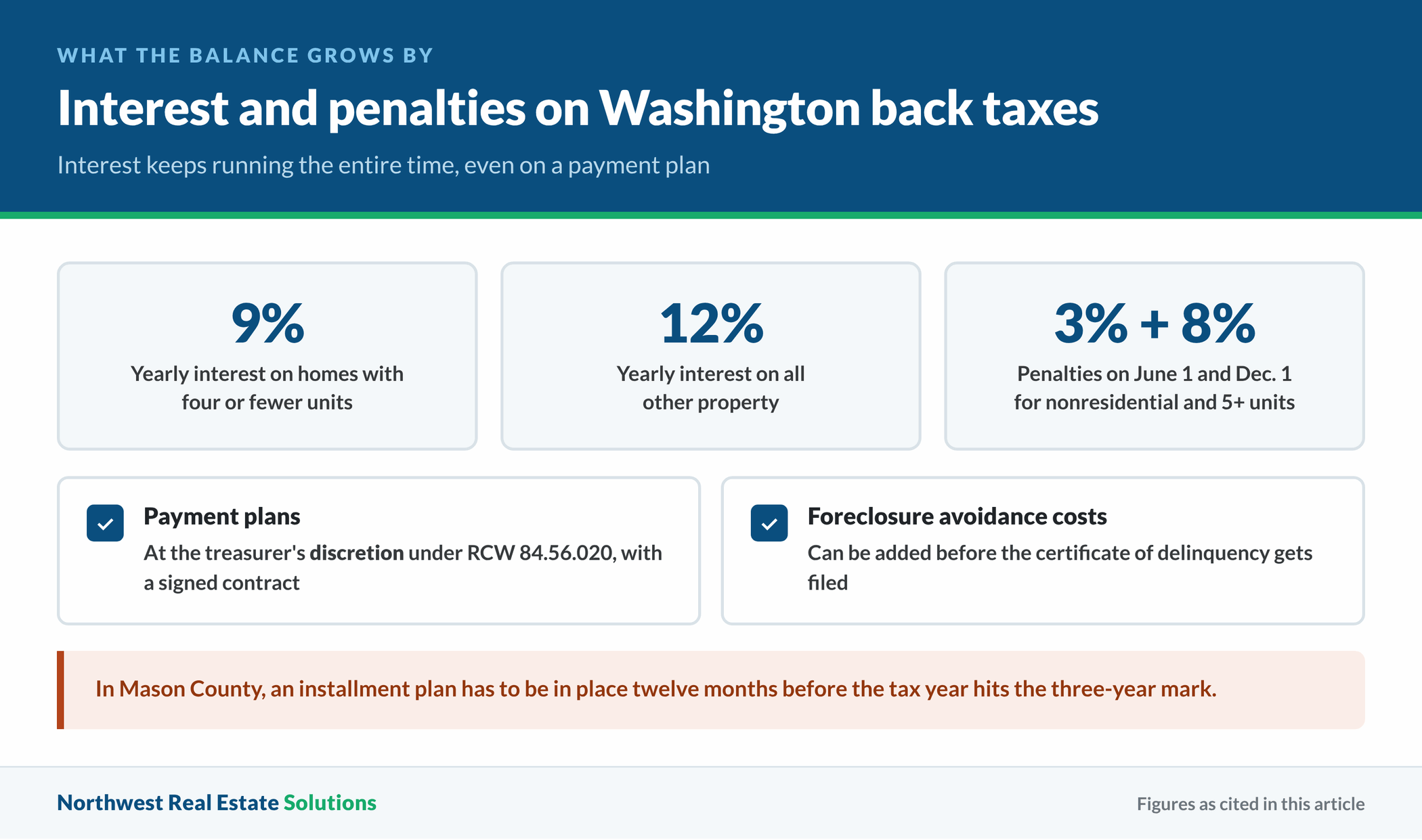
Penalties are a different animal, and the details are often reported incorrectly. The Legislature re-established penalties only on nonresidential real property and on residential property with more than four units per parcel. For property that does carry penalties, the schedule adds 3 percent of the delinquent tax on June 1 and another 8 percent on December 1 of the year the tax is due. Those penalties hit the current year’s tax one time, but interest keeps accruing month after month as long as the balance sits there. The Department of Revenue’s notice on the 2021 legislative changes lays out the whole rewrite, and the current statutory text lives at RCW 84.56.020.
There’s one more charge to know about. Once taxes go delinquent and before the certificate of delinquency gets filed, the treasurer is authorized to assess and collect tax foreclosure avoidance costs. Those show up as a line item on your statement and surprise owners who thought they were just paying taxes plus interest.
Now the relief programs, because some readers reading this qualify and don’t know it. Washington runs four programs to help individual homeowners with property taxes or special assessments: an exemption for seniors and people with disabilities, a deferral for that same group, a deferral for homeowners with limited income, and a grant program for widows and widowers of veterans. The limited-income deferral is open to homeowners whose combined disposable income is $57,000 or less. For the senior and disability deferral, you need to be at least 60 by December 31 of the year you apply or unable to work because of a disability.
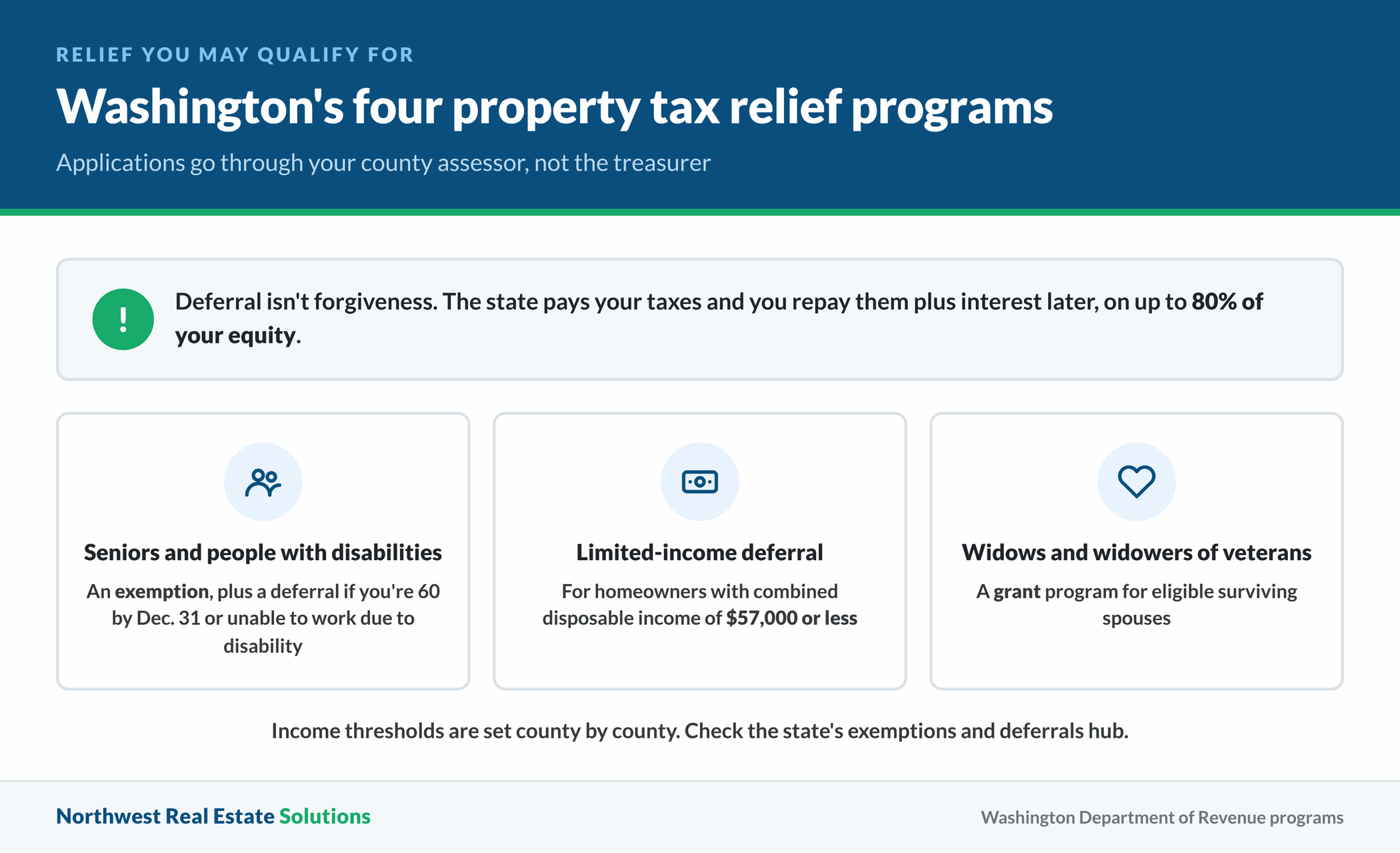
Deferral isn’t forgiveness. The Department of Revenue pays your property taxes for you, and you repay that amount plus interest when a triggering event occurs. You can defer up to 80 percent of the equity in your land and residence, provided you keep a fire and casualty policy naming the Department of Revenue as loss payee. Income thresholds are now set county by county, so check the state’s exemptions and deferrals hub rather than guessing.
The applications for these programs go through your county assessor, not the treasurer, which is a distinction that sends people to the wrong counter, and I’ve watched sellers waste a whole afternoon over it. Expect to document income, and expect to be asked about everyone living in the household who contributes to it. If the paperwork feels like more than you want to tackle alone, your local senior center or area agency on aging often has someone who walks residents through these forms as a matter of routine. There’s no shame in asking, and the exemption in particular is one of those benefits plenty of eligible people simply never claim.
Should you take a payment plan? Only if the math genuinely works. If a plan tacks four hundred dollars a month onto a budget that’s already running short, where exactly is that money coming from? A plan that fails leaves you closer to the auction than when you started, with more interest attached.
Can You Sell a House with Delinquent Property Taxes in Washington?
Early in my career I told a seller she’d have to clear her tax balance before we could even open escrow, and I was flatly wrong about that.
Delinquent property taxes get paid at closing, out of the proceeds, exactly like a mortgage payoff. The title company orders a certificate of taxes due from the county treasurer, the escrow officer wires the funds on the day of recording, and the lien is released. Nobody expects you to show up with a cashier’s check for three years of back taxes before a buyer will sign, and in every sale I’ve closed, sellers are relieved to learn that.
That’s true right up until the auction. Getting current on the delinquent amounts is called redeeming the property, and a sale that closes before the deadline accomplishes the same thing through a third party’s money instead of yours.
Timing matters most. Homes sold across Washington spent a median of 28 days on market, measured over the rolling 90 days ending September 30, 2026. Add thirty to forty-five days for a financed buyer to close, and a conventional listing runs roughly two to two and a half months from sign-in-the-yard to recorded deed. List in late summer for a December auction, and the math works. List four weeks before the sale date, and it doesn’t, unless you’re selling to someone who pays cash. For a fuller timeline, see how long it actually takes to sell a house in Washington.

Buyers’ lenders generally don’t flinch at delinquent taxes, as long as the preliminary title report shows they’ll be cleared at closing. Underwriters see this weekly. What does spook them is a filed certificate of delinquency with an auction date inside the escrow period, because the lender knows the title company can’t insure around a pending foreclosure that might complete first.
Which brings up the part worth planning around: once the county’s lawsuit is on file, you’re negotiating against a fixed date that nobody at the courthouse will move for your convenience.
If you’re in that position, tell the treasurer’s office you’re selling. Not as a plea for mercy, but as information. Ask them what they need from a title company to confirm a sale is in progress, ask how late in the process a payoff can be wired and still be credited before the auction, and ask whether they want anything from you in writing. Then make sure your escrow officer talks to that same office directly rather than relying on a figure pulled off a website. Interest accrues monthly, payoff quotes have good-through dates, and a closing that slips past that date needs an updated number or it funds short. Short payoffs don’t release liens.
Three paths exist, and they’re not equal. List with an agent if you have time, equity, and a house that shows reasonably well. Sell to a cash buyer if the clock is tight or the property needs work you can’t fund. Borrow against the equity if your credit and income support a hard-money loan or a HELOC, though lenders get cautious once a foreclosure action appears in the public record.
For homeowners in Snohomish County and up and down the I-5 corridor, Northwest Real Estate Solutions handles these closings regularly, including the coordination with the treasurer’s office that trips up out-of-area buyers. Getting the payoff figures right matters, since interest accrues monthly and a figure quoted in March is stale by June.
Heirs selling an inherited house have an extra step. The estate has to have authority to convey, which means letters testamentary or a small estate affidavit, depending on how the property was titled. Start that conversation with a probate attorney the same week you discover the tax problem, not the week before the auction. Probate moves slowly enough to swallow your entire window, and I’ve seen it eat up months before anyone realized the deadline was close.
A seller once asked me whether selling with back taxes was something buyers would hold against her. Not in this market. Buyers care about the house, the price, and whether title closes clean. The county’s balance is a line on a settlement statement, not a scarlet letter.
How Do Delinquent Taxes Affect Your Home’s Sale Price in Washington?
Unpaid taxes don’t lower what your house is worth by a single dollar; they lower what you walk away with, and that’s a different problem.
An appraiser valuing your home looks at square footage, condition, location, and recent comparable sales. The treasurer’s ledger doesn’t enter into it. Where the damage happens is in your net proceeds, and in what deadline pressure does it put on your negotiating position?
Run the subtraction before you do anything else. From the sale price, subtract the mortgage payoff, the delinquent taxes with accrued interest, any foreclosure avoidance costs, agent commissions if you’re listing, and the state excise tax.
That last one surprises sellers who’ve only owned property in other states. Washington charges a graduated real estate excise tax on the seller: 1.10 percent of the portion of the price up to $525,000, 1.28 percent from there to $1,525,000, 2.75 percent up to $3,025,000, and 3.00 percent above that. Most cities and counties stack a local REET of 0.25 to 0.50 percent on top. On a $600,000 sale with a half-percent local rate, that’s about $6,735 to the state and $3,000 locally, roughly $9,735 total.
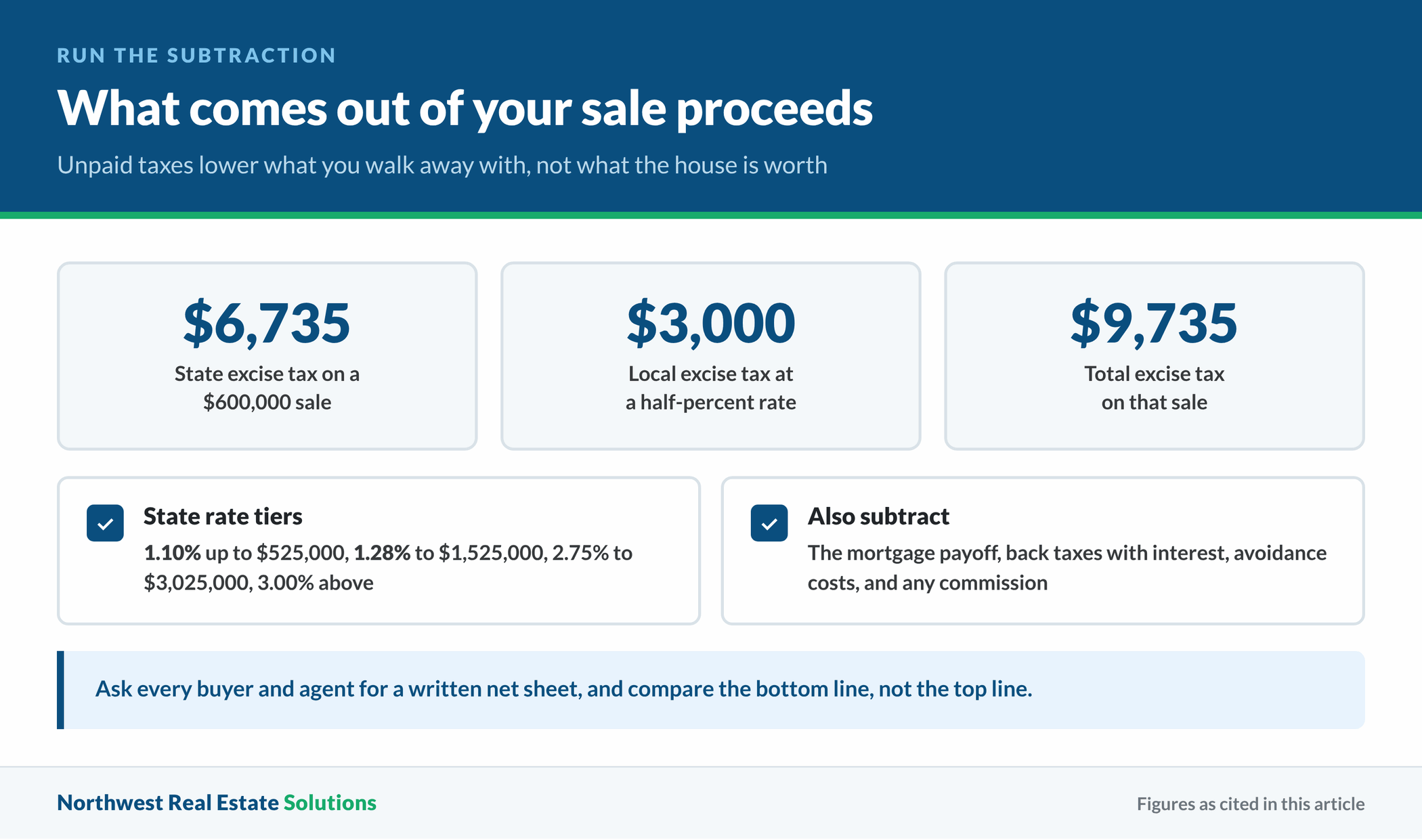
Don’t do that arithmetic on a napkin. Ask for a written net sheet, which is a line-by-line estimate of where every dollar of the sale price goes, and ask for one from everybody competing for your business. An agent will prepare one, so will a reputable cash buyer, and title and escrow companies produce them too. Then lay them side by side and compare the bottom line, not the top line. The number that matters is the wire that hits your account on recording day, and I’ve seen a lower offer beat a higher one on that line because of who was paying closing costs and how long the carrying period ran.
Here’s the local picture for anyone selling north of Seattle. Snohomish County’s median sold price was $705,500 as of September 30, 2026, with a median of 25 days on market and prices down 5.6% year over year. Everett, Marysville, and Mill Creek all sit inside that number, and they behave differently from one another. A tidy rambler in the Silver Lake area of Everett and a tired bungalow near the waterfront get very different buyer attention at the same list price.
Statewide, the typical sold home closed at 98.9% of its final list price in that same reporting period. Sellers who price correctly get close to asking. Sellers who start high, sit, and then cut under deadline pressure usually end up below what a realistic initial price would have produced.
Which is the actual cost of waiting. Not the interest, which on a few thousand dollars of back taxes amounts to a modest monthly number. The expensive part is accepting a lowball offer in week ten because the auction is in week twelve and you have no leverage left.
Ask yourself this: what price would you take on day fifty that you’d have laughed at on day five? That gap is what procrastination costs, and it’s almost always larger than the tax debt that caused it.
Buyers care more about condition now than during the frantic years. Buyers today have options; they’re ordering inspections, and they’re negotiating repairs. A roof at the end of its life or a failing septic system will come out of your price one way or another, through a credit, a reduction, or a buyer walking.
If you are listing and money is tight, spend it where buyers look first. Hauling junk out of the garage, clearing the yard, cleaning the carpets, replacing dead bulbs, and fixing the door that doesn’t latch cost almost nothing and change the first photograph, which is the only one showing most buyers ever give you. What I’d skip is anything that requires permits, a contractor’s schedule, or a month of your remaining runway. Half-finished projects read worse to a buyer than untouched ones, and a seller against a foreclosure calendar cannot afford to be waiting on a subcontractor who stops answering the phone.
After enough of these sales, here’s my blunt opinion: a seller with real equity and four or five months of runway should list the property conventionally and net the most money possible. A seller with two months, deferred maintenance, and a job that can’t absorb showings should take the certainty of a cash close and stop bleeding. Picking the wrong lane for your circumstances costs more than either option ever does on its own.
What Paperwork Do You Need to Sell a House with Back Taxes in Washington?
Relax, you won’t need a mountain of extra forms. A tax-delinquent sale in Washington looks like any other closing with maybe three additions to the stack.
Start with the certificate of taxes due. Your escrow officer orders it from the county treasurer, and it states exactly what’s owed through a given date, including interest and any added costs. That figure expires, so if your closing slips two weeks, the title company updates it.
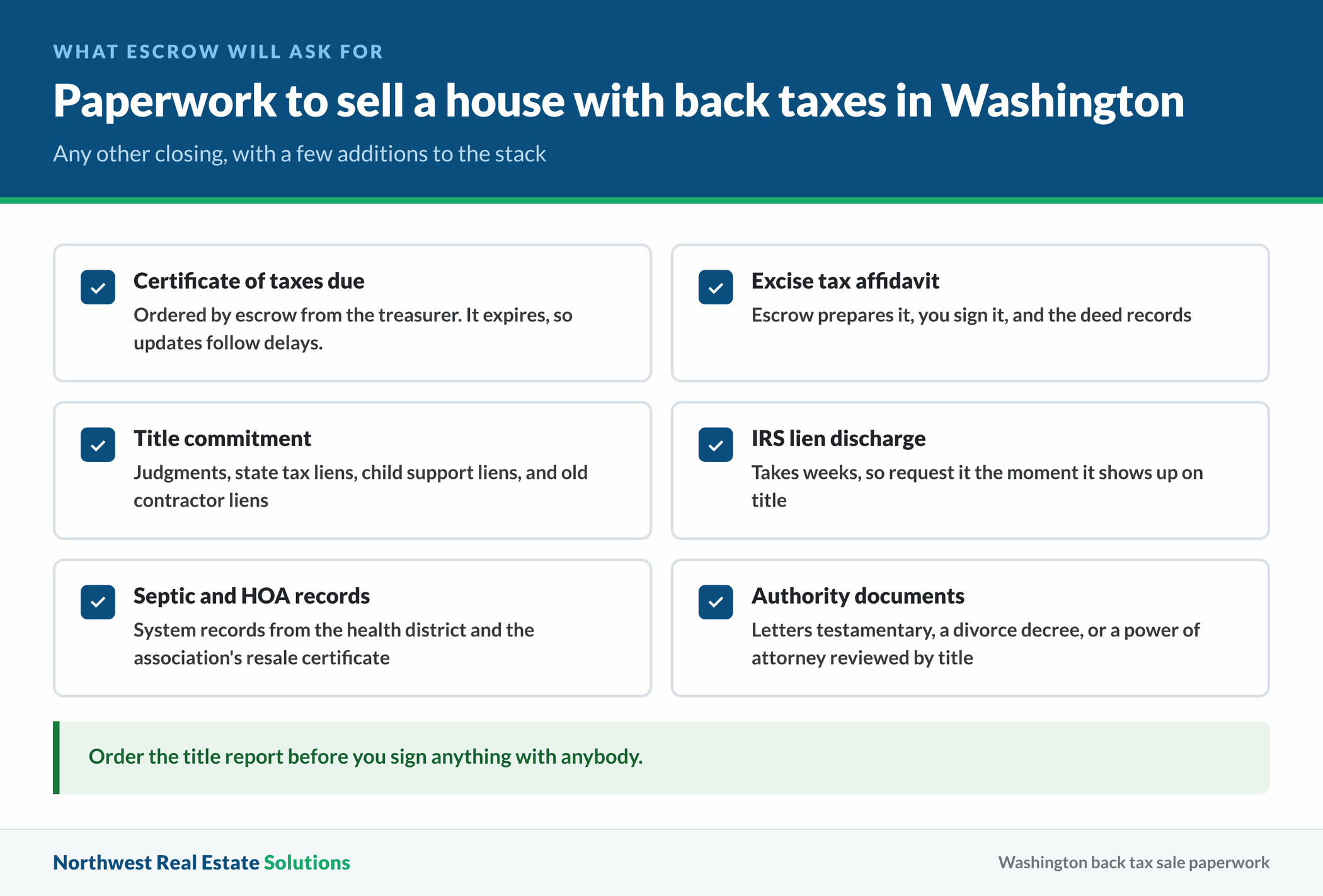
The real estate excise tax affidavit gets filed with the county at recording. Without it, the deed doesn’t record. Your escrow officer prepares it, and you sign it, so this one rarely becomes your problem.
Then there’s the title commitment, and this is where surprises live. A preliminary title report pulls every recorded encumbrance against the parcel: the first mortgage, judgments, state tax liens from the Department of Revenue, child support liens, utility assessments, and old contractor liens nobody remembered, and I’ve seen those contractor liens surface on properties that looked clean on paper. Each one needs a payoff or a release before a title company will issue title insurance to your buyer.
Federal tax liens deserve their own paragraph. An IRS lien recorded against you attaches to the real estate, and clearing it for a sale usually means requesting a discharge or subordination from the Internal Revenue Service. That process takes weeks, not days, and the IRS has specific application procedures and a dedicated advisory group that handles them. Call them the moment you spot the lien on your title report, because waiting until you’re in escrow is how sales die.
Sellers in unincorporated Snohomish County with on-site septic will need their system records. The Snohomish Health District maintains as-built drawings and inspection history, and most purchase agreements out here require a current inspection with the pumping report attached. Pull your file early; the search takes a few days, and a failing system changes the whole negotiation.
Condominium sellers have to order a resale certificate from the association, which includes the budget, the reserve study, and your account balance. Associations typically charge for it and take a week or two to produce it.
Manufactured and mobile homes bring a wrinkle worth flagging. Counties treat delinquent mobile home and personal property taxes separately from real property foreclosure, with their own distraint sale process, and the Thurston County Treasurer’s foreclosure information page explains how that track differs. If the home was never title-eliminated and attached to the land, you may be selling two assets at once.
Estate sales add letters testamentary, a death certificate, and sometimes a lack of probate affidavit. Divorce cases add the decree and a quit claim deed. Anyone selling under a power of attorney should have the title company review that document before closing day, since escrow companies reject defective POAs constantly. If your ownership came through a divorce decree, read up on whether you can sell a house with a quitclaim deed in Washington.
Can’t find your deed? It’s not a crisis. Recorded documents live with the county auditor or recorder, and you can request a copy of the deed that put the property in your name without hiring anybody. Same goes for recorded liens and releases. What you cannot recreate from public records is anything that was never recorded, which is why the lease, the HOA statement, the septic file, and any contractor invoices matter so much. Scan what you have, even if it’s a phone photo, and put it all in one place before the first call.
When more than one person is on title, signatures become a logistics problem. Siblings scattered across three states, an ex-spouse who isn’t speaking to you, and a co-owner deployed overseas—all of it is workable, but none of it is fast. Tell your escrow officer early who has to sign, where each person physically is, and whether anyone has a mobility or travel limitation. Escrow companies arrange mobile notaries and out-of-state signings all the time, and they’d much rather hear about it in week one than the night before closing.
One habit I’d push on every seller: order the title report before you sign anything with anybody. Title companies will run a preliminary search cheaply, and knowing you have an old judgment or a forgotten second lien change, which offer is genuinely the best one. I’ve seen sellers accept a higher gross price only to discover that the liens ate the difference, and the lower offer with the faster close would have left them better off.
Keep your documents in one folder, paper or digital. Escrow officers ask for the same items repeatedly, and the sellers who close fastest are the ones who can produce a payoff statement or a septic record the same afternoon it’s requested.
Is Selling to a Cash Buyer a Good Option with Unpaid Taxes in Washington?
Ten days to close, no appraisal, no lender, no repair list. That’s the pitch, and for a seller staring at a December auction date, it sounds like exactly the right medicine. Then the preliminary title report comes back with an old child support lien, a judgment from a credit card suit, and a mechanic’s lien from a contractor who was paid but never released it. Suddenly the ten-day close is a twenty-five-day close, and the buyer wants a price adjustment because the payoffs ate the margin.
Speed in a cash transaction comes from skipping financing, not from skipping title work. No legitimate buyer closes without a clear title, because no title company will insure it.
What a cash sale genuinely gives you: certainty of close, an as-is purchase, no showings, and control over the closing date. Those are real advantages when the county has already filed its lawsuit. What it costs you is retail price. A buyer taking on deferred maintenance, unknown liens, and a hard deadline prices that risk in, and anyone who tells you otherwise is selling something.

Market context helps you judge whether the discount is reasonable. King County posted a median sold price of $841,000 at the end of September 2026, down 3.9% from a year prior, with 4.3 months of inventory. Pierce County came in at $570,000, up 0.9%, moving in a few weeks. A cash offer in a county with four-plus months of supply should look different from one written when inventory was scarce, and you’re entitled to ask the buyer how they arrived at their number. If your house is in Pierce County’s biggest city, here’s how to sell your house fast in Tacoma, WA.
Vet whoever shows up at your door. Ask for proof of funds from an actual bank, not a letter from an affiliated lender. Ask whether they intend to assign the contract to someone else, because wholesalers tie up properties they never plan to buy. Ask which title company holds the earnest money and whether that deposit goes hard immediately. Ask who pays closing costs and the excise tax, and get it in writing on the purchase and sale agreement.
Read the inspection contingency before you sign, too. A long open-ended inspection period on an as-is purchase is how a buyer keeps the right to renegotiate after you’ve stopped talking to everyone else, and in my own purchases that renegotiation always arrives late, when your calendar is tighter than it was. A short inspection window, a meaningful earnest money deposit, and a firm closing date written into the contract are worth more to a seller against a deadline than a few extra thousand dollars on the purchase price from someone whose offer can quietly evaporate.
A seller in the City of Everett called me once after signing with an out-of-state buyer who’d promised a two-week close, then asked for three extensions and finally walked. By then she’d lost six weeks off a very short clock. Local matters here, not for sentimental reasons, but because a buyer who closes in Snohomish County every month already knows the treasurer’s payoff process and the recording timelines.
Northwest Real Estate Solutions works these files regularly across Western Washington, and the reason I point people toward local buyers in tax situations is simple: the payoff coordination has to be right the first time. There’s no second chance after an auction.
Cash isn’t automatically the answer. A homeowner with substantial equity, a presentable house, and six months before any sale date should list it. The spread between a retail sale and a cash sale on a $500,000 house is real money, and nobody should hand that over for convenience they don’t need.
But if the roof leaks, the tenant won’t let anyone in for showings, and the certificate of delinquency has already been filed, certainty beats theoretical top dollar every single time.
Have a Question About Selling a House with Tax Debt in Washington?
Nobody at the treasurer’s office is trying to take your house. That’s the first thing I say to people who are embarrassed about this, and most of them are embarrassed. Counties are collecting revenue for schools, fire districts, and roads. Foreclosure is their last tool, not their goal, and they’d rather have your money than your property.
Start with a phone call to your county treasurer. Ask for the exact payoff through a date sixty days out, ask whether a payment plan is still available on your parcel, and ask whether a certificate of delinquency has been filed. Those three answers determine every decision that follows.
Then pull a title report. Then get an honest read on value, not a Zestimate, but a real opinion from someone who sells or buys in your zip code.
The Washington Homeownership Resource Center is a legitimate statewide nonprofit that helps homeowners facing foreclosure, and county treasurers themselves point people there. Free help exists. Use it before you pay anyone a fee for “foreclosure rescue,” which is a category of business I’d approach with both eyebrows up.
Whatever path you choose, choose it while you still have options. Sell on the open market, sell direct, refinance, apply for a deferral, or set up a plan with the treasurer. All of those beat an auction. The team at Northwest Real Estate Solutions will talk through the numbers with you even if the right answer turns out to be listing with an agent instead, and that’s the conversation worth having first.
Frequently Asked Questions
How Far Behind on Property Taxes Can You Get Before Foreclosure Starts in Washington?
The three-year threshold described earlier is the trigger, and it runs from the date a given tax year went delinquent, not from the date you got your first notice. Your county treasurer is the only office that can tell you precisely which tax year is driving your parcel’s status, and the answer isn’t always the year you’d assume. Call them and ask which year is the problem year, because paying the wrong year’s balance won’t stop the lawsuit.
What’s the Best State for Buying Tax Lien Certificates?
Washington isn’t one of them, and that’s the most useful thing I can tell you. Counties here sell deeds through superior court foreclosure rather than auctioning lien certificates to investors, so there’s no certificate to buy and no interest rate bid against other investors. States that do sell lien certificates each set their own redemption periods and return rates by statute, and if you’re comparing them, read the actual statutes rather than an investing seminar’s marketing material.
Is Washington’s Capital Gains Tax Exemption for Real Estate Changing in 2026?
Real estate sales sit outside Washington’s capital gains excise tax entirely, whether you’re selling a primary residence, a rental, or a commercial building. Tax law can change in any legislative session, so I won’t predict what a future legislature does, and anyone who tells you with certainty what’s coming is guessing. Check the Department of Revenue’s current guidance before you close, and talk to a CPA about your federal obligation, which is a separate matter from the state rule.
Do You Pay Sales Tax When You Buy a House in Washington?
No. Real property purchases aren’t subject to retail sales tax here. What applies instead is the real estate excise tax covered above, and by custom and contract, that one lands on the seller at closing rather than the buyer. Buyers do pay their own closing costs, lender fees, and title charges, so budget for those, just not for sales tax on the purchase price.
We Buy Houses in Portland, Southwest Washington, and Across the State
Portland is our home market, and Clark County sits just across the Columbia from it. RMLS counted 1,902 closed sales across the Portland metro in August 2026, down 5.9 percent from a year earlier. With fewer sales closing, a listing that has to beat an auction date has less room to wait for the right buyer.
We’re cash home buyers in Portland, and we buy in Washington too. Across the river, we buy houses in Vancouver. Up the I-5 corridor, we’re cash home buyers in Tacoma. You can see every area on our “We Buy Houses in Washington” page.
Sell Before the Tax Auction With a Cash Offer
If you’re staring at a tax notice and trying to figure out what to do next, we’re happy to walk through the numbers with you, including the option where you don’t sell to us at all. No pressure, no obligation, and no one will chase you afterward. Call Northwest Real Estate Solutions, tell us what the notice says and which county sent it, and we’ll tell you honestly what your options look like, whether that’s a cash offer, a referral to an agent, or just a phone number at the treasurer’s office you didn’t know to call. Sometimes the most useful thing that comes out of the conversation is finding out you have more time than you thought.
If the county has already filed its lawsuit or the auction date is closer than a listing can handle, we can buy the house as it sits and pay the treasurer, your lender, and any other liens from escrow at closing. We’ll give you a cash offer in writing so you can compare it with a listing, a payment plan, or a deferral before you decide.
Have more questions first? Check out other frequent questions. When you’re ready, fill out our quick contact us form or use the short form below.
Helpful Washington Blog Articles
- How to Sell a House in Probate in Washington
- Selling a House to a Family Member in Washington
- Capital Gains Tax After Selling a House in Washington
- Selling A House with Delinquent Property Taxes in Washington
- Do All Heirs Have to Agree to Sell Property in Washington
- Do I Need a Lawyer to Sell My House in Washington?
- Sell a House That Failed Inspection in Washington
- Who Pays Closing Costs When Selling a House in Washington
- How to Sell a House with a Squatter in Washington
- Appraisal-Required Repairs in Washington
- Can I Sell a House with a Quitclaim Deed in Washington?
- Sell a House with Water Damage in Washington
- How to Sell an Apartment in Washington
- The Difference Between a Title and a Deed