

Signing day feels like the finish line. You sit down with a stack of paper, your hand cramps, someone shakes it and says congratulations, and your bank balance doesn’t budge. Nobody prepares you for the gap between the handshake and the deposit, and it can feel longer than escrow did. I’ve sat through the lag more than once, and most of it comes down to a handful of steps after closing that anyone can learn.
How Long After Closing Does Seller Get Money, Exactly?
A widow I worked with sold her late husband’s house on a Friday afternoon and spent the weekend sure the sale had fallen apart. She called me Saturday morning in a panic. Her answer turned out to be simple. The title company’s wire department had gone home at 4 p.m. for the weekend.
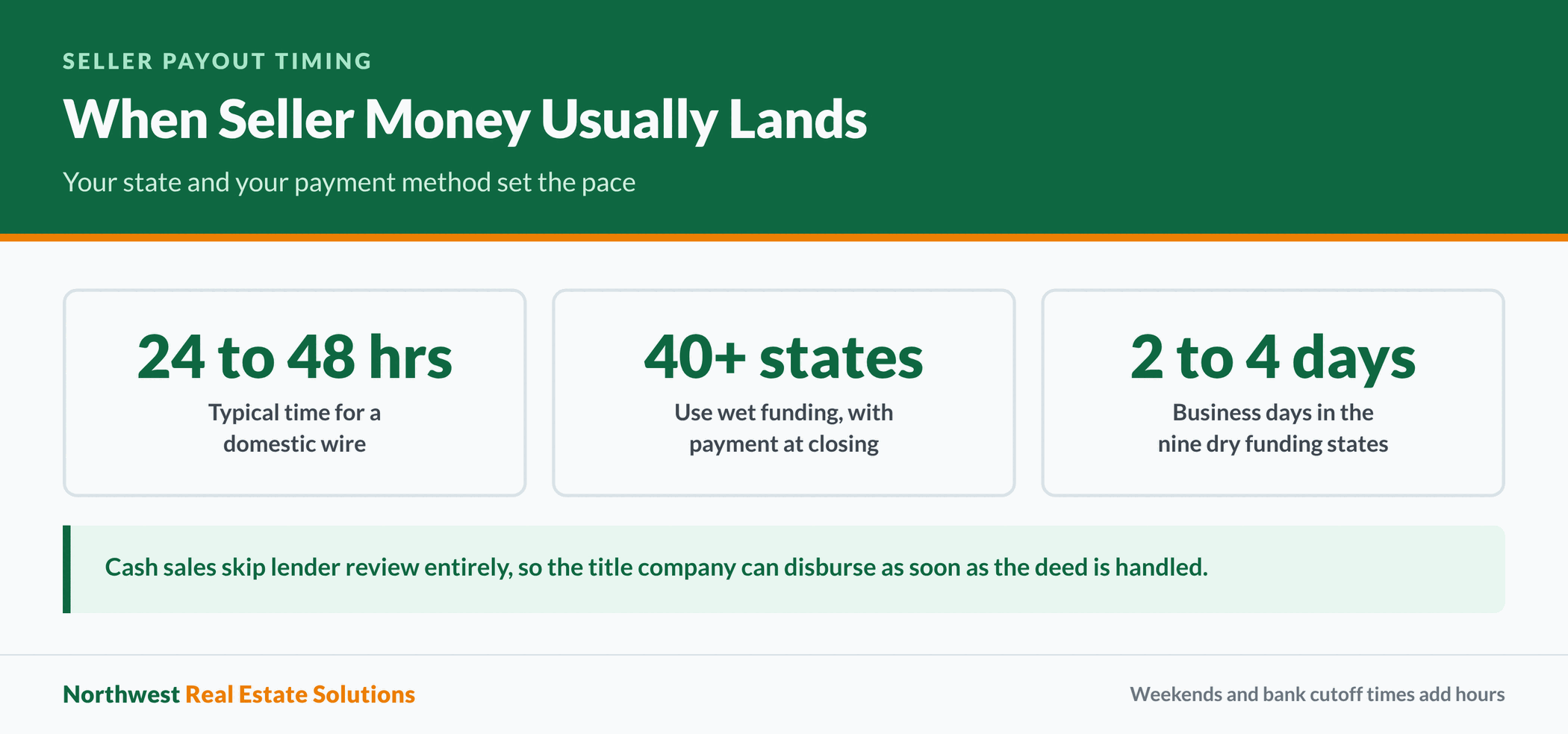
Two things set your timing: the state you’re selling in and the payment method you choose. In most of the country, funds can be released at or right around the signing table. More than 40 states use wet funding rules, where payment has to happen at the same time as everything else. Same-day money still isn’t guaranteed, though it puts you in the fastest lane available.
With a domestic wire, the money usually lands within 24 to 48 hours. Money from a sale that closes Tuesday morning typically shows up Tuesday evening or Wednesday. Close on a Friday and you’re probably looking at Monday, since banks don’t move wires over the weekend.
In the nine states that use dry funding, the wait after closing runs longer. Funds go out two to four business days after the paperwork is done and the lender’s conditions are met. Sellers there sometimes assume something went wrong. Nothing did, because the rule simply works differently.
Cash sales cut out the slowest link entirely, because no lender underwriter is reviewing a signed loan package before releasing money. A title company can disburse after closing as soon as the deed is handled under local practice. That’s one reason sellers on a tight deadline, like a job relocation or a probate timeline, come to buyers like Northwest Real Estate Solutions instead of listing. Fewer moving parts leave fewer places for the money to get stuck.
Anyone who promises a specific hour for your money after closing is guessing. Banks have cutoff times, and wire desks have queues. Federal holidays add another wrinkle, since wires don’t move on those days either.
What Happens Between Signing Day and Money in Your Account?
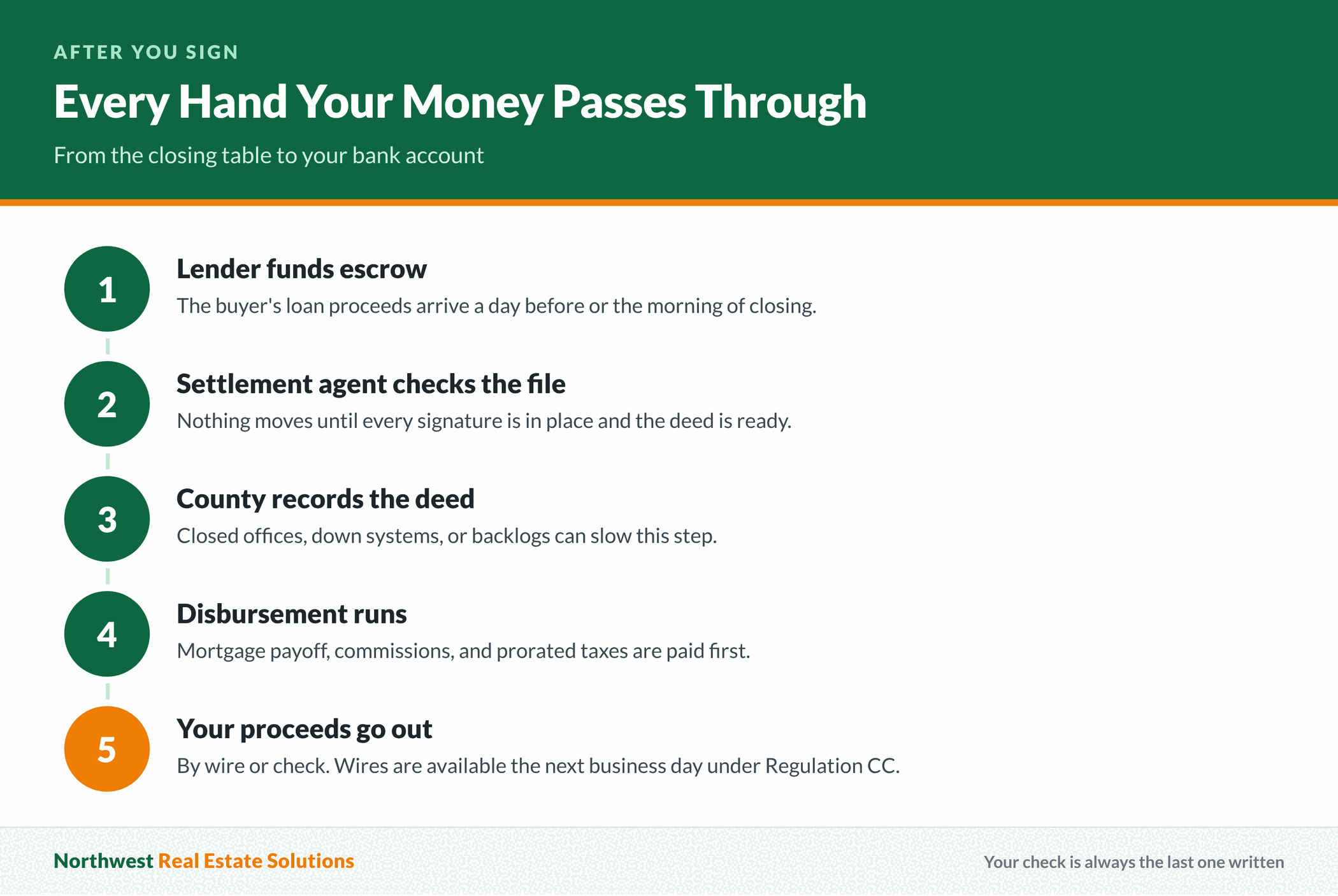
Picture me pulling out a chair at your kitchen table. You just signed, and you want to know who’s touching your money before you do. It passes through several hands first.
The buyer’s lender wires the loan proceeds into escrow, usually the day before or the morning of closing. From there, the settlement agent holds that money along with the buyer’s down payment. Nothing moves until the agent confirms every signature is in place and the deed is ready for recording.
Recording can hold up your money too. The county recorder’s office has to accept the deed, so closed offices, down systems and backlogs in busy counties can all slow things down. Some title companies release seller proceeds after closing as soon as they confirm the recording is accepted. Others wait for the recorded document to come back.
Then the agent runs the disbursement after closing. Your mortgage payoff goes to your old lender, commissions go to the brokerages, and property taxes get prorated and settled. What’s left is yours, and your check is always the last one written.
How much paperwork sits between you and that wire? More than the signing appointment suggests. Federal rules add structure to the buyer’s side of the timeline. The Closing Disclosure has to reach the borrower three business days before the loan is consummated, a requirement the Consumer Financial Protection Bureau built into the TRID rule. Sellers don’t get that waiting period. Most title and escrow companies prepare a separate seller’s settlement statement showing your sale price, payoffs, prorations, commission and net proceeds.
Ask for that statement a day early and read it twice. I’ve watched sellers catch a wrong payoff figure at the table, and fixing one number mid-signing can push your funding into the next business day.
Wet Funding Vs. Dry Funding: Why It Affects Your Closing Payout
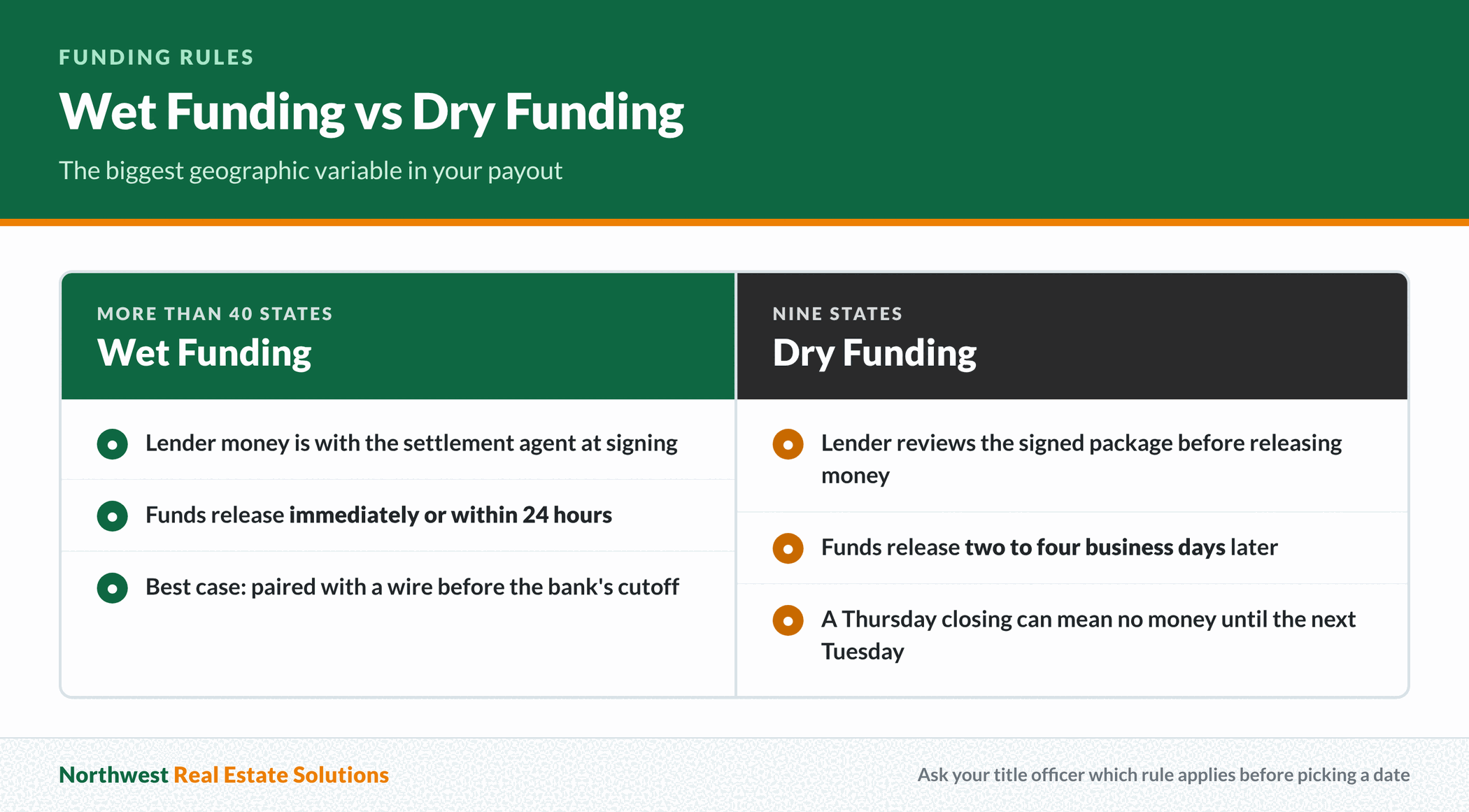
Funding rules are the biggest geographic variable in the whole process. Wet funding means the lender’s money is already sitting with the settlement agent when pens hit paper. Those funds go out right after the documents are signed, and sellers get paid on closing day instead of waiting.
Dry funding flips the order. Everybody signs, and then the lender reviews the executed package before releasing a dollar. Nine states run this way. The practice exists to protect lenders from funding loans with flawed paperwork, and it does catch real errors. Your proceeds after closing just sit in limbo while that review happens.
Which category is your state in? Ask your title officer directly, in writing, before you pick a closing date. Most sellers never ask, then spend three days refreshing a banking app.
A planning note that pays for itself: schedule your closing on a Monday, Tuesday, or Wednesday. In a dry funding state, a Thursday signing can realistically mean no money until the following Tuesday or Wednesday. I’ve had sellers insist on a Friday because it fit their move-out plan, then call me Saturday wondering where everything went. Now I walk them through the timing before they pick the date.
Your payment method stacks on top of the funding rule. Title companies in dry funding states usually hold money for a day or two after closing, and wet funding states release it immediately or within 24 hours. Pair wet funding with a wire sent before the bank’s cutoff and you’re in the best case. Combine dry funding with a paper check deposited Friday afternoon, and you’ve built the slowest version of the same transaction.
Cash buyers sidestep the wet-versus-dry question, since there’s no lender funding decision at all. Direct buyers such as Northwest Real Estate Solutions bring their own funds to escrow, which removes a whole category of delay from the back half of your sale.
Mortgage Payoff and Closing Costs: What Comes Out of Your Check?
“I sold for well over what I owe, so why is my net so much smaller than I pictured?” I hear that question at nearly every kitchen table I sit at. It comes down to the order of payment.
Your net proceeds after closing are whatever survives the deductions. On a traditional listing, plan on giving up roughly 6 to 10 percent of the sale price, with agent commissions as the biggest slice. Title insurance premiums, escrow fees, transfer taxes where your state charges them, and recording fees fill out the rest.
Mortgage payoff trips people up in one specific way. Your payoff figure isn’t the loan balance on last month’s statement. It includes interest accrued through the funding date, plus any recording fee for the lien release. Payoff quotes also expire, usually within a couple of weeks, and a stale quote forces the title company to order a fresh one.
Prorated property taxes deserve a close look. Depending on whether your state bills in arrears or in advance, you’ll either credit the buyer for taxes you haven’t paid or get credited for taxes you already covered. One line like that can swing your proceeds after closing in either direction by a meaningful amount.
Repair credits negotiated after inspection come off the top too, along with any seller concessions toward the buyer’s costs. Earnest money from the buyer gets applied to their side of the sales contract rather than handed to you separately.
For context on what you’re netting, the national median existing-home price in October 2026 was $416,700, according to the National Association of Realtors. It was up 0.4% from $414,900 a year earlier, the 40th straight month of annual increases. Run ten percent against a number like that and the deduction side clearly deserves attention.
Ask for a draft settlement statement several days out. You’ll have time to question anything that looks off instead of finding it during signing.
Wire Transfer or Check: How Will You Receive Money After Closing?
“Can I just take a check and walk out?” Usually, yes. I’d still push you toward the wire in most situations.
Wire transfers are how most sellers get paid after closing. Funds go from the closing agent straight to your bank, usually within a day or two. You’ll hand over your account and routing numbers ahead of time, and the title company will almost certainly call to verify them by voice. Welcome that call. Wire fraud in real estate is real, and I’d question any title company that skips the check.
Federal banking rules work in your favor once the money arrives after closing. Under Regulation CC, wire transfers have to be available for withdrawal no later than the business day after the banking day they’re deposited. Cashier’s checks get similar treatment, with one catch. Hand one to a teller and it’s next-day money. Deposit it through an ATM or a phone app, though, and it can drop to second-business-day availability.
So if you take a check, take it inside a branch. Don’t photograph it from your car.
There’s one more downside to the check route. A cashier’s check is a physical object you have to protect, carry and deposit, and if you’re moving out of state that same week, it’s a real hassle. Wires skip all of that, so there’s nothing to carry or lose.
Know your bank’s daily cutoff time before closing day. Many branches post it online, and a quick call settles it if yours doesn’t. Money that arrives after the cutoff posts the next morning, no matter when the title company pressed send.
What Can Delay Your Payment After Closing, and How Do You Avoid It?
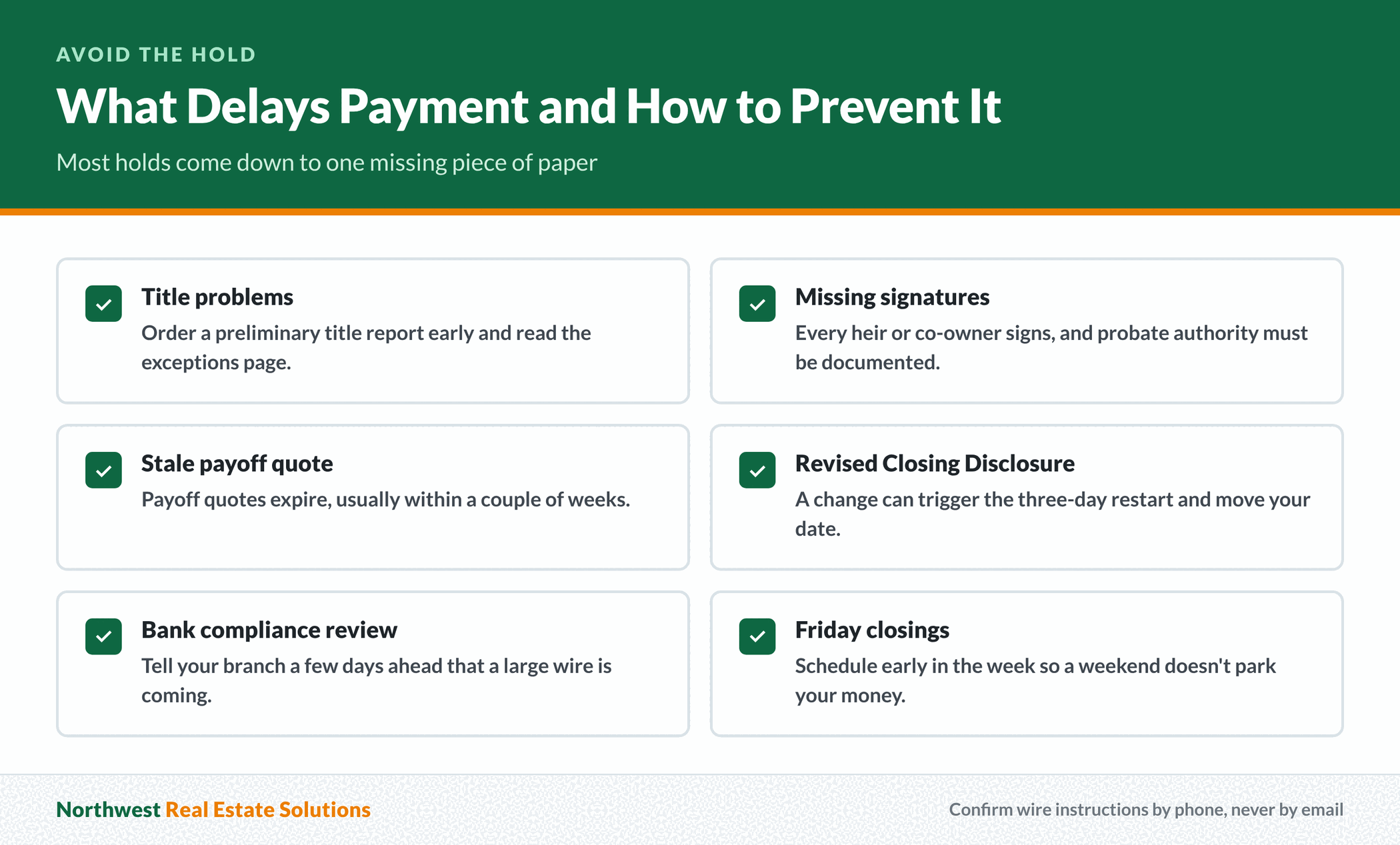
Miss one document, and your money can sit in escrow for a week while you reschedule a notary appointment. That’s the real cost of the small stuff.
Title problems cause the longest holds after closing. An old lien nobody knew about, a contractor’s claim from a decade-old remodel, or a misspelled name on a prior deed can stop disbursement cold while the title company clears it. Order a preliminary title report early and read the exceptions page.
Heirs and divorcing couples run into signature problems constantly. If three siblings inherited the house, all three sign. One sibling living overseas can add a week to the wait for your money after closing all by himself. Probate authority has to be documented before any title company will release funds to an estate.
Some time ago an out-of-state heir called me about a house she’d listed twice. Both agent listings expired without a single offer, and she’d been paying utilities on an empty place with a dead furnace and her father’s old fishing boat still in the garage. We closed in under three weeks, and her funds were wired the day after signing.
Lender-side changes hit the buyer’s timeline and yours together. A revised Closing Disclosure that triggers the three-day restart pushes the closing date back, and your proceeds move with it.
Paperwork on your side is what you control. Return every document the title company requests the same day they ask, and give them a payoff authorization early. Confirm your wire instructions once, by phone, and never change them by email.
Why Is My Money Taking So Long After Closing?
You sign at 10 a.m., you’re told the wire goes out “today,” and by dinner the app still shows the same balance. A wire sent at 3:45 p.m. can miss a cutoff, sit overnight in the originating bank’s queue, and post sometime the next morning. The money is moving. Your bank just hasn’t credited it.
A slower market adds its own drag earlier in the process. Homes took a median of 35 days on market in October 2026, up from 33 days in September and 34 days in October 2025. Existing-home sales fell 5.5% that month to a 3.75 million annual rate, the lowest since August 2010. With thinner buyer pools, more sales hinge on a single financed offer, and a shaky offer gives the funding step more chances to stall.
Banks sometimes flag large wires that arrive after closing for compliance review before releasing the funds. Call your branch manager a few days ahead and tell them a six-figure wire is coming. Thirty seconds of warning has saved sellers two days.
A landlord once showed me a contractor’s estimate for a rental kitchen that ran higher than the kitchen would have added in value, cabinets, subfloor and all. She’d sat on the estimate for months, hoping a different number would appear, and it never did. Selling as-is let her stop carrying a vacant unit, and she had her money in hand the week after we signed.
Frequently Asked Questions
When You Sell a House, How Soon Does the Money Actually Reach You?
Count on a day or two after closing in most states if you choose a wire, and a few business days longer in the handful of states that verify loan documents before releasing funds. The day of the week you close matters as much as anything else, since weekends and bank cutoff times add real hours. Cash sales tend to land on the faster end because no lender approval sits between signing and disbursement.
How Does a Real Estate Closing Actually Work?
A neutral third party, usually a title company or a closing attorney depending on your state, collects the buyer’s funds, confirms clear ownership and prepares the settlement statement. Everyone signs, and the deed gets recorded with the county. The settlement agent then pays off your mortgage, the commissions and any outstanding liens. Whatever remains is yours, sent by wire or check.
What Happens to the Property After Closing?
Ownership transfers to the buyer once the deed is recorded, and your responsibility for the home ends at the moment spelled out in your contract. Keep your copy of the settlement statement somewhere safe, since you’ll want it for your tax return. Cancel your homeowners insurance only after confirming the recording went through, and notify your utility companies of the final date.
Can the Title Company Hold My Funds After Closing for Any Reason?
Yes, and it’s usually something fixable. Missing documentation, an unresolved lien, an incorrect payoff amount, or a missing signature from a co-owner can all pause disbursement after closing. Ask the settlement agent for the specific item holding things up. Usually it’s one piece of paper, not a problem with the sale itself.
Is There Anything I Should Do the Week Before to Get Paid Faster?
Confirm your funding method early, give the title company clean wire instructions over the phone, and tell your bank a large deposit is coming. Request the draft settlement statement a few days ahead so you can question any line that looks wrong before signing day. An early-week closing date also keeps a weekend from parking your money in transit after closing.
If you’re trying to decide between a traditional listing and a direct sale, we’re glad to talk it through with you. There’s no pressure, no obligation and no hard sell if listing with an agent turns out to serve you better. Reach us at northwestrealestatesolutions.com whenever you’re ready.
Closing Timelines in the Portland Market
Across the Portland metro, RMLS data showed a median sale price of $545,000 in September 2026, flat from a year earlier. Average market time stretched to 68 days, so Portland sellers often wait longer to reach the closing table than they wait for their money after closing.
We also buy houses with our own funds across the metro, including from sellers in Gresham, which keeps lender review out of your timeline.
Ask Us About Your Closing Timeline
If you’d like a clear picture of when your money would land after closing, contact our team with a few details about the house. You can also use the form below, and we’ll reply on your schedule.
Helpful Washington Blog Articles
- How to Sell a House in Probate in Washington
- Selling a House to a Family Member in Washington
- Capital Gains Tax After Selling a House in Washington
- Selling A House with Delinquent Property Taxes in Washington
- Do All Heirs Have to Agree to Sell Property in Washington
- Do I Need a Lawyer to Sell My House in Washington?
- Sell a House That Failed Inspection in Washington
- Who Pays Closing Costs When Selling a House in Washington
- How to Sell a House with a Squatter in Washington
- Appraisal-Required Repairs in Washington
- Can I Sell a House with a Quitclaim Deed in Washington?
- Sell a House with Water Damage in Washington
- How to Sell an Apartment in Washington
- The Difference Between a Title and a Deed
- How Long After Closing Do Home Sellers Actually Receive Their Money