

Two names on one deed, and two very different ideas about whether the house should go.
I’ve bought houses all over Washington, and the calls that stay with me aren’t about cracked foundations or tired roofs. They’re about family. A brother in Spokane wants his money out. His sister in Bellingham can’t picture losing the family cabin. If you share jointly owned property in Washington and the other owners won’t move, the law gives you real options, though fewer than a quick search makes it sound.
What Does Washington Law Say About Jointly Owned Property?
Most people assume two names on a deed means a fifty-fifty partnership where either owner can act for both. State law in Washington sees it differently. What you can do with jointly owned property depends on the deed’s wording, how the ownership started, and whether you and the other owner are married.
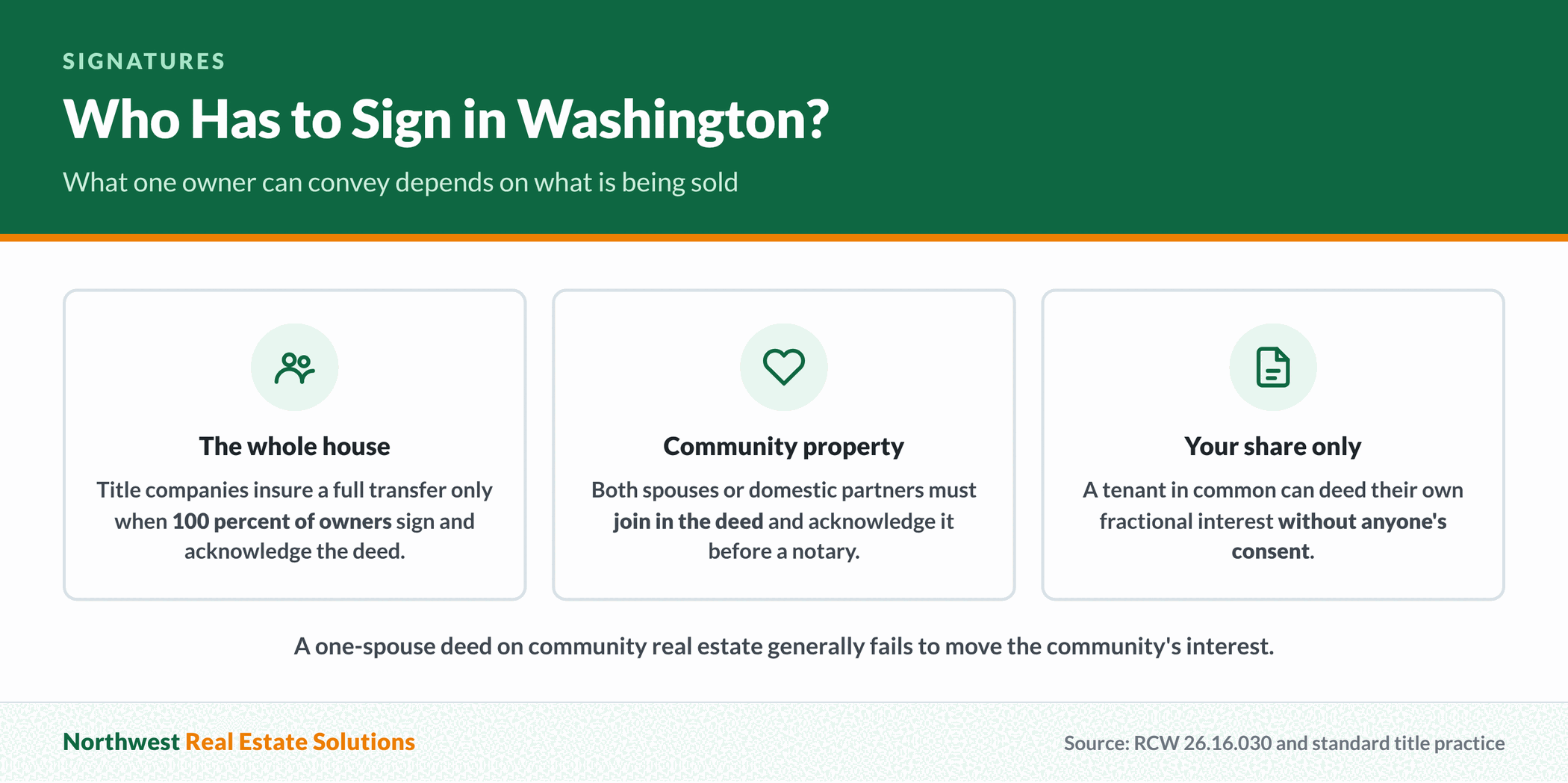
The married-couple rule trips up more sellers than anything else, so start there. Under RCW 26.16.030, one spouse cannot sell, convey, or encumber community real property unless the other spouse or domestic partner joins in signing the deed. Both of you also have to acknowledge it before a notary. Whose name sits on title doesn’t change that. One spouse signing a community property deed alone generally won’t carry the community’s interest at all.
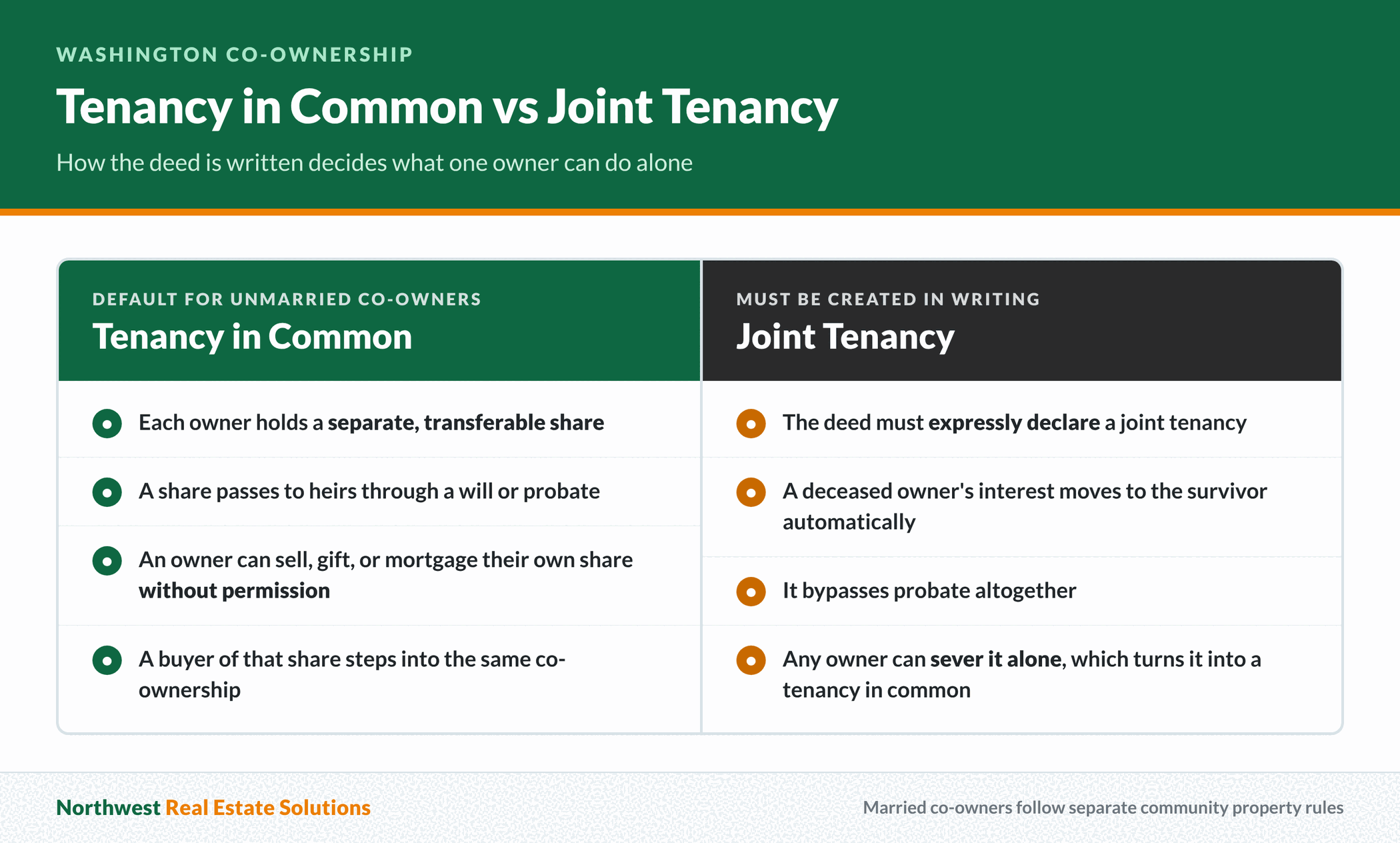
Co-owners who aren’t married follow a separate set of rules. Unless the paperwork says otherwise, Washington treats most shared ownership between non-spouses as a tenancy in common. Joint tenancy has to be created in writing, and the document must state outright that the interest is a joint tenancy.
So your first step is practical, not legal: read your own deed. The county auditor where the property sits keeps a copy. King, Pierce, Snohomish and Clark record deeds like every other county, and most let you search online for free.
I keep running into families who inherited a house twenty years ago and never checked how title is held. The deed says something they didn’t expect, and they learn it in escrow when the title company flags it.
Tenants in Common vs Joint Tenancy: How Does Ownership Affect a Sale?
A woman in Olympia called me about her late father’s rambler, sure she owned half of it. Her father’s deed named her and her stepmother as joint tenants, so she owned nothing. The stepmother took the whole house by survivorship the day he died.
Under a tenancy in common, each co-tenant holds a separate share that can be transferred, and that share passes to heirs through a will or through probate. Joint tenancy runs the other way. When one owner dies, their interest moves straight to the surviving joint tenant and skips probate entirely.
That difference shapes a sale. A tenant in common can sell, gift or mortgage a fractional interest without asking anyone. The buyer steps into the co-tenancy and inherits the same standoff. Joint tenants hold a stranger power. In Washington, joint tenancy carries survivorship and severability, including each tenant’s right to sever the joint tenancy alone. Sever it, and survivorship evaporates. From then on, the ownership is a tenancy in common.
The setup feels simple until one co-owner needs cash, remarries or gets sued. That’s when the family learns the paperwork gave a co-owner the power to act alone.
Early last year, an heir living in Arizona asked me to look at her mother’s split-level in Kent. Two agent listings had expired with zero offers, mostly because the co-owner wouldn’t let anyone into the garage. It was packed floor to ceiling with decades of storage. We bought her interest and worked out the rest directly.
Married couples holding jointly owned property sit in a third category altogether. Community property in Washington falls outside both boxes and follows the joinder rule above.
Do All Owners Need to Sign for a Jointly Owned Property Sale?
To hand a buyer clean title to the whole house, yes, every owner on the deed signs.
Title companies are the real enforcers in Washington. They won’t insure a transfer of 100 percent of the property unless 100 percent of the owners have signed and acknowledged the deed. Without title insurance there’s no lender, and without a lender most retail buyers walk away. Separate property belonging to one spouse can be conveyed by that owner alone. Community real estate needs both signatures and both acknowledgments.
Partial interests are where it gets interesting. Signing away only your own share as a tenant in common needs no other owner’s consent. The deed is valid and recordable. It just conveys less than the whole property, and the buyer knows it.
Who buys a one-third interest in a house they can’t live in alone? Investors who focus on co-ownership disputes do, usually at a steep discount, because they’re pricing in legal fees and time.
Powers of attorney and court-appointed personal representatives change the picture too. A personal representative with nonintervention powers can often sign for the estate’s share without rounding up every heir. That authority depends on how the estate was opened. Your county’s superior court clerk or a probate attorney can confirm what your letters allow.
Sellers also forget to budget for excise tax at closing. Real estate transfers are taxed here, and the Washington Department of Revenue sets rates by sale price and location. Partial-interest transfers are still taxable in most cases.
Can One Owner Sell Jointly Owned Property in Washington?
One owner can sell their own slice, never the whole house, unless a court order or a signed agreement says otherwise.
Picture three siblings who hold a Tacoma duplex as tenants in common after their father’s estate closed. Any one of them could deed their third to a stranger tomorrow. None of them can deed the building.
Married sellers get almost no room here. Community real estate in Washington needs both spouses, and a deed signed by one spouse generally fails to move the community’s interest.
People ask about one exception: separate property that only looks jointly owned. A house one spouse owned before the marriage, or inherited during it, can stay separate. Under Washington rules, an inheritance received during a marriage counts as separate property, even though it arrived after the wedding. Commingled mortgage payments and refinances can blur that line fast, though, so get an attorney’s read before you set a closing date.
Divorce adds another layer. In some Washington counties, filing a dissolution triggers automatic temporary orders that limit transferring real estate while the case is open.
Investors who regularly buy fractional interests, including the team at Northwest Real Estate Solutions, can usually tell you within a day if your share is sellable on its own or headed for court. I’ve seen that quick read save sellers months of guessing, and the call costs you nothing.
What Happens If One Owner Refuses to Sell Jointly Owned Property?
“My brother just says no. Now what?”
Nothing happens, and that’s the painful part. Your co-owner doesn’t have to explain, negotiate or answer your emails.
Stalemates get expensive in Washington because of carrying costs. Property in King County carried a median sold price of $838,990 in October 2026, well above the statewide median of $612,000 that month. I’ve watched owners stall for a year before realizing insurance, taxes, and upkeep on a house at that price add up to real money every year the fight drags on.
If you’re the one paying those bills, you aren’t necessarily out of luck. Courts in Washington recognize contribution claims in partition cases. Any co-tenant who covered mortgage payments, taxes or needed repairs can ask for credit against the other shares, so keep every receipt.
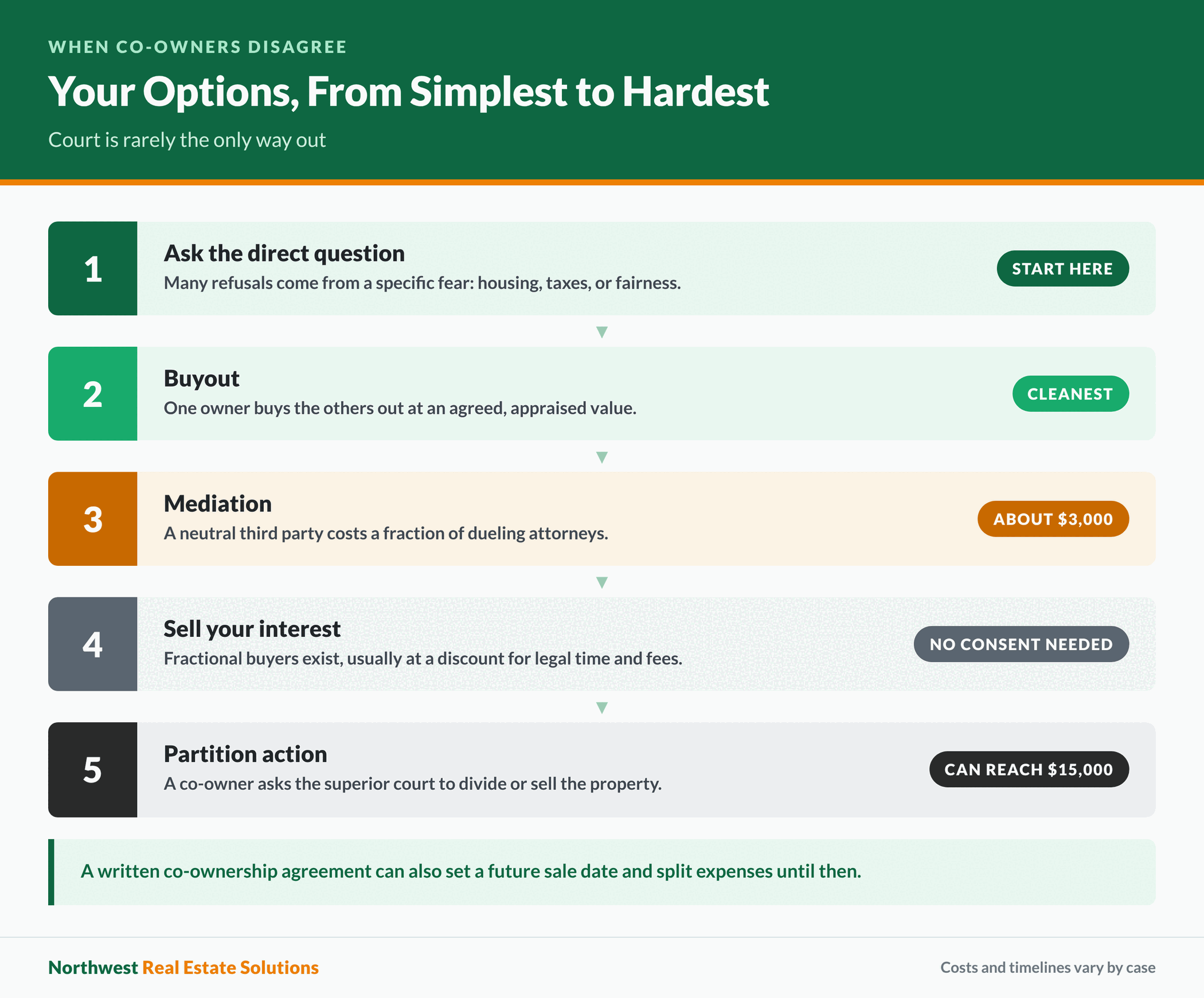
A refusal isn’t always a refusal. About half the owners I meet who “won’t sell” are afraid of something specific: where they’ll live, a tax bill they heard about, or a sibling they think is getting more. Ask them directly. Plenty of standoffs end with a two-hour conversation nobody had bothered to start.
The clock still matters. Washington homes that sold in the 90-day window ending October 21, 2026 spent a median of 32 days active, and sellers collected 98.5 percent of list price.
What Are the Options When Co-owners Disagree on Selling Jointly Owned Property?
“Court is the only way out of this.” I hear that a lot, and most of the time it’s wrong.
A buyout tends to be the cleanest fix. One co-owner buys out the others’ interests at an agreed value, usually backed by an appraisal, and the deed gets re-recorded in one name. Financing is the usual hurdle, because refinancing into one borrower’s name takes decent credit and equity.
Mediation works better than its reputation. Both sides sit down with someone who has no stake in the house. Superior courts in Washington encourage it, and a neutral third party costs a fraction of two attorneys arguing.
Then there’s selling your interest outright. Fractional buyers exist. You just won’t find them shopping the MLS.
Some families choose a cooling-off arrangement instead. A written co-ownership agreement can set a future sale date, split the expenses, and spell out what happens if someone wants out early. It gives everyone a date to plan around instead of an open-ended fight.
Rental income can calm things down too. A Spokane bungalow that throws off monthly cash flow is easier to hold than an empty house. Spokane County’s median price sat near $435,000 in the fall of 2026, according to local market reports. Co-owners who were fighting about a sale sometimes stop once the checks arrive.
Would you rather spend $15,000 on attorneys or $3,000 on a mediator and an appraiser? For most co-owners, that’s the real choice.
Can a Co-owner Force the Sale of Jointly Owned Property?
Four heirs inherited a waterfront cottage near Port Townsend. Three wanted cash, and one wanted summers there forever. Nobody was wrong, and nobody would budge.
Yes, a co-owner can force a sale of jointly owned property in Washington. The tool is a partition action, and it’s a right, not a request. Washington’s partition statute lets one or more tenants in common bring an action for partition and for sale of the property. A sale is the remedy when the property can’t be divided without great prejudice to the owners.
Courts can shape the outcome, though. Judges may order a sale when division isn’t possible without great prejudice, and the court appoints one or more referees to handle it.
Heirs’ property now gets special treatment. Washington adopted the Uniform Partition of Heirs Property Act. Courts first decide if the property qualifies as heirs property, in which case it’s partitioned under that chapter unless all cotenants agree otherwise in a record. That newer chapter lets cotenants who didn’t ask for a sale buy out the ones who did, once the property’s value is set.
My view hasn’t changed: forcing a sale works, and it’s still usually the worst financial outcome available.
How Does a Partition Action Work for Jointly Owned Property in Washington?
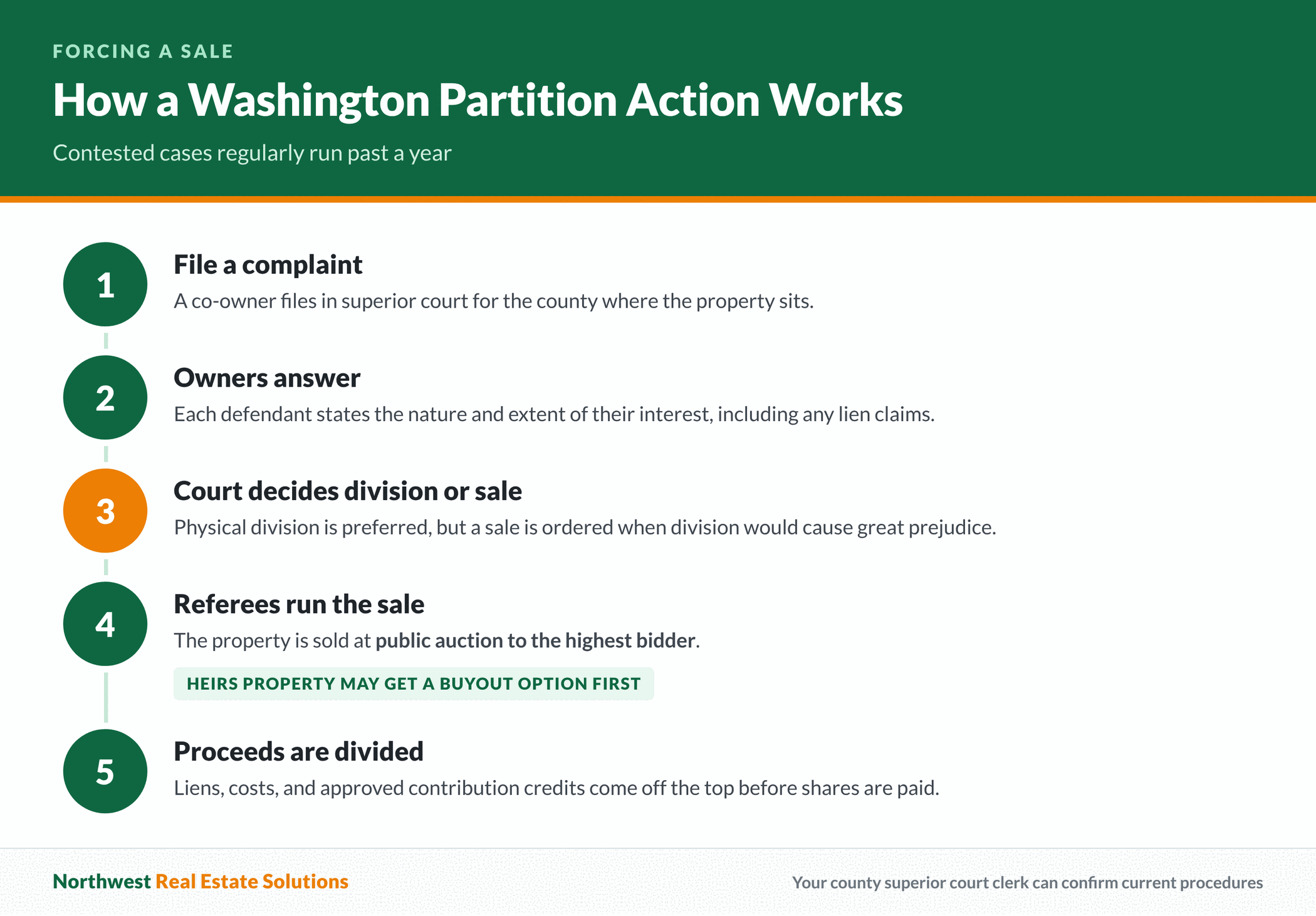
Filing fees in Washington superior courts run a few hundred dollars. The attorney retainer is where the real money starts, and contested partitions regularly run past a year. Little about the older partition chapter has changed since 1877, twelve years before Washington became a state.
A co-owner starts the case by filing a complaint in the superior court for the county where the property sits. The other owners answer and state the nature and extent of their interests, including any lien claims. Next, the court picks between dividing the land and selling it. Division is the statute’s preference, which works fine for 40 acres in Yakima County and almost never for a townhouse in Ballard.
If the court orders a sale, referees run it. Washington’s partition statute calls for referee sales at public auction to the highest bidder, handled the way execution sales are. Timelines and notice rules change, so check current filing procedures with the superior court clerk in your county.
Proceeds get split after liens, costs and approved contribution credits come off the top. Contribution credits are the piece that surprises people. The sibling who paid eight years of property taxes on jointly owned property can walk away with more than an equal share, as long as they documented it.
An heir in Mount Vernon reached out on a Tuesday, right after moving her mother into assisted living. That’s when she realized the 1960s farmhouse had three names on the deed, and she hadn’t spoken to two of them since a funeral. We agreed to buy her interest, then negotiated separately with the other two over about six weeks, and nobody filed anything. I’ve seen this exact tangle more than once.
Before you pay a retainer, get a straight valuation and a realistic read on what a fractional interest is worth. Northwest Real Estate Solutions handles these situations across Washington without needing every owner to agree first, and that alone sometimes breaks the logjam.
Frequently Asked Questions
What Does “Joint With Right of Survivorship” Mean in Washington?
When one owner dies, their share passes straight to the surviving owner instead of going through probate or to heirs named in a will. To create it in Washington, the deed itself has to spell this out in writing, so two names alone won’t do it. Either joint tenant can also end the arrangement while alive, which turns the ownership into a tenancy in common and drops the survivorship feature.
Can I Sell My Share of Jointly Owned Property Without Telling My Co-owners?
Legally, yes. Tenants in common can transfer their own fractional interest without permission, and no notice is required. The buyer becomes your co-owners’ new partner, though, and usually has every reason to file for partition. Married owners of community real estate in Washington don’t have this option at all.
How Long Does It Take to Force the Sale of Jointly Owned Property in Washington?
Contested cases commonly stretch well past a year once you count the filing, the answers, valuation disputes and the sale itself. Uncontested partitions, where everyone mostly agrees on the outcome, can wrap up in a few months. Compare either one to how quickly a cooperative sale closes in Washington, and negotiating usually wins on the math.
Does One Owner’s Bankruptcy or Debt Affect Jointly Owned Property?
It can. A creditor with a judgment against one co-owner can attach that person’s interest, and in Washington a bankruptcy trustee may pursue a sale of the whole property to reach it. Joint tenancy won’t shield the property from creditors either, since the statute that authorizes it expressly preserves creditors’ rights.
Do I Need a Lawyer to Handle Jointly Owned Property Disputes in Washington?
For a simple buyout between people who get along, a real estate attorney reviewing the deed and closing documents is usually enough. If someone has refused to cooperate for months, or an estate is involved, hire a litigator early, before anyone makes statements they can’t take back. Many Washington attorneys offer a flat-fee consultation that will tell you which situation you’re in.
What If a Co-owner Has Disappeared or Can’t Be Located?
Washington partition procedure allows service by publication when a party truly can’t be found, and courts can appoint someone to represent unknown or missing interests. Title companies also have processes for missing owners on jointly owned property, though they’ll want proof of your search. Your county superior court clerk can explain the current publication requirements.
If you’re stuck between co-owners and tired of having the same argument on repeat, I’m glad to look at your situation. I’ll walk you through your options, including the ones that don’t involve selling to me. There’s no pressure and no obligation, just a straight conversation about jointly owned property in Washington and a reasonable way forward.
Co-Owned Homes in the Tacoma Market
Tacoma’s median listing price sat near $619,000 in September 2026, and listings averaged 25 days on the market, based on RexMont’s monthly data. At that price, every extra month of a co-owner standoff adds real carrying costs for everyone on the deed.
Talk Through Your Co-Ownership Options
If you share a house with someone who won’t budge, you can reach out to our team for a straight read on what your share is worth. Fill out the form below, and we’ll follow up on your timeline.
Helpful Washington Blog Articles
- Sell a House with Water Damage in Washington
- How to Sell an Apartment in Washington
- How Long Does It Actually Take to Sell a House in Washington
- How To Attract Buyers For Distressed Property In Washington
- Selling a House in a Trust After Death in Washington
- Can Someone Take Over My Mortgage in Washington
- Can I Sell My House For Less Than Appraised Value In Washington State
- Can I Sell My House Below Market Value in Washington
- How to Sell a House That Needs Repairs in Washington
- Can You Sell a House As-is Without an Inspection in Washington
- How to Take Your House Off the Market in Washington
- How Much Do Realtors Charge to Sell a House in Washington
- Can I Sell My House with a Pending Insurance Claim
- Can One Owner Sell Jointly Owned Property in Washington