

Equity isn’t the gap between your home’s value and your loan balance. Your banking app shows you that figure, and it runs cheerful by several thousand dollars, so don’t trust it at face value. Before one dollar touches your mortgage payoff, a stack of costs comes off the top of the sale price.
Oregon’s median sale price sat at about $507,000 in August 2026, according to Redfin’s Oregon market data. A seller at that price point hands over tens of thousands before the payoff wire even goes out.
So what matters isn’t what your house is worth. It’s what’s left after the sale pays everyone else first.
Total Seller Costs by Home Value in Oregon
Underestimate this, and you learn the truth at the signing table, when an escrow officer slides a settlement statement across the desk showing a number you have to bring, not take. I’ve watched that happen. The sale either dies right there or the seller empties a retirement account to save it.
Commissions carry the heaviest weight. An August 2026 survey of agents put Oregon’s average total real estate commission at 5.22%, split into about 2.67% for the listing agent and 2.55% toward the buyer’s side. Commissions are negotiable and always have been. Flat fee MLS services and discount brokerages exist for exactly this reason, and I’d push any seller with thin equity to at least call two of them before signing a standard listing agreement.
When you make those calls, ask three specific things. What’s included for the fee, meaning photography, lockbox, showing coordination, and whether anything gets billed separately. Whether buyer-side compensation is handled as a line item you control or baked into the agreement. And how you cancel if the relationship isn’t working, because a six-month exclusive with no exit clause is a long time to sit with a decision you regret in week three.
Everything else at closing averages another 2.40% of the price in Oregon. Escrow and settlement charges, recording fees, prorated property taxes, and the credits a buyer squeezes out after inspection all fall into that bucket.
Add those two together and you’re near 7.6% of the sale price gone before the lender gets paid. On a $500,000 house, that’s roughly $38,000.
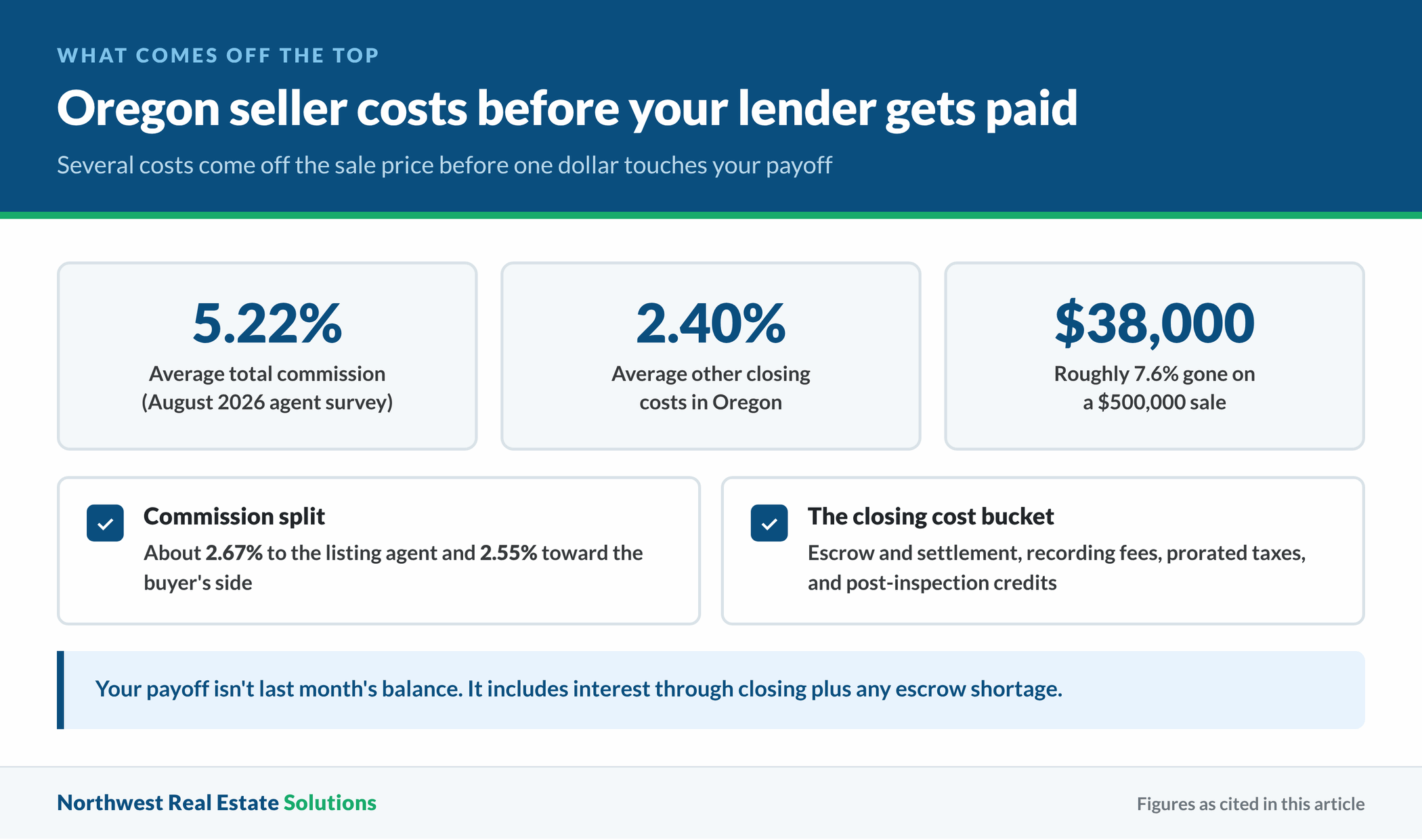
Now layer your mortgage on top. Payoff isn’t the balance printed on last month’s statement; it includes interest accrued through the closing date plus any unpaid escrow shortage. If you’re behind on payments, late fees and any foreclosure attorney costs are added too. A title company pulls the official payoff demand, and that’s the figure that matters.
Two details on that demand trip people up. It carries a good-through date, and if closing slides past it, escrow has to request an updated figure with additional daily interest tacked on, which means your final number isn’t locked until you actually close. And your servicer may charge a fee to prepare the statement and record the release of its lien. Separately, whatever sits in your escrow impound account comes back to you by mail weeks after closing, not at the table, so don’t count on it to cover moving expenses. We’ve covered the rest of that process in our guide to selling your Portland, Oregon, home with an existing mortgage.
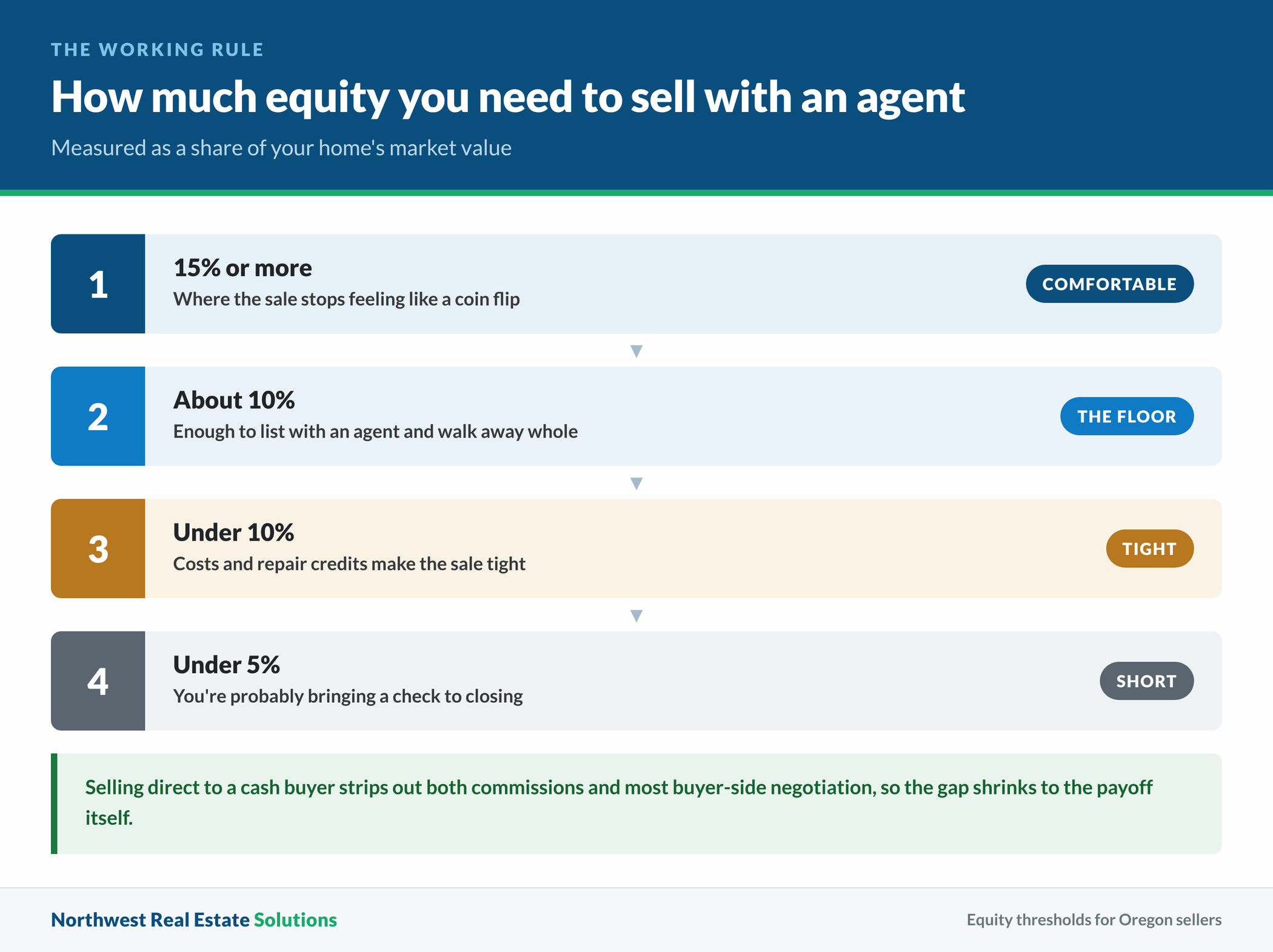
The working rule I give sellers is this: you want somewhere around 10% of your home’s market value sitting in equity to list with an agent and walk away whole. Below that, the sale gets tight. Below 5%, you’re probably bringing a check.
That cushion isn’t arbitrary. It covers the costs above, plus the repair credit that shows up in the second week of escrow when the inspector finds knob-and-tube wiring in a 1920s Northeast Portland bungalow or dry rot under a deck in Lake Oswego.
Does that mean a low-equity seller is stuck? Not at all. Selling direct to a cash buyer strips out both commissions and most of the buyer-side negotiation, which changes the arithmetic quickly. Companies like Northwest Real Estate Solutions buy as-is and cover typical closing costs, so the gap you need to clear shrinks to the payoff itself.
Higher-priced homes don’t escape the percentage; they just pay more in raw dollars. A seller in the West Hills clearing a $900,000 sale writes bigger checks to the same parties. The one advantage at that level: there’s usually enough equity that nobody notices the bleeding, at least in the deals I’ve seen come through.
Regional Cost Variations Across Oregon
A couple of years ago, three siblings in Gresham reached out after quietly covering two mortgages for almost a year, their late mother’s house plus their own. They’d been splitting the payments three ways without telling anyone, and the garage still held her husband’s woodworking bench and about forty coffee cans of screws. We closed in under three weeks, and the payment bleeding stopped.
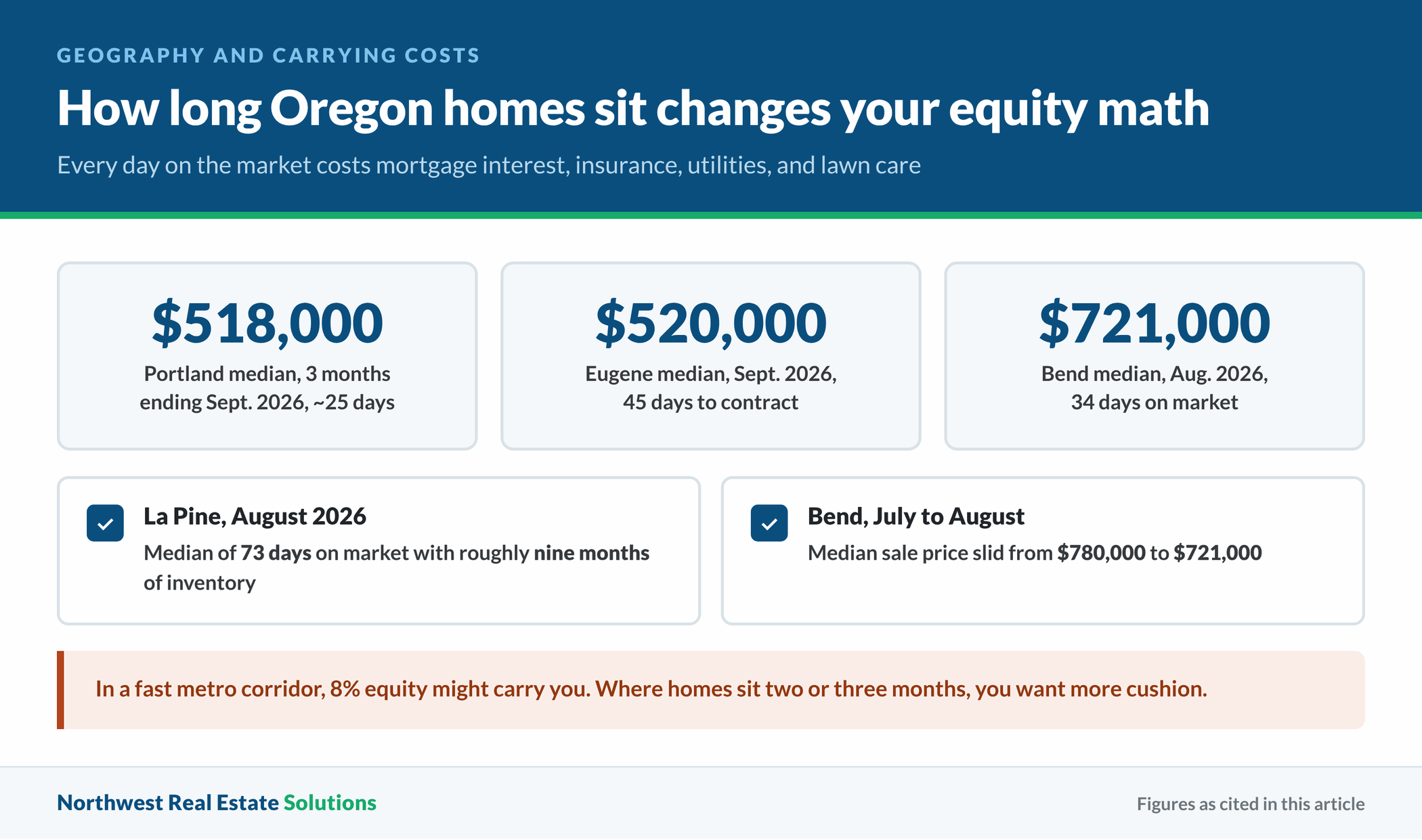
Carrying costs are where geography hits hardest. Portland homes sold at a median of $518,000 over the three months ending September 2026, down 2.2% year over year, and they went pending in about 25 days according to Redfin’s Portland market data. Fast market, modest holding cost.
Drive two hours southeast and the math changes. Bend’s median sale price slid from $780,000 in July 2026 to $721,000 in August, and median days on market stretched to 34. Out in La Pine that same month, the median climbed to 73 days, with roughly nine months of inventory sitting unsold.
Eugene lands in between. Homes there closed at a $520,000 median in September 2026, with sellers waiting an average of 45 days to go under contract, per Lane County MLS figures. Every one of those days costs you mortgage interest, insurance, utilities, and lawn care.
Tally those up honestly before you decide how long you can wait. Principal and interest, property taxes, homeowners insurance, power and water even in an empty house, and yard maintenance you now pay someone else to do. If the home sits vacant, call your insurance agent before the last box leaves, because an unoccupied dwelling often needs a different policy or an endorsement, something I’ve seen trip up sellers who assumed their regular policy still applied. Finding that out after a pipe lets go in January is an expensive way to learn it.
Then there’s the Washington County wrinkle. Oregon law blocks cities and counties from taxing real estate transfers under ORS 306.815, with one grandfathered exception for jurisdictions that had a tax operating before March 31, 1997. Washington County is the only one that qualified.
If your property sits in Beaverton, Hillsboro, Tigard, Tualatin, Sherwood, or Aloha, expect a transfer tax of $1 per $1,000 of consideration. That’s a tenth of a percent, often split between buyer and seller by custom rather than by law. The Washington County recording division handles it, and exemption claims must be filed within fifteen days of recording the instrument. If you think your transfer qualifies, just call them directly, since the recording staff will tell you in one phone call.
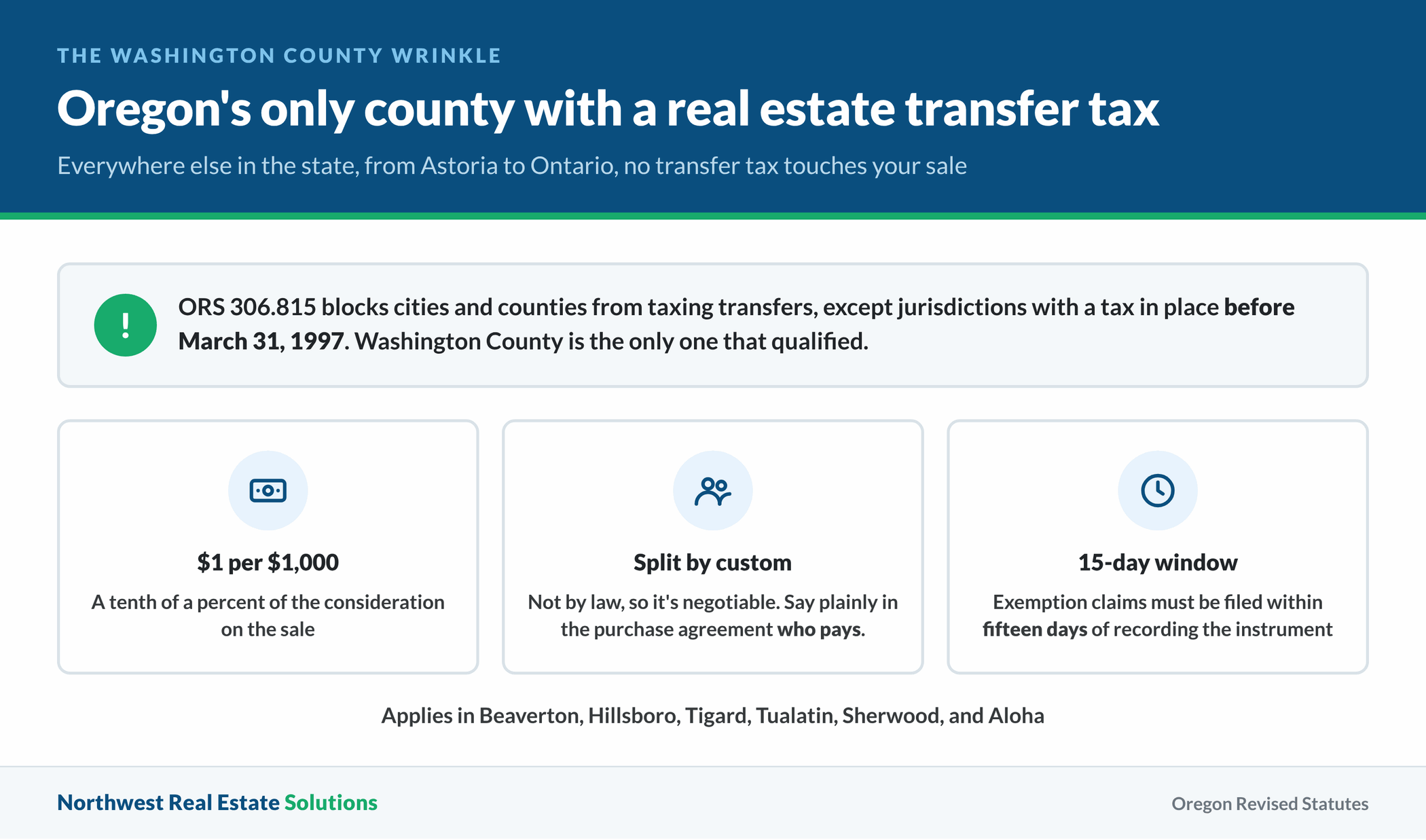
Because the split is custom and not statutory, it’s negotiable like anything else in the contract. Ask your escrow officer what’s typical in your immediate area, then make sure the purchase agreement says plainly who pays, because silence in the contract is how small surprises end up on the settlement statement.
Everywhere else in the state, from Astoria to Ontario, no transfer tax touches your sale.
Title and escrow practices shift by region too. Rural Oregon transactions sometimes need a survey, well testing, or septic certification that a Salem subdivision sale never involves. A seller near Sisters with a shared water system can spend weeks and real money proving that system works before a lender will fund.
If you’re on acreage or outside city services, start those items the week you decide to sell rather than waiting for a buyer to demand them. Septic pumping and inspection appointments book out, water tests take days to come back from the lab, and a buyer watching the calendar will use any delay as leverage.
What does all this mean for your equity target? In a fast metro corridor, that 10% floor might carry you through. In a county where homes sit for two or three months, I’d want more cushion, because each month of carrying costs quietly eats the equity you were counting on.
How Do You Estimate Your Net Proceeds When Selling in Oregon?
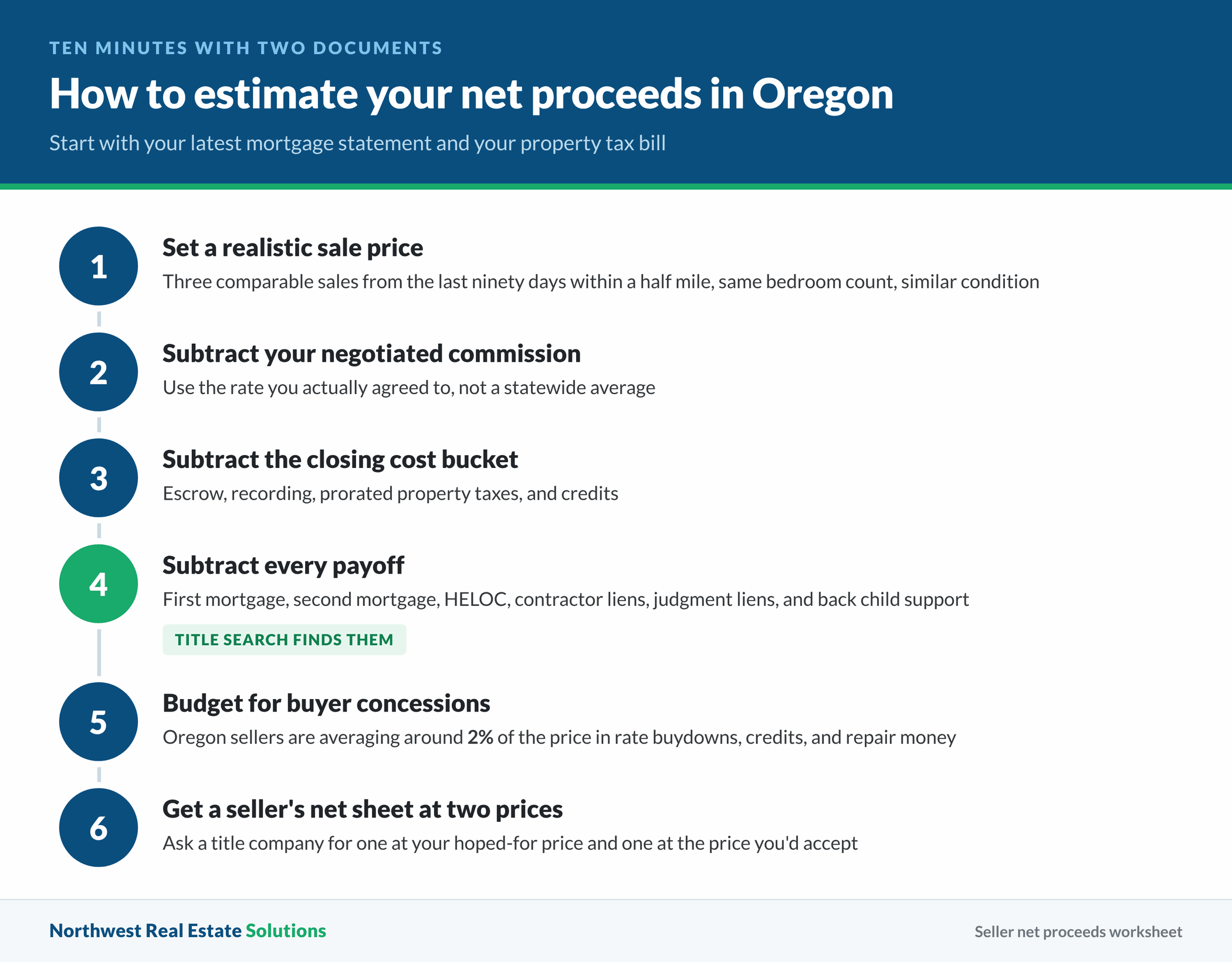
Bring me your most recent mortgage statement and your property tax bill, and we can get within a few hundred dollars in about ten minutes. That’s the whole exercise. No spreadsheet gymnastics required.
Start with a realistic sale price, not a hopeful one. Pull three comparable sales from the last ninety days within a half-mile, with the same bedroom count and similar condition. Zillow’s estimate is a starting point, not evidence.
Subtract commissions next, using whatever rate you’ve actually negotiated rather than a statewide average. Then subtract the closing costs bucket. Then the payoff, including any second mortgage, HELOC, or contractor lien you forgot about. Judgment liens and back child support attach to proceeds too, and escrow will find them during the title search.
Some obligations stay out of sight until closing day. If you financed solar panels, find out early whether that loan must be paid off at closing or can transfer, because the buyer’s lender will ask. Condo and HOA sellers should budget for document and transfer fees the association charges to produce records. And a home equity line with a zero balance still has to be formally closed and released, which often takes the bank several weeks.
Buyer concessions deserve their own line. Oregon sellers are averaging around 2% of the sale price in buyer incentives right now, which shows up as rate buydowns, closing cost credits, or post-inspection repair money. Plan for it. In a market where nearly a third of Portland-area listings took a price cut in the period ending August 2026, buyers are asking and getting.
Property taxes get prorated at closing based on where you are in the tax year. Oregon’s effective property tax rate on owner-occupied homes runs about 0.77% of value, per Tax Foundation figures, so the daily proration is small but real. Your county assessment and taxation office can tell you exactly what’s been paid and what’s still owed.
Taxes on the gain are a separate matter. The federal exclusion lets you keep up to $250,000 of profit tax-free if you’re single, or double that filing jointly, provided you owned and lived in the home at least two of the five years before the sale. That covers most Oregon homeowners outright.
Anything above the exclusion gets taxed twice over. Federal long-term capital gains rates apply, and Oregon treats the gain as ordinary income on its progressive schedule running from 4.75% to 9.9%, as Edelman Financial Engines explains. No preferential state rate exists for long-term gains in Oregon. Portland-metro sellers may owe local income taxes on top of that. Our guide to seller tax responsibilities when selling a home in Portland, OR goes deeper on what you’ll owe.
Ask any title company for a seller’s net sheet before you list. They produce them free, they produce them fast, and the estimate is far more honest than an agent’s back-of-napkin figure. I’ve also seen sellers get a net sheet from a direct buyer alongside a listing estimate just to compare the two side by side, which is exactly the right instinct.
Request the net sheet at two prices, one at what you hope to get and one at what you’d accept after a price reduction. Seeing both columns tells you how much room you have to negotiate, and it keeps you from discovering in month three that the reduction you just agreed to wipes out your cushion entirely.
One warning worth repeating: escrow can’t release proceeds until every recorded claim clears. An old roofing lien from 2014 that nobody satisfied will hold your money hostage while a title officer chases paperwork. Pull your own title report early if you suspect anything.
Do Pre-Sale Home Improvements Pay Off in Oregon?
For years I told sellers to paint every room before listing, and I was wrong about half the time.
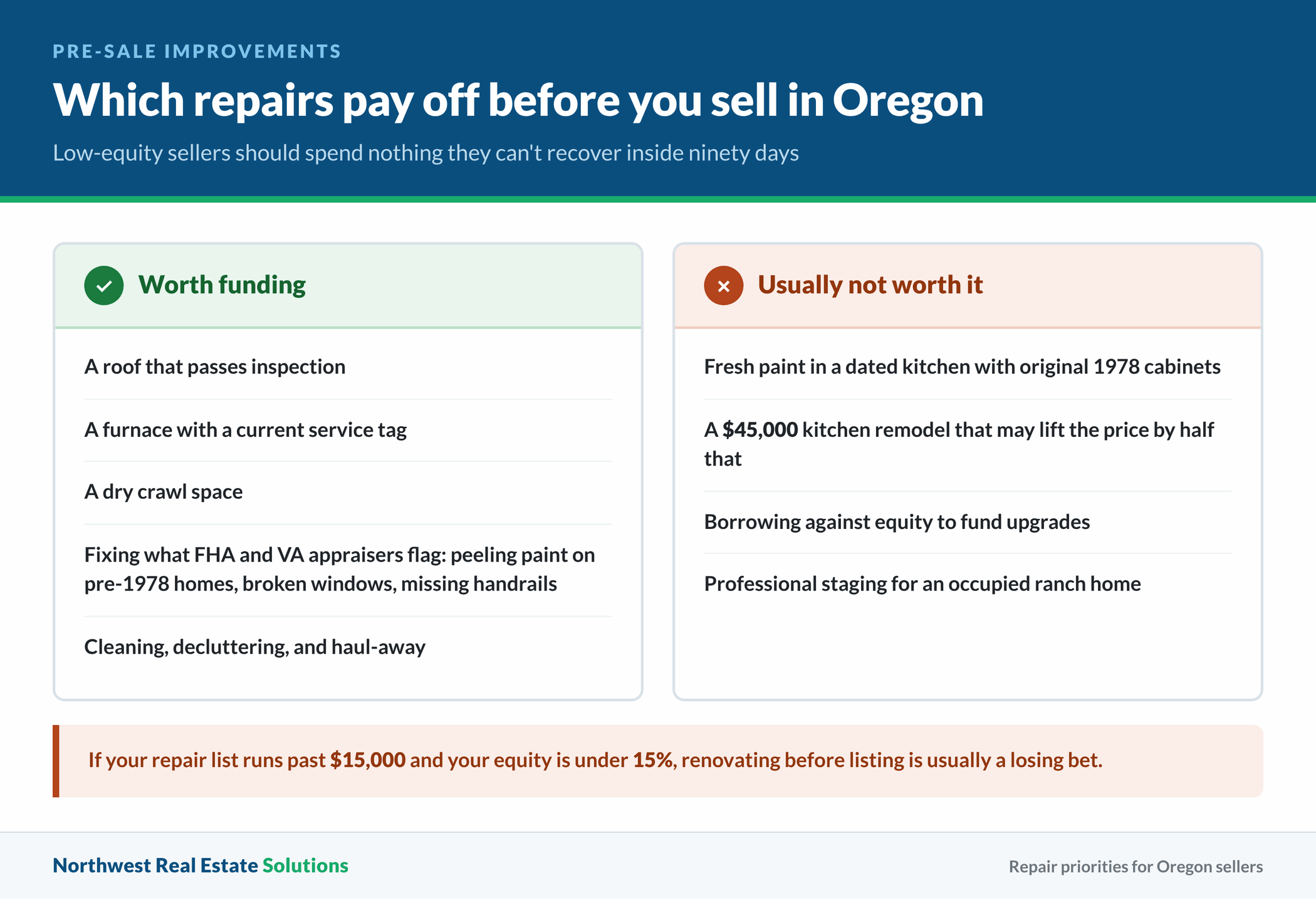
Fresh paint in a dated kitchen with original 1978 cabinets doesn’t fool a buyer; it just signals that you spent money in the wrong place. What moves a sale is the boring stuff. A roof that passes inspection. A furnace with a current service tag. A crawl space without standing water, which I check every February myself because a wet one has killed more Willamette Valley deals than bad paint ever did.
You won’t get your money back on big renovations at the closing table in Oregon right now. A $45,000 kitchen remodel might lift your sale price by half that in a market where values are flat to slightly down. If you’re borrowing to fund the work, you’re converting equity into debt and hoping a buyer rewards your taste.
Low-equity sellers should spend nothing they can’t recover within ninety days.
Cleaning and decluttering are the exception. Haul-away costs a few hundred dollars and consistently returns more than any cosmetic upgrade I’ve seen. Buyers can’t picture their life in a house they can’t walk through.
What about staging? For a vacant home in Northwest Portland or a condo in the Pearl, professional staging earns its fee. For an occupied three-bedroom ranch in Keizer, a weekend of decluttering gets you ninety percent of the same result at ten percent of the cost.
The repairs I’d genuinely fund come down to safety and lender requirements. An FHA or VA buyer’s appraiser will flag peeling exterior paint on pre-1978 homes, broken windows, and missing handrails. Those flags kill financing. Fix them or expect your buyer pool to shrink to cash offers only.
Sellers also underrate what repairs cost in time, not just dollars. A contractor in Central Oregon might book you six weeks out, and you’re making payments through every one of those weeks. Run that number before you commit.
Get three written bids before you commit to anything structural, and ask each contractor whether the work needs a permit. Unpermitted additions and converted garages surface during the appraisal or the county records search, and in my experience, explaining a finished basement that the assessor has never heard of is a conversation you want to have on your terms, not mid-escrow. A pre-listing inspection can help here, but understand the tradeoff: once you know about a defect, you disclose it.
Here’s my blunt take on the as-is question: if your repair list runs past $15,000 and your equity is under 15%, renovating before listing is usually a losing bet. You’d be spending borrowed money to chase a price the market may not pay. Selling as-is to a direct buyer, or listing honestly with a price that reflects condition, keeps more in your pocket more often than not.
Disclosure obligations don’t vanish either. Oregon sellers complete a property disclosure statement for most residential transactions, and papering over a known defect with new drywall creates a legal problem that outlives your closing.
The Bottom Line on Oregon Home Seller Costs
Ten percent equity is the floor I’d want under any Oregon homeowner before calling a listing agent, and fifteen is where the sale stops feeling like a coin flip.
Below that line, you still have moves. Bringing cash to closing works if you have it. A short sale works if your lender cooperates, though it takes months and bruises your credit. Renting the house out buys time if the rent covers the note.
Selling direct removes the two largest variables at once: commission and buyer-side negotiation. You trade some top-line price for certainty and speed, which is the right trade for a seller facing a payment deadline, a job transfer, or a probate court timeline. It’s the wrong trade for someone with deep equity, a fixed-up house, and six months of patience.
If you go that route, vet the buyer the way you’d vet a contractor. Ask for proof of funds, ask whether they intend to close themselves or assign the contract to someone else, ask which title company holds escrow, and ask what happens to your earnest money if they walk. A straight answer to all four takes about five minutes. Hesitation on any of them tells you plenty.
Whatever route you take, get your actual numbers before you make the decision. Not the Zillow number. Not the number your neighbor got in 2022.
An heir in Albany called us about a house her father had lived in since the mid-1990s, every closet and every bedroom packed to the ceiling, with a vintage Ford pickup under a tarp in the detached garage. Her two siblings lived out of state and wanted nothing but a clean exit and a check. She kept the pickup and a box of photographs; we handled the rest, and the four of us signed on a Thursday afternoon at a local title office.
Frequently Asked Questions
How Can You Keep Oregon Capital Gains Tax Off Your Home Sale?
The federal exclusion described earlier is your main tool, so be sure you can prove you met both the ownership and residency tests before closing. Keep every receipt for capital improvements, since those raise your cost basis and shrink the taxable gain, something I’ve seen sellers overlook until it costs them at closing. For rental or investment property, a 1031 exchange can defer the full gain if you line up the replacement property correctly. Talk to a CPA before you sign, not after.
What Should You Avoid Doing Before You Sell?
Don’t open new credit lines or take a HELOC against the house in the months before listing, because it adds to your payoff and complicates escrow. Skip the expensive cosmetic projects discussed above, and resist the urge to price high and “see what happens,” since stale listings get fewer offers than fresh ones. Also, don’t hide a known defect. Disclosure problems have a way of following you after closing.
Is Oregon a Buyer’s Market or a Seller’s Market Right Now?
It depends enormously on where your house sits. Portland and Eugene are moving at a reasonable clip with prices roughly flat, which reads as balanced rather than favoring either side. Central Oregon and rural counties have tilted toward buyers because there’s more inventory and longer waits to go under contract. Price your home against what’s closing in your own ZIP code, not against the statewide headline.
Which Taxes Come Out of Your Sale in Oregon?
You’ll settle up on property taxes through a proration at closing, based on where your sale lands in the tax year. Most of the state charges no transfer tax at all; the lone county exception is the one covered above. On top of that, you’ll owe income tax on any gain that exceeds the federal exclusion, which Oregon folds into your regular income rather than taxing at a special rate.
We Buy Portland and Oregon Houses With Thin Equity
Portland is our main market, and inventory there has crept up. RMLS put the Portland metro at 3.8 months of inventory in August 2026, up from a year earlier. More supply usually means more time on the market. Each month you carry the house eats into what you keep.
We’re cash home buyers in Portland, and we buy houses across the metro and the rest of the state. Out east, we’re a company that buys homes in Gresham. On the west side, we buy houses in Beaverton, where the Washington County transfer tax comes into play. You can see every area on our We Buy Houses in Oregon page or meet the Northwest Real Estate Solutions team first.
Find Out What Your Oregon House Would Net You
If you want to sit down and walk through your actual numbers, payoff, costs, and what’s realistically left, we’re glad to do that with you. No pressure, no obligation, and no hard feelings if listing with an agent turns out to be the better path for your situation. Reach out whenever you’re ready.
Bring your latest mortgage statement and your property tax bill, and we’ll walk through the numbers with you. We’ll show you what a cash offer leaves after your payoff, with no commission to subtract. Put that beside a title company’s net sheet for a listing and pick the path that fits.
Have more questions first? Check out other frequent questions. When you’re ready, fill out our quick contact us form or use the short form below.
Helpful Oregon Blog Articles
- Who Is Responsible For HOA Fees At Closing In Oregon
- Guide To Oregon Inheritance Laws
- Paperwork For Selling Your Oregon Home by Owner
- Understanding Squatters’ Rights In Oregon Real Estate
- How To File A Quitclaim Deed For Real Estate In Oregon
- Homeowners Insurance When Selling a House in Oregon
- Can You Sell a House with Asbestos in Oregon
- How to Sell a House with Mold in Oregon
- Can the Seller Back Out of a Contract in Oregon?
- How Much Equity Do I Need to Sell My House in Oregon?
- Taxes When Selling an Inherited House in Oregon
- Do Open Houses Still Work When Selling a Home in Oregon?
- How to Sell a House with Flood Damage in Oregon