
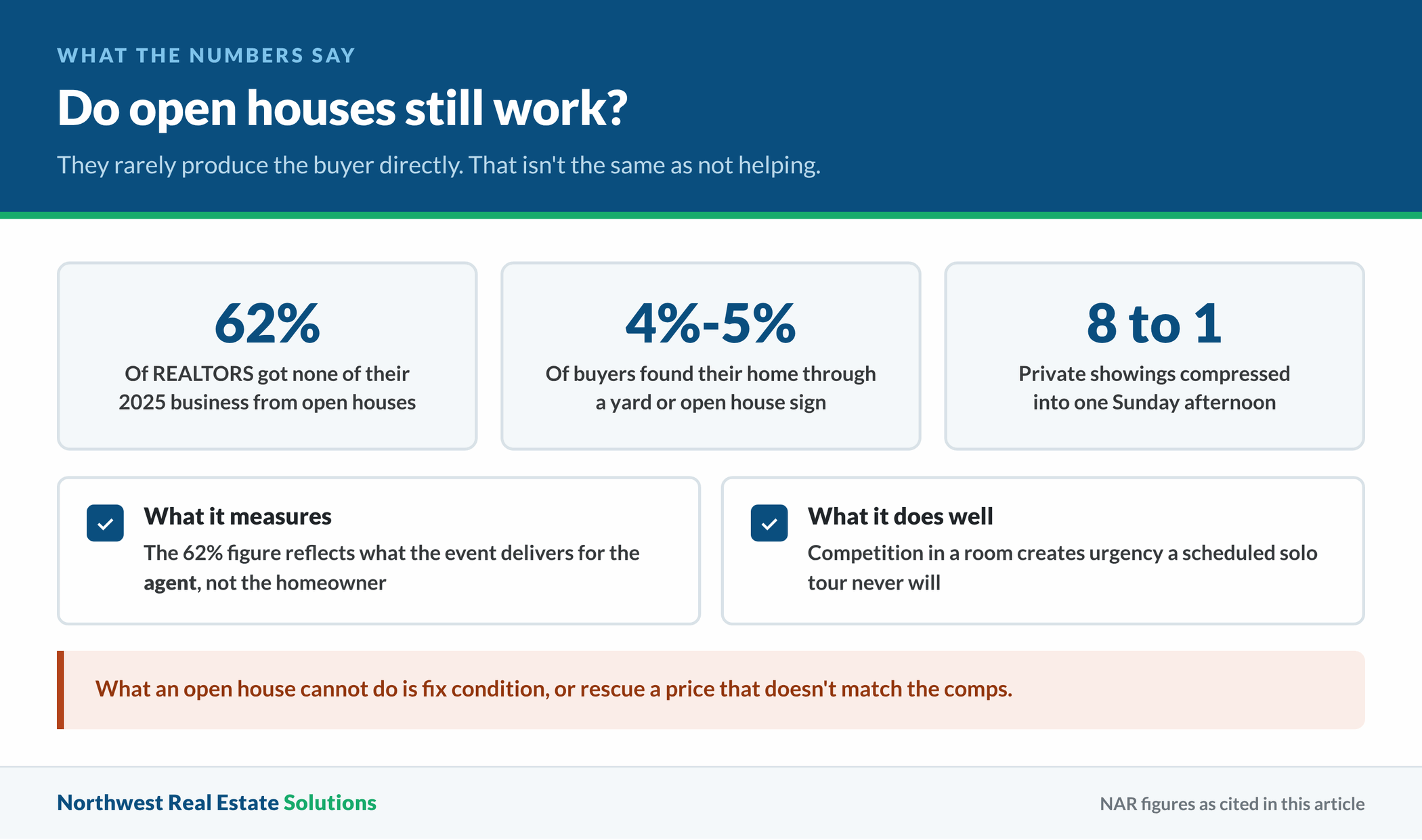
Sixty-two percent of REALTORS got none of their 2025 business from hosting an in-person open house, according to NAR’s 2026 Member Profile. People pass that figure around as proof the open house is dead. It proves something narrower. It measures what the event delivers for the agent standing at the door, not what it delivers for the homeowner who owns the place. Those are two different questions, and if you’re weighing a sale anywhere between Astoria and Ontario, only one of them is yours.
What Is an Open House in Oregon, and How Does It Work?
Friday morning, a Sellwood bungalow had exactly two private showings booked for the entire week. By Sunday night the sellers had nineteen names on a sign-in sheet, three repeat visits scheduled, and one written offer sitting in their inbox.
The whole pitch fits in two sentences. Mechanically, an open house is a published window, usually three hours on a Saturday or Sunday, when any buyer can walk through a listed property without an appointment.
Your listing agent posts it to RMLS, the regional MLS that covers most of western Oregon, and the date syndicates out to Zillow, Redfin, and the brokerage’s own site within hours. Directional signs go up at the nearest arterial, and a sign lands in the yard too. Somebody, usually the listing broker or an associate from the same office, hosts the house, greets visitors, collects contact information, and answers questions about the roof.
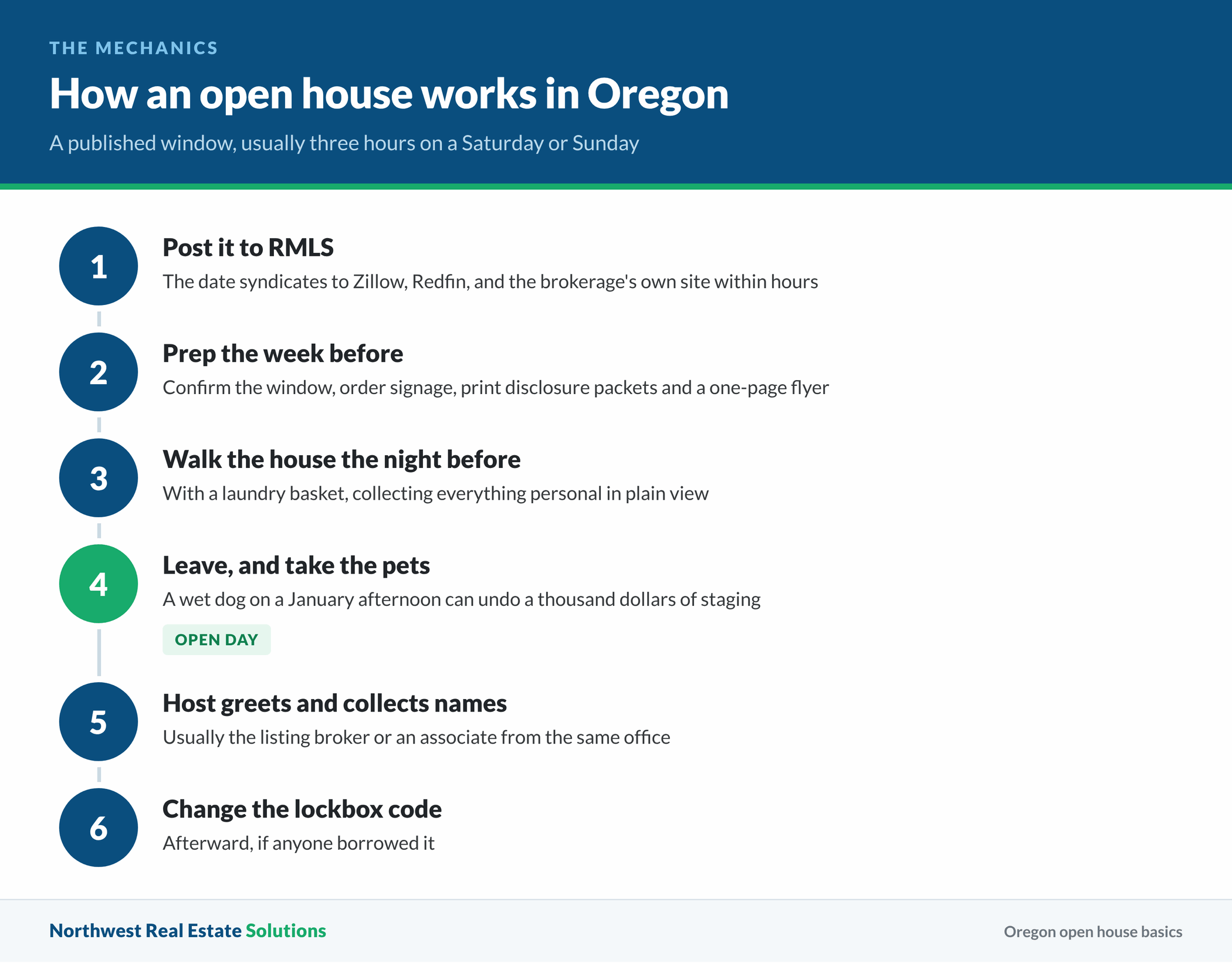
You need the week before as much as the day itself. Expect your agent to confirm the time window with you, order signage, print disclosure packets and a one-page flyer, and tell you what to move out of sight. You’ll want the lockbox code changed afterward if anyone borrowed it, and you’ll want to walk the house yourself the night before with a laundry basket, collecting everything personal that’s sitting in plain view.
Sellers almost always leave. Pets leave too, which matters more in Oregon than people admit, because a wet dog on a January afternoon can undo a thousand dollars of staging.
FSBO sellers run their own open houses all the time here. A for sale by owner can buy a flat-fee MLS listing, hang the signage, print a disclosure packet, and host the afternoon personally. The tradeoff is that you’re negotiating in your own kitchen with strangers who came to find flaws, and most people handle that badly, something I’ve watched play out poorly more than once. Our full guide on how to sell a house by owner in Oregon covers the rest of that process.
Rural listings follow different rules of thumb. Out past Molalla or along Highway 101, nobody stumbles across your open house. Every visitor drove there on purpose, which changes who shows up and why.
Do Open Houses Work When Selling a Home in Oregon?
For about five years I told sellers that open houses were theater, and I was wrong in a specific way.
They rarely produce the buyer directly. Roughly 4 to 5 percent of buyers found the home they purchased through a yard sign or an open house sign, per NAR’s buyer and seller survey data. Where I got it wrong was treating “doesn’t find the buyer” as the same thing as “doesn’t help.” An open house compresses eight separate private showings into one Sunday afternoon. Buyers who’ve already seen your photos online get a low-commitment way to walk through. Competition in a room creates urgency that a scheduled solo tour never will.

Even the neighbors earn their keep, which surprises people. The couple down the block who came to compare countertops is also the person most likely to call their sister in Beaverton who has been looking in this exact neighborhood for a year. Referral traffic from curious neighbors is unglamorous, but it’s occasionally real.
What an open house cannot do is fix conditions. A while back I bought a duplex from a longtime landlord out in Gresham who’d held it since the eighties. His contractor priced the kitchen at more than the kitchen was worth, with cabinets, subfloor, and a gas line all tangled together. A chest freezer in the garage had been leaking into the wall behind it for who knows how long. Three open houses wouldn’t have moved that property one dollar; the estimate itself was the problem.
The honest line between the two outcomes is that. For a clean, well-priced property in a walkable Oregon neighborhood, an open house adds real momentum to the first ten days on market. For a property with deferred maintenance, tenants in place, or a price that doesn’t match the comps, it mostly produces polite feedback and a lot of foot traffic from neighbors pricing their own homes.
What Do Open House Statistics Say About Oregon Home Sales?
Does any of this hold up in our market?
Statewide, the median sale price in Oregon sat at $506,889 in August 2026, down about 0.6 percent year over year, with a median of 39 days on market. With that stretch covering about six weekends, your open house only gets one shot, so its value depends almost entirely on whether it lands in the first week while buyer interest in a new listing is at its peak.
Portland runs faster than the state as a whole. Homes in the city sold at a median of $518,253 over the three months ending September 2026, down 2.2 percent from the prior year, and went pending in about 25 days with an average of two offers per sale, which doesn’t leave sellers much cushion. I’ve seen one extra interested party from a Sunday open house be the difference between accepting terms you like and accepting terms you tolerate.
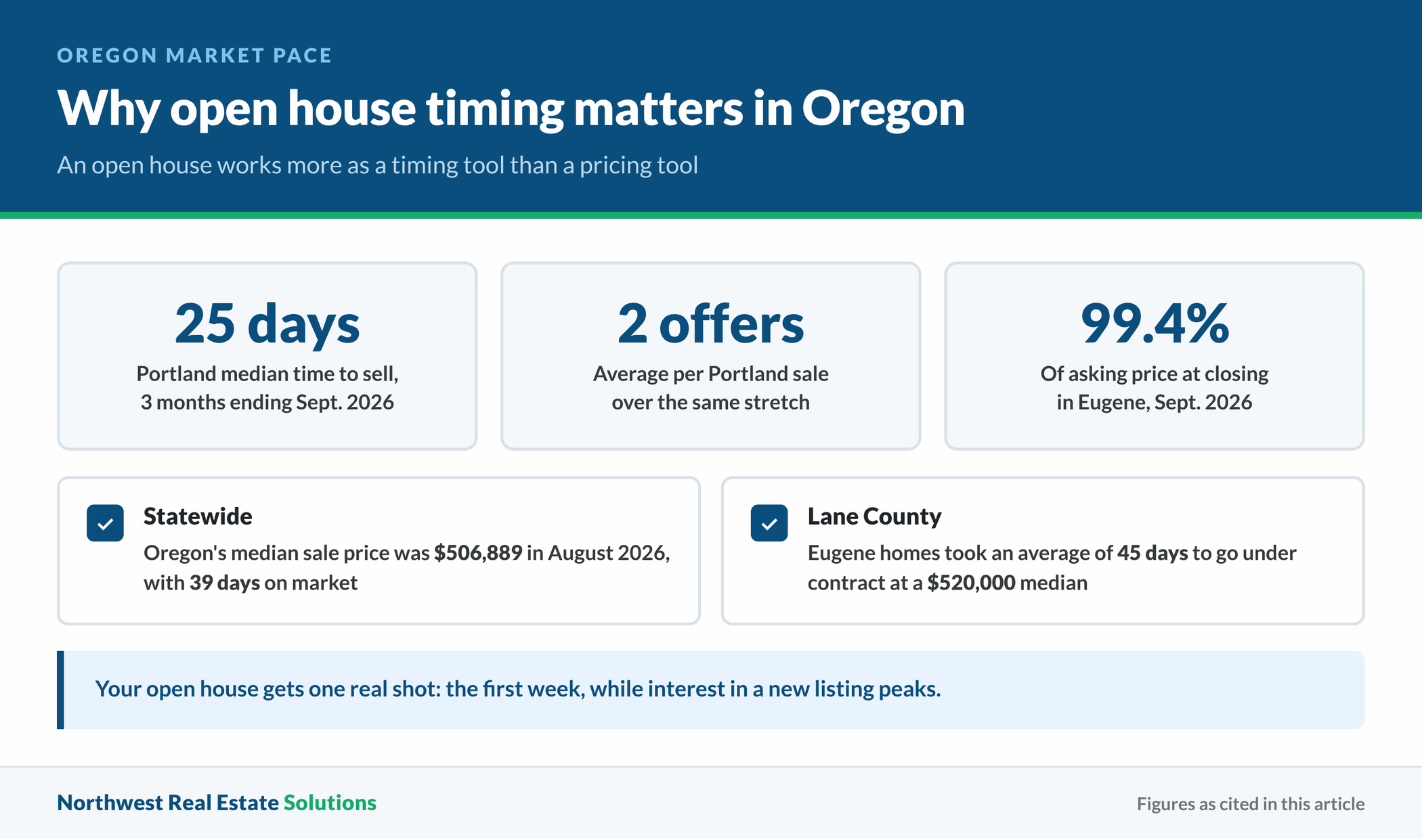
Lane County tells a slower story. Eugene posted a median sale price of $520,000 in September 2026, took an average of 45 days to go under contract, and sellers closed at 99.4 percent of asking. When homes sell that close to list, the open house isn’t pushing your price up. It’s shortening the calendar.
Two numbers, one conclusion: in a market where most well-priced properties go pending inside six weeks, I’ve seen that an open house works more as a timing tool than a pricing tool. Sellers who hope a crowded Sunday will rescue an inflated list price are hoping against the statistics.
When Is an Open House Most Likely to Pay Off in Oregon?
Springfield is the clearest example I can point to: homes there averaged 43 days on market in September 2026, and 59.4 percent of homes sold within 30 days at a median of $478,500. That’s a market with real buyer volume at an attainable price point. Open houses perform best exactly there.
Price band drives most of it. Homes below the regional median draw first-time buyers, and first-time buyers browse on Sundays. They’re earlier in the process, less likely to have a buyer’s agent already, and more willing to wander through four houses in an afternoon.
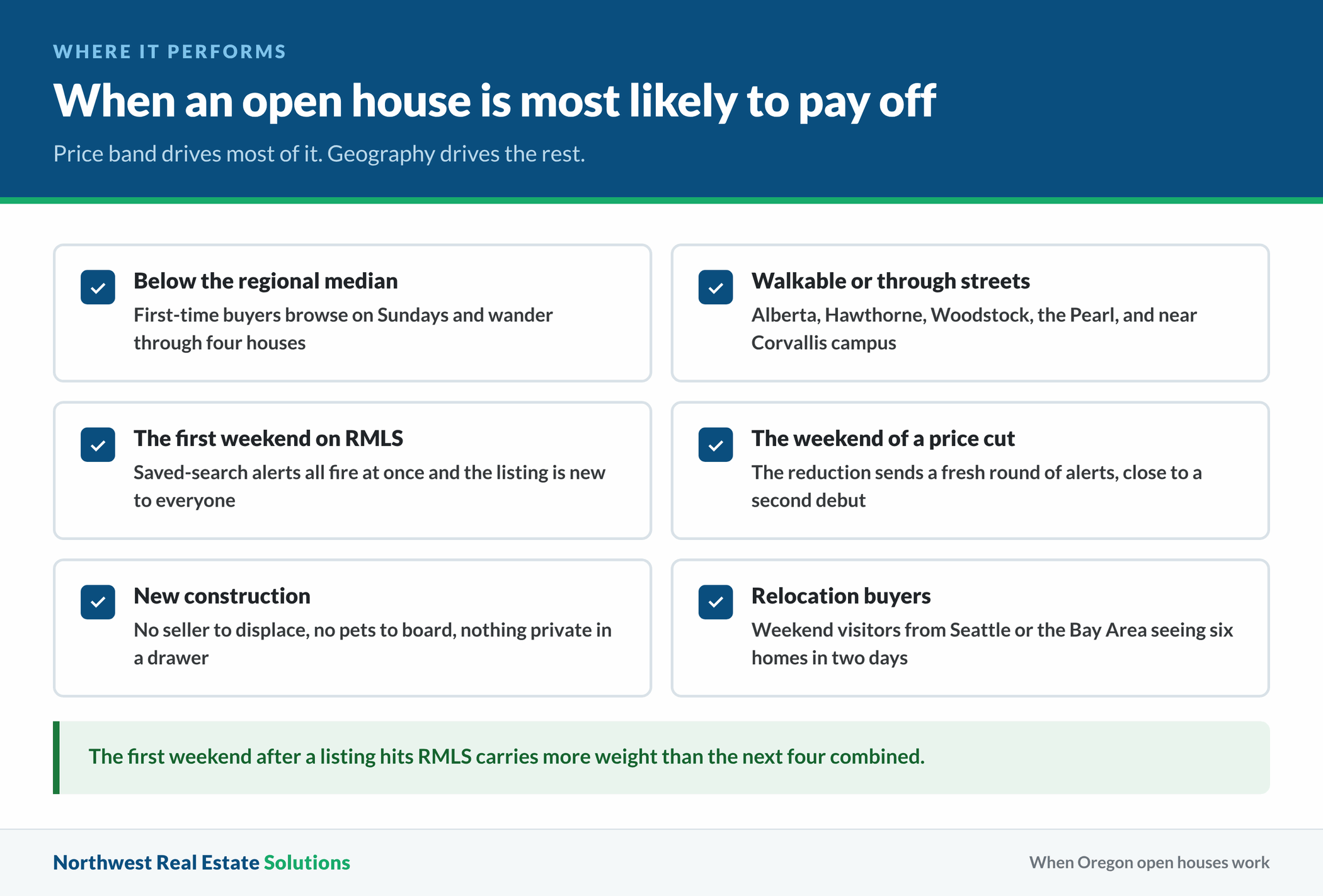
Geography drives the rest. A house on a through street in Alberta, Hawthorne, or Woodstock gets drive-by traffic all day. Condos near the Pearl District and bungalows within walking distance of Corvallis campus life both benefit, since the target buyer is already in the neighborhood on foot. Compare that to a ten-acre parcel outside Sweet Home, where the only visitors are the ones who planned the trip a week in advance.
Timing matters more than marketing strategy advice usually admits. The first weekend after a listing hits RMLS carries more weight than the next four combined, because the saved-search notifications all fire at once and the property is new to everyone.
A second moment is worth using, and sellers often miss it. If you take a price reduction after a few quiet weeks, the reduction itself kicks a fresh round of alerts out to saved searches. Pairing that adjustment with an open house the same weekend gives the listing something close to a second debut, and in my experience it’s far more effective than dropping the price quietly and waiting.
New construction is the other reliable case. Builders in Hillsboro and Redmond run standing weekend hours for a reason: there’s no seller to displace, no pets to board, and no private information sitting in a desk drawer.
Relocation buyers deserve a mention too. People moving from Seattle or the Bay Area often fly in for a single weekend and want to see six properties in two days with no appointments.
Are There Reasons to Skip the Open House in Oregon?
Open the doors, fill the house, and collect offers. That’s the sequence in theory. In practice the sign-in sheet fills with three neighbors, a couple who is eleven months from pre-approval, and one person who wanted to see the remodel because they grew up on the block.
Occupied rentals are the clearest skip. Oregon tenants have a right to quiet enjoyment of the home they’re renting, and parading thirty strangers through someone’s living room on a Saturday builds resentment fast. Cooperation from a tenant is worth more to your sale than one afternoon of traffic.
Privacy concerns are legitimate and get waved off too often. Strangers open medicine cabinets. They photograph layouts. People going through a divorce, an estate settlement, or a health crisis frequently don’t want the whole neighborhood touring the house while they sort through what to keep. If a divorce is behind the sale, here’s our guide to selling your Portland home during divorce.
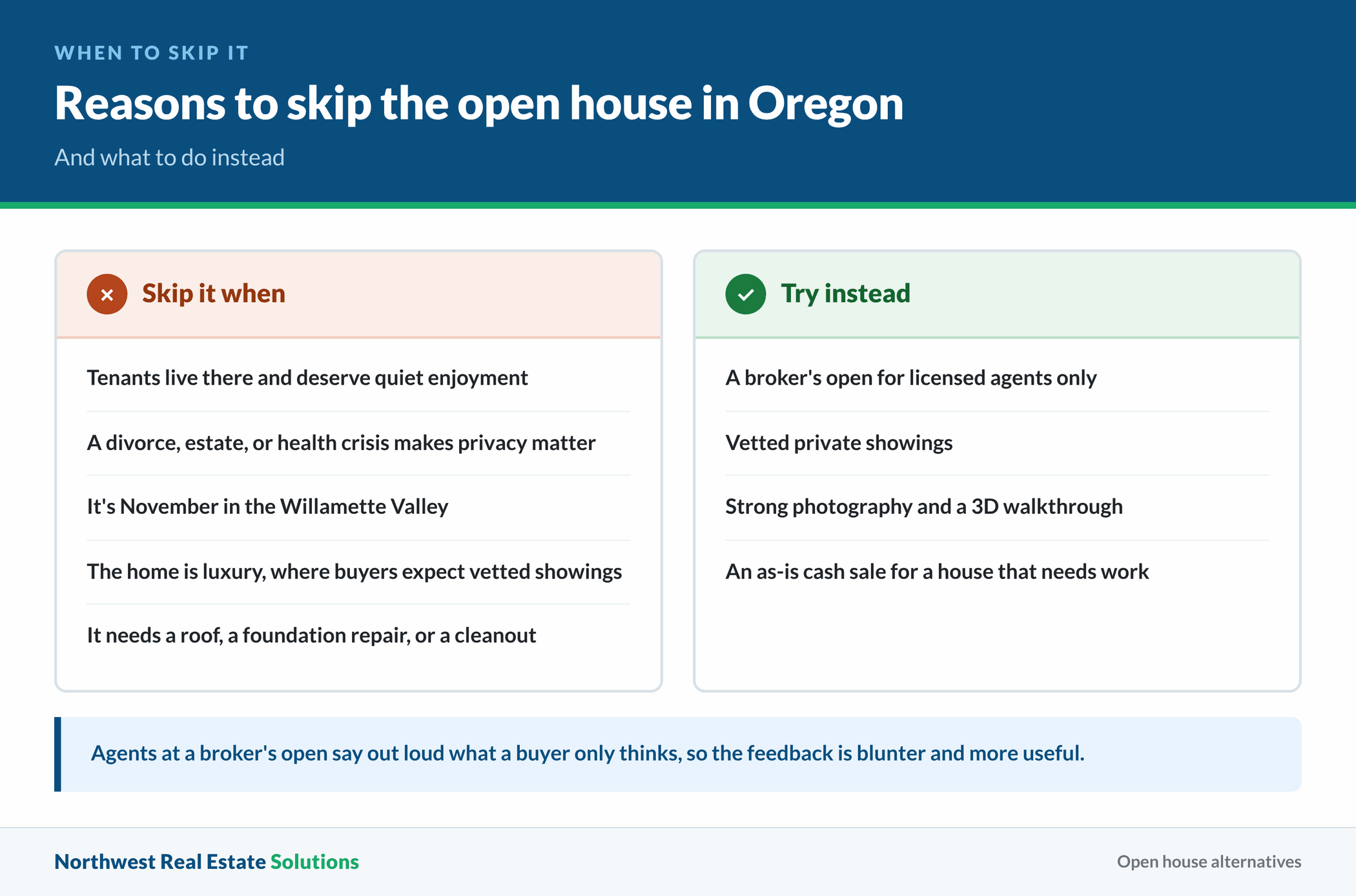
Buyers here weigh weather more than in Phoenix or Dallas. A November open house in the Willamette Valley means wet floors, muddy entries, and daylight fading by four. Inclement weather doesn’t just reduce attendance; it puts your property in its worst possible frame.
If you want the exposure without the public, ask about a broker’s open instead. It’s a weekday hour or two for licensed agents only, with no sign-in sheet full of neighbors, and the people walking through are the ones with buyers already in their pipeline. The feedback tends to be blunter and more useful, too, because agents will say out loud what a buyer only thinks.
Luxury properties follow their own logic. Sellers of luxury homes in Dunthorpe, Lake Oswego, or on the west side of Bend typically prefer vetted private showings to open attendance, and the buyer pool at that level expects it.
Condition matters just as much. If your property needs a roof, a foundation repair, or a full cleanout, marketing it to retail buyers can cost you months and leave you negotiating repairs anyway. Selling as-is for cash is arithmetic, not surrender, and a direct buyer like Northwest Real Estate Solutions will give you a number on the house as it stands. Worth noting on the cost side: Oregon has no statewide transfer tax, and Washington County is the only county that charges one, at a dollar per thousand of sale price.
Open House Tips for Oregon Sellers: How Do You Make It Count?
Price it right and the open house is a formality; price it wrong and you’ve organized a petition drive against your own listing.
That’s what I’d say sitting across a kitchen table, and everything else is detail. Still, the details separate a productive Sunday from a wasted one.
You won’t find a bigger lever than light in this state from October through April. Every lamp on, every blind up, every burned-out bulb replaced the day before. Grey sky through a dirty window reads as gloom, and gloom reads as expensive.
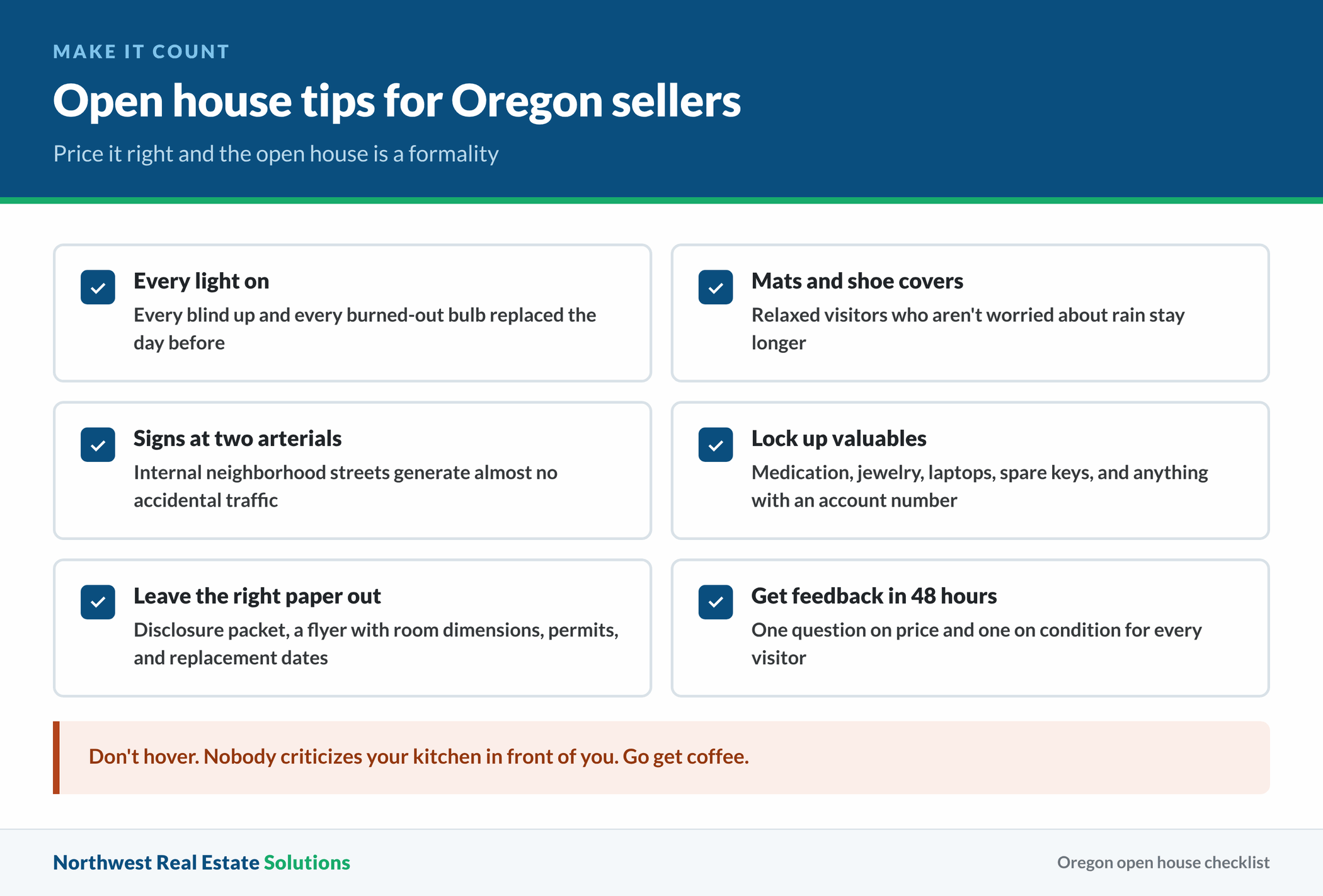
Put a mat and a basket of shoe covers at the door, and put a second mat inside it. Visitors relax when they aren’t worried about tracking rain across your floors, and relaxed visitors stay longer. Directional signs belong at the nearest two arterials, not just on your own corner, because in every house I’ve bought, internal neighborhood streets generate almost no accidental traffic.
Lock up what shouldn’t be seen and leave out what should. Medication, jewelry, checkbooks, laptops, spare keys, and anything with an account number go in a locked closet or in your car. On the counter, leave the disclosure packet, a flyer with room dimensions, recent permit records if you pulled any, and a short list of what you’ve replaced and when. Buyers remember a furnace with a date on it. Skip the elaborate snack spread; a stack of flyers people actually take home does more work than a cheese tray.
Ask your listing agent what the advertising plan looks like beyond the MLS field. Are there targeted social ads for buyers searching your ZIP code? Is a Matterport walkthrough already live? An email to every agent who showed a comparable property in the past month? Open houses that get promoted perform; from what I’ve seen, open houses that just get posted don’t.
Feedback is the underrated output. A good host asks every visitor one question about price and one about condition, then reports back within 48 hours. Six people saying the third bedroom feels small is market price information you can act on, and it arrives weeks before a price reduction would have.
One mistake I see constantly: sellers who hover. Nobody criticizes your kitchen in front of you, so nobody tells you the truth. Go get coffee.
What Open House Advice Should Oregon Buyers Follow?
Walk into an open house without a pre-approval letter and you’ll lose the house to the person who brought one, usually by Tuesday.
Everything else flows from that. The agent greeting you at the door works for the seller, and anything you say about your budget, your timeline, or how much you love the backyard travels straight back to them. Friendly is fine. Candid is costly.
Use the visit for the things photos can’t carry. Does the crawlspace smell like moisture? How much moss has settled on the north slope of the roof? Are there hairline cracks at the basement corners in an older Portland four-square? Run the shower. Open the electrical panel door and look for a fuse box or an old aluminum setup.

Check the things you’ll live with daily and nobody photographs. Where is a second car park on a narrow Northeast Portland street? How loud is the furnace when it kicks on? Whether the upstairs bathroom still has pressure when the kitchen tap runs. If a neighbor is out front, talk to them for two minutes; they’ll tell you about the drainage, the traffic, and the last owner’s remodel faster than any disclosure form.
Ask what the days-on-market number looks like, and ask whether there have been price adjustments. Both answers are public, both are useful, and the host will usually just tell you.
The seller’s property disclosure deserves ten real minutes of your attention, not a glance. Prior water intrusion, a roof replaced without permits, an underground oil tank: those show up in writing, and an underground tank is common enough in older Oregon neighborhoods that it should be the first thing you look for.
Don’t sign a buyer representation agreement at the door because someone hands you a clipboard. You can like an agent and still take a day to read the contract before you’re bound to it.
If you’re a serious buyer in a tight market, go back a second time on a weekday. Traffic noise, afternoon light, and the neighbor’s dog all behave differently when there isn’t a crowd in the house.
Virtual Open Houses vs In-person Open Houses: Which Works Better in Oregon?
Virtual tours beat in-person open houses for most Oregon listings, and the gap isn’t close.
Nearly every buyer starts online now, and a Matterport scan runs 24 hours a day in every time zone. Buyers in Seattle, Sacramento, and Bend are touring your house at 11 p.m. without anyone unlocking a door. For relocation buyers, and Oregon gets plenty of them, the virtual tour is the first showing, and it’s sometimes the only one before an offer.
In-person still wins on the things a camera flattens. Smell, sound, slope, and light. A scan won’t tell you the house sits ten feet below the street and the driveway ices over in January, or that the “quiet” street feeds a school pickup line at 3 p.m.

The practical answer is that they do different jobs. The virtual tour filters. The open house converts. Listings that lead with strong photography and a 3D walkthrough tend to draw better-qualified open-house traffic, because the people who show up already know the floor plan and came to confirm a decision rather than browse one.
Where virtual pulls clearly ahead: rural listings outside Medford or Pendleton where the buyer pool is scattered, luxury properties where the seller doesn’t want strangers in the house, and winter listings when turnout drops anyway.
In-person pulls ahead with condos and townhomes under the median price, anything in a walkable Portland neighborhood where foot traffic is real, and homes where the main selling point is a feeling rather than a feature. Nobody buys a 1920s bungalow off a scan.
If you’re choosing where to spend money, spend it on the scan and the photography first. That’s the asset working as you sleep, costing you one afternoon of preparation instead of every weekend for a month.
Frequently Asked Questions
Are open houses required to sell a house in Oregon?
No. Open houses are a marketing choice, not a legal or MLS requirement. Many Oregon homes sell on scheduled private showings alone, especially in tighter inventory markets.
Do open houses actually sell homes?
Rarely to the person who walks through the door. Roughly a small single-digit percentage of buyers purchase the home they found at an open house. The real value is accelerated exposure, agent awareness, and honest pricing feedback in the first two weeks.
Is it safe to hold an open house?
With precautions. Lock up medication, jewelry, mail, spare keys, and anything with account numbers on it. Require sign-ins, keep a second person in the house when possible, and tell a neighbor it’s happening.
Should I go to an open house without an agent?
You can, but get pre-approved first and understand the host represents the seller. Nothing stops you from looking. Just don’t negotiate against yourself at the kitchen island.
When is the best time to hold an open house in Oregon?
Sunday between noon and 3 p.m. performs most consistently; ideally, on the first or second weekend, the listing is live. Avoid holiday weekends, Ducks and Beavers home games, and the first genuinely sunny Saturday in May.
Do I have to leave during my own open house?
Yes. Buyers won’t speak freely with you there, and you’ll lose the feedback that makes the whole exercise worthwhile.
If you’re weighing whether an open house makes sense for your situation, it’s worth talking through with someone who knows how your specific neighborhood behaves. No pressure either way, and no obligation to list. Sometimes the honest answer is that your house will sell fine without one.
We Buy Houses in Portland and Across Oregon
Portland is our home market, and the metro has more homes competing for each buyer than it did a year ago. RMLS put Portland metro inventory at 3.8 months in August 2026, up from 3.5 months a year earlier. With more listings to choose from, buyers can afford to skip an open house that doesn’t look worth the drive.
We’re cash home buyers in Portland, and we buy houses across the metro and the rest of the state. West of the city, we’re investor home buyers in Beaverton. Down the valley, we buy houses in Corvallis. You can see every area on our “We Buy Houses in Oregon” page.
Skip the Open House and Get a Cash Offer
If your house needs work, has tenants in it, or you’d rather not have strangers walking through, you don’t need an open house to sell. Northwest Real Estate Solutions will walk the property once, on your schedule, and give you a cash offer in writing. Compare it to your net from a listing and choose what fits.
Have more questions first? Check out other frequent questions. When you’re ready, fill out our quick contact us form or use the short form below.
Helpful Oregon Blog Articles
- Who Is Responsible For HOA Fees At Closing In Oregon
- Guide To Oregon Inheritance Laws
- Paperwork For Selling Your Oregon Home by Owner
- Understanding Squatters’ Rights In Oregon Real Estate
- How To File A Quitclaim Deed For Real Estate In Oregon
- Homeowners Insurance When Selling a House in Oregon
- Can You Sell a House with Asbestos in Oregon
- How to Sell a House with Mold in Oregon
- Can the Seller Back Out of a Contract in Oregon?
- How Much Equity Do I Need to Sell My House in Oregon?
- Taxes When Selling an Inherited House in Oregon
- Do Open Houses Still Work When Selling a Home in Oregon?
- How to Sell a House with Flood Damage in Oregon