
Thirty days is the floor. That’s not the average or what you should plan around. It’s the absolute fastest an uncontested case can move. Most landlords I talk with in Washington are shocked when I say the realistic window is closer to two months, and that’s before anybody files a single defense. Statutory clocks govern the eviction process here, and nobody can shorten them, so knowing those clocks is the difference between a plan and a prayer. I’ve bought houses from landlords who were burned out by exactly this. Let’s walk through what the timeline really looks like across Washington.
What Legally Counts as Eviction in Washington?
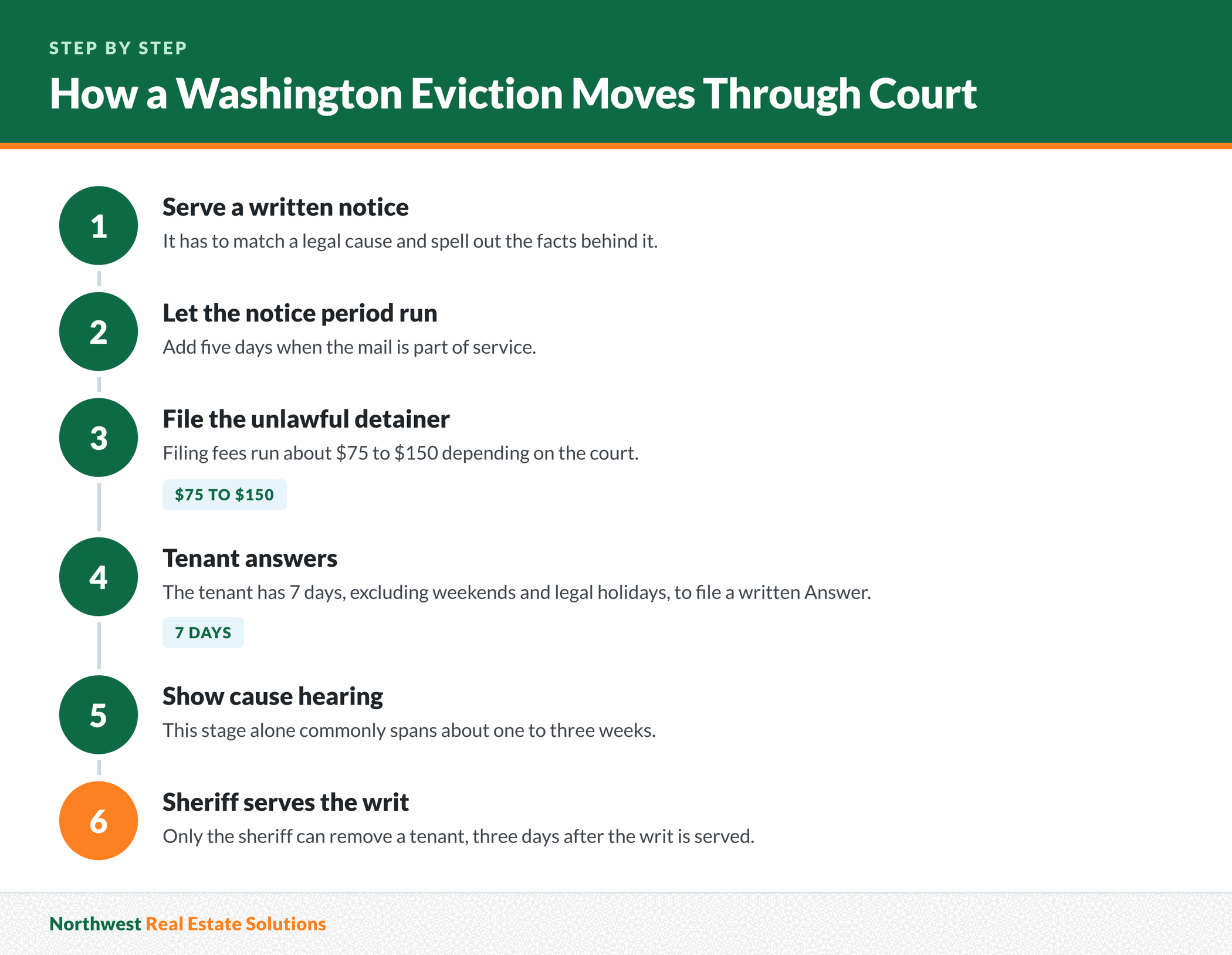
Three days is the shortest notice period in the whole book, reserved for waste, nuisance, or unlawful activity. Even then, nobody’s out in 72 hours. Washington’s summary eviction proceeding is the unlawful detainer action, filed in Superior Court and governed jointly by the general unlawful detainer statute, RCW 59.12, and the Residential Landlord-Tenant Act, RCW 59.18. Nothing else counts. A text telling a tenant to leave isn’t the eviction process, and neither is a talk on the porch.
Self-help has no place here. I’ve watched owners in Spokane and Vancouver torch their own cases by trying it. Changing locks, shutting off utilities, removing belongings, or physically removing a tenant is illegal under Washington law. The moment you do it, your eviction process stops being about unpaid rent. It becomes about what you did.
So what does the law actually recognize? A written notice matching a legal cause, then a lawsuit, a court ruling, and a sheriff. That’s the chain. Skip a link and it breaks.
A few years back a young couple in Bothell called me while they were clearing out a parent’s rambler, the one with a carport full of half-finished garden beds. Mom had just moved into assisted living. They’d inherited a tenant along with the house and figured they could just ask him to leave, since the family needed to sell. They couldn’t, and finding that out mid-cleanout changed their whole plan.
Washington treats possession of a home as a legal status, not a courtesy. That framing is why the eviction process takes as long as it does.
Can a Washington Landlord Evict Without Cause?
No, and I know that’s not what most owners want to hear when they’re sitting at the kitchen table with a stack of unpaid rent notices. Under RCW 59.18.650, effective 2021, landlords in Washington cannot evict tenants without one of 16 specifically listed just causes. Those include nonpayment of rent, lease violation, owner-occupancy, substantial renovation, and sale of the property. The protection applies at lease end too, so a landlord can’t refuse to renew without just cause.
That shield covers month-to-month tenancies as well. Since 2021, a Washington landlord can’t simply decline to renew a month-to-month tenancy, so a periodic tenancy ends only for one of the causes listed in the statute. You can read the full statute on the Washington State Legislature site.
This is where sellers in Washington get tangled up. Selling a tenant-occupied single-family home counts as a recognized cause, but it carries one of the longest notice periods on the list. Owner or immediate-family move-in, or the owner’s sale of a single-family residence, requires 90 days’ written notice. That’s three months of waiting before you can even file.
My opinion, and plenty of agents disagree: most Washington owners shouldn’t try to hand a vacant house to a retail buyer while a tenant is still in place. You’re betting a 90-day clock against a market that shifts. Selling with the tenancy intact to an investor skips the eviction process entirely. It’s one reason folks reach out to Northwest Real Estate Solutions when the math on waiting stops working.
You also have to spell out the cause. The notice must identify the facts and circumstances known to the landlord, with enough detail that the tenant can respond and prepare a defense. Vague notices get tossed, and you start over.
What Notice Periods Apply Before Eviction in Washington?
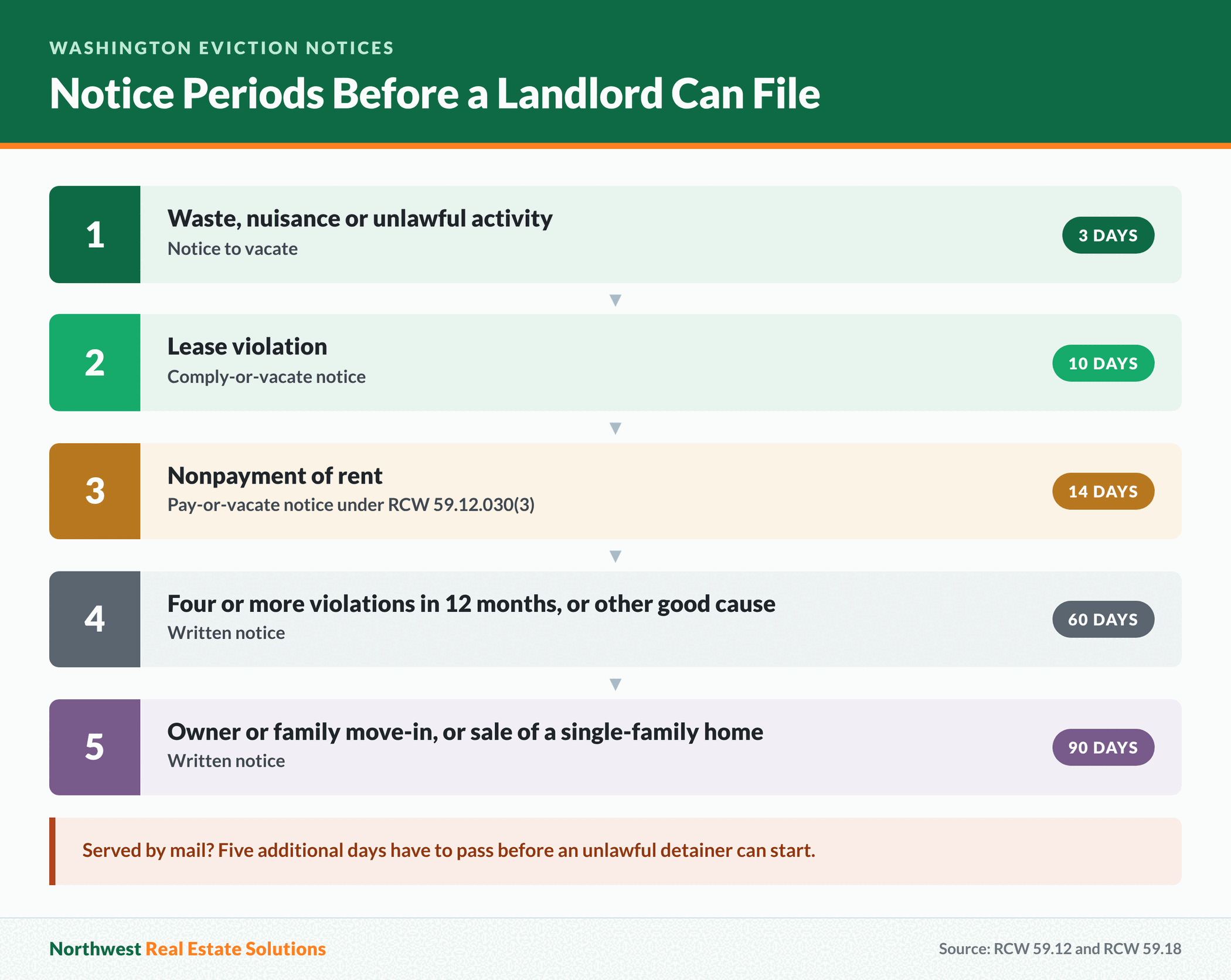
Every eviction process in Washington begins with one of these clocks ticking. As of 2026, nonpayment of rent requires a 14-day pay-or-vacate notice under RCW 59.12.030(3). A lease violation requires a 10-day comply-or-vacate notice. Waste, nuisance, or unlawful activity requires a 3-day notice to vacate.
In a nonpayment case, those first fourteen days matter more than anything else. Paying the total amount due within those 14 days defeats an unlawful detainer. Tenants who can scrape the money together should know that window exists.
Longer notices attach to no-fault grounds. Four or more lease violations within 12 months, or other good cause, requires 60 days’ written notice. Add that to a court schedule and your eviction process in Washington turns into a seasonal project, not a monthly one.
Service is where good cases die. Washington allows personal delivery, substitute service on a person of suitable age plus mail, or conspicuous posting plus mail. When the mail piece is used, five more days have to pass before an unlawful detainer action may be commenced. The mailing must be posted from within Washington state.
Five extra days sounds small. It isn’t, once you’ve already waited two weeks.
Local ordinances pile on extra rules. Seattle, Tacoma, and other Washington cities may require longer notice periods or added steps. Before you serve anything in a Washington city with its own ordinance, check the local rule with your city’s renting-and-housing office, because guessing wrong costs you the whole notice period twice.
How Long Does Each Step of the Eviction Process Take?
A landlord in Puyallup called me in August, three months into a nonpayment case, convinced the courthouse had lost his file. It hadn’t. He was simply living inside a timeline nobody had explained to him.
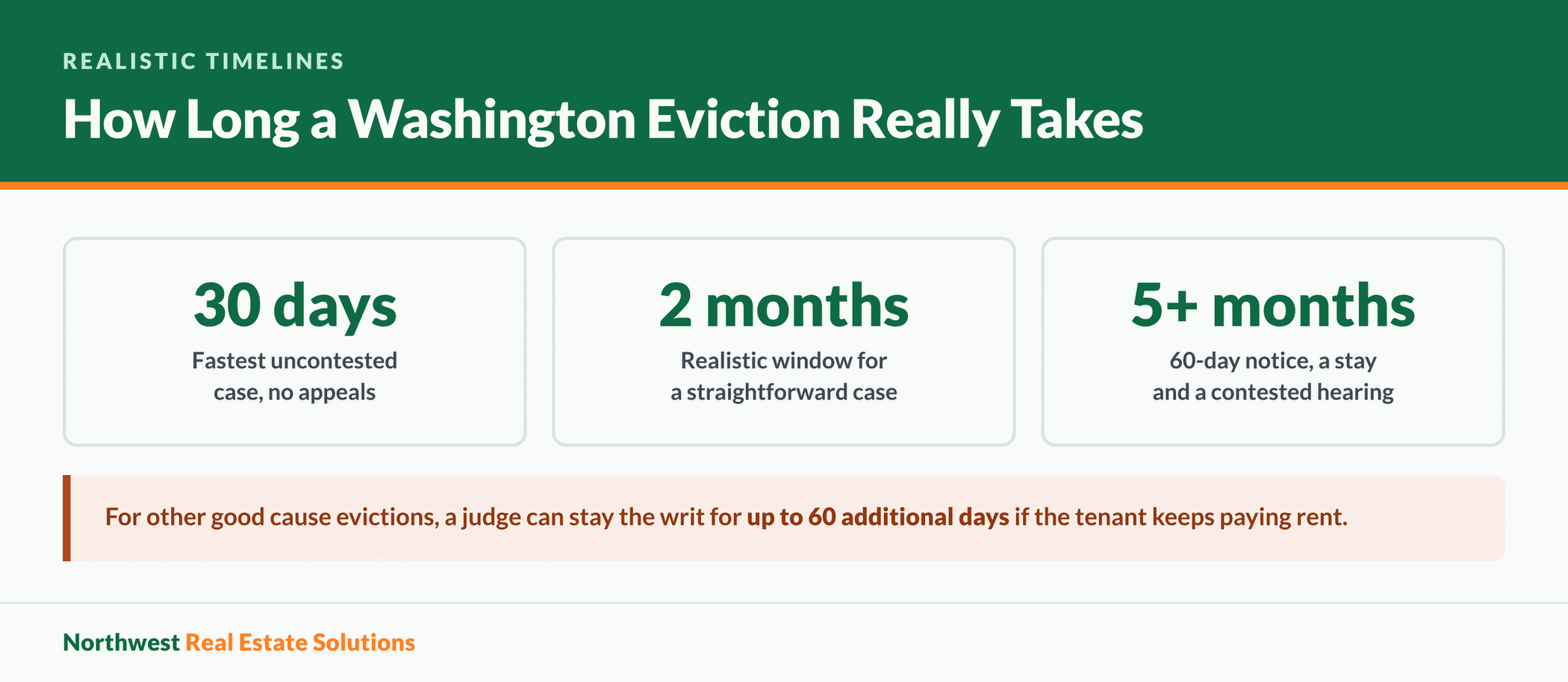
Add up the pieces and the picture gets honest fast. Uncontested cases in Washington typically move through the courts fairly quickly from notice to sheriff’s lockout. The minimum realistic timeline, with everything uncontested and no appeals, runs roughly 30 days. Once the notice expires and the unlawful detainer lawsuit is filed, the court phase usually takes another two to four weeks.
The response window is short and strictly counted, so there’s little room to waste time. A tenant has 7 days, excluding weekends and legal holidays, to file a written Answer to the unlawful detainer with Superior Court. Hearings keep their own rhythm. If you request a show cause order, the hearing happens only after it’s served, with notice time required.
Then comes the final piece, the one that surprises people who thought the ruling was the end. Only the sheriff can remove a tenant, and that happens three days after the writ is served.
Filing isn’t free, either. An unlawful detainer action in Washington Superior Court or District Court runs about $75 to $150 in filing fees, depending on the court. Attorney time dwarfs that.
Which would you rather have: sixty days of legal process with no rent coming in, or a closing date? That’s the real question behind most eviction process calls I take from Washington owners.
How Do Court Delays Affect the Eviction Process Timeline?
For years I told owners that a clean case moves on schedule. I was wrong about how often “clean” survives a courthouse calendar.
Court congestion varies across Washington counties, and the eviction process bends around whatever the local docket allows. The show-cause hearing stage alone commonly spans about one to three weeks. King County Superior Court in downtown Seattle runs a different volume than a rural eastern Washington docket, and your case inherits that difference.
Defective paperwork causes sellers the worst delays. A process that started with an improperly served notice is one of the most common reasons Washington cases get dismissed and restarted. Dismissal doesn’t mean you lost for good. It means you’re back at day one with a tenant who now knows the drill.
Washington judges also have explicit power to slow things down. When a landlord relies on the “other good cause” ground, the court may stay a writ of restitution for up to 60 additional days for good cause shown, including trouble procuring alternative housing. That stay must be conditioned on the tenant continuing to pay rent during the stay period.
Stack a stay on top of a 60-day notice and a contested hearing, and an eviction process in Washington can run past five months.
Meanwhile the market keeps moving without you. Washington’s statewide trailing median sold price sat at $612,000 as of October 2026, with the median active listing price at $649,000. Carrying costs during a drawn-out eviction process eat real equity.
What Can Tenants Do to Fight an Eviction in Washington?
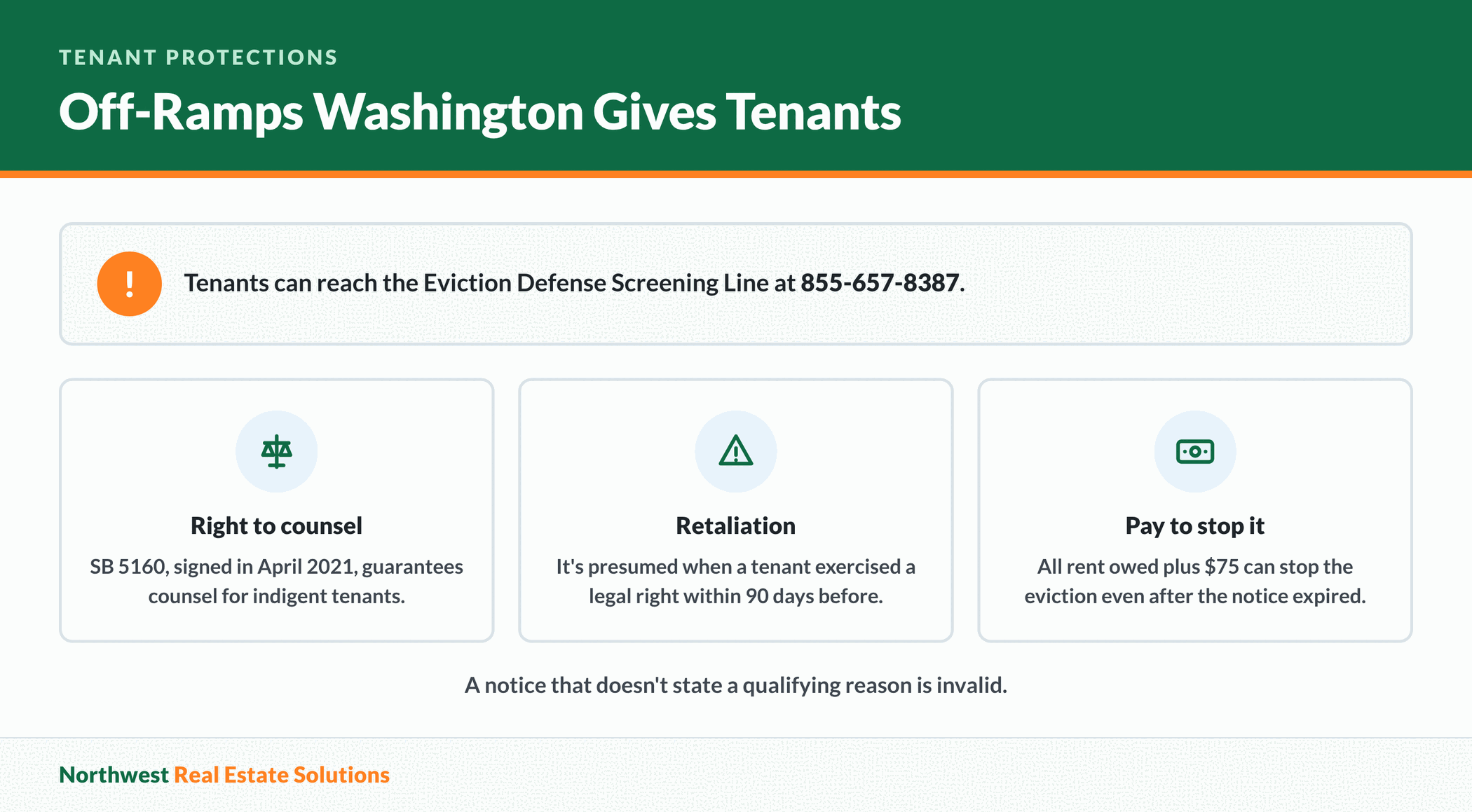
“My tenant won’t have a lawyer, so this should be quick.” I hear that a lot, and it’s been wrong in Washington for years now. The governor signed SB 5160 in April 2021, making Washington the first state to guarantee counsel for indigent tenants in eviction cases. Full statewide rollout put more than 60 attorneys into full-time defense of tenants in unlawful detainer proceedings across every corner of Washington.
Representation changes outcomes, and it stretches timelines. Tenants reach it through a single statewide door: the Eviction Defense Screening Line at 855-657-8387, or an online application through the Northwest Justice Project. Eligibility details are laid out at WashingtonLawHelp.
Defenses aren’t just delay tactics, either. Say a tenant exercised a legal right, like reporting code violations, organizing with other tenants, or asking for repairs, within 90 days before the eviction. Then retaliation is presumed. And when a notice doesn’t state a qualifying reason, or the reason given doesn’t qualify, the notice is invalid.
Money can end a case late in the game. A tenant can pay all rent owed plus $75 to stop the eviction, even after the notice has expired.
Landlords reading this should take the hint. Washington built its eviction process to give tenants real off-ramps, and every off-ramp is also a calendar entry for you.
What Happens After an Eviction Judgment Is Issued?
“So we won, when do we get the keys?” Not that day.
Winning gets you an order, not an empty house. After the court hearing on issuance of the writ of restitution, the sheriff serves the writ if the court rules for the landlord. To get that writ, a landlord must first obtain an order setting a show cause hearing, a summary proceeding where the superior court evaluates the case. The three-day wait after service follows. Only then does a deputy show up.
Belongings add another layer. Washington mandates 45 days’ written notice to the tenant’s last known address before disposing of property left behind. Owners planning a quick turnaround rarely budget for that.
Then there’s the part nobody photographs for the listing: the condition of a unit after a months-long eviction process. I’ve walked through units with deferred maintenance, a furnace that quit in January and carpets past saving, all at once. You end up deciding whether to pour $30,000 into a rental you’ve grown to resent.
Selling as-is after an eviction process concludes is a legitimate choice, not a surrender. Washington’s county markets price that decision differently. Snohomish County showed a median sold price of $697,000 with 26 median days on market in October 2026. Clark County came in at $530,700, up 10.1% year over year as of October 2026.
Run the numbers on holding costs plus repairs versus a direct sale. The answer usually shows up inside an hour.
Where Can Washington Landlords and Tenants Get Eviction Process Help?
A tenant in Bellingham got a 14-day notice on a Tuesday and assumed she’d be out by the next week. One call to a screening line later, she had a lawyer, a payment plan, and a lease she got to keep.
Free legal help exists on both sides of the eviction process in Washington, and people underuse it. Several organizations provide free legal help, tenant advocacy, and eviction defense services to protect housing rights, and the Washington State Housing Finance Commission keeps that list. CLEAR can be reached by dialing 211 in King County, 1-888-201-1014 outside King County, or 1-888-387-7111 for seniors age 60 and over.
King County renters have a dedicated program. The Housing Justice Project, run through the King County Bar Association, provides free legal representation for income-eligible renters facing eviction. Landlords, your county clerk’s office can confirm current filing requirements and courtroom procedures, which really do differ from Thurston to Yakima.
Washington courts publish plain-language guidance too. The Washington Courts self-help “Eviction” page covers termination notices, the court process, defenses, and illegal lockouts or utility shutoffs, and you’ll find it through courts.wa.gov.
A man called me on a Wednesday afternoon from Gig Harbor. He’d been quietly covering two mortgages for close to a year. The second was on a duplex with a tenant who’d stopped paying the winter before. His wife had no idea how deep it had gotten. What he needed wasn’t an eviction process lecture. He needed somebody to run numbers with him at a kitchen table and lay out the exits honestly. We did both, and the talk about his duplex took twenty minutes.
For owners weighing whether to finish an eviction process or sell the property and be done, talking to a buyer who works in Washington every week costs nothing.
Frequently Asked Questions
What Does It Take to Evict Someone in Washington State?
You need a legal cause from the just-cause statute and a written notice matching that cause and stating the specific facts behind it. After that come properly completed service, an unlawful detainer lawsuit in court, and a judge’s order. Then the sheriff handles the physical removal. The eviction process in Washington doesn’t allow shortcuts at any of those stages, and trying one usually hands the tenant a defense.
How Long Does It Typically Take to Evict a Tenant?
Plan on roughly two months for a straightforward, uncontested case in Washington, counted from the day you serve notice to the day the sheriff completes the lockout. The fastest possible path runs about half that. It assumes flawless paperwork, no tenant response, and a court calendar with room. Any contested defense, service defect, or judicial stay pushes an eviction process well past that.
How Long Does an Apartment Eviction Last on Your Record and in Court?
In court, apartment cases follow the same eviction process timeline as single-family rentals in Washington, since the statute doesn’t distinguish by property type. Larger Washington complexes often keep counsel on retainer, so filings happen faster after a notice expires. On the record side, a filed unlawful detainer can surface in tenant screening for years. That’s exactly why resolving things before a filing is worth real effort.
Can My Landlord Evict Me If I Have Nowhere Else to Go?
Having nowhere to go doesn’t stop a Washington eviction process on its own, but it isn’t meaningless either. Under one of the no-fault grounds, a judge can delay a writ for extra time when you show good cause, including trouble finding housing. That delay is conditioned on you keeping up with rent. Call the statewide eviction defense screening line as soon as you get court papers, because a free attorney can raise defenses you’d never find alone.
Does a Pending Eviction Process Stop Me From Selling My Rental in Washington?
Not at all. Plenty of Washington owners sell mid-case, and investors buy tenant-occupied property all the time. Sometimes they take over the case, and sometimes they negotiate a cash-for-keys resolution instead. Selling often ends up faster and cheaper than finishing the eviction process yourself, especially once you count lost rent, attorney fees, and repairs on the back end.
If you’re a Washington landlord staring down an eviction process you never wanted, we’re glad to talk it through. The same goes if you’ve already been through one and the house just doesn’t feel worth the fight anymore. You can reach us at Northwest Real Estate Solutions, get straight answers about your options, and decide on your own timeline. No pressure, no obligation, and no hard feelings if you decide to keep it.
Selling a Tenant-Occupied Home in Vancouver
Zillow shows Vancouver homes going pending in around 24 days, while an eviction can take two months or longer. That gap is why Vancouver landlords often sell with the tenant still in place instead of waiting on the court calendar.
We buy houses in Washington as-is, including rentals with tenants still living in them, so you don’t need to make repairs first.
Talk Through Your Rental Situation
If you’re weighing an eviction against a sale, contact our team or fill out the form below. We’ll make you a fair cash offer, and you’re free to say no.
Helpful Oregon Blog Articles
- Who Is Responsible For HOA Fees At Closing In Oregon
- How to Find a Realtor in Another State Before You Move
- Who Pays Real Estate Agents in Oregon
- How Much Does an Estate Have to Be Worth to Go to Probate in Oregon
- Can You Cancel a Listing Agreement with a Real Estate Broker in Oregon
- How Long Does an Eviction Process Take in Washington