
A house worth $210,000 in Roseburg can force a family into full court administration. A house worth $195,000 two blocks away might not. That $15,000 gap decides whether an heir files a one-page affidavit or spends most of a year under a judge’s eye. Oregon draws these lines by dollar amount. They don’t care how simple your family situation is. If you’ve just inherited a house and you’re wondering whether probate is headed your way, the number you need is specific.
What Size Estate Goes to Probate in Oregon?
Guess wrong on the threshold and you lose more than time. You can lose the authority you thought you had. An affidavit that turns out to cover an estate above the value limits loses its power, and the estate gets pushed into full probate anyway. A sale you were halfway through can stall right there.
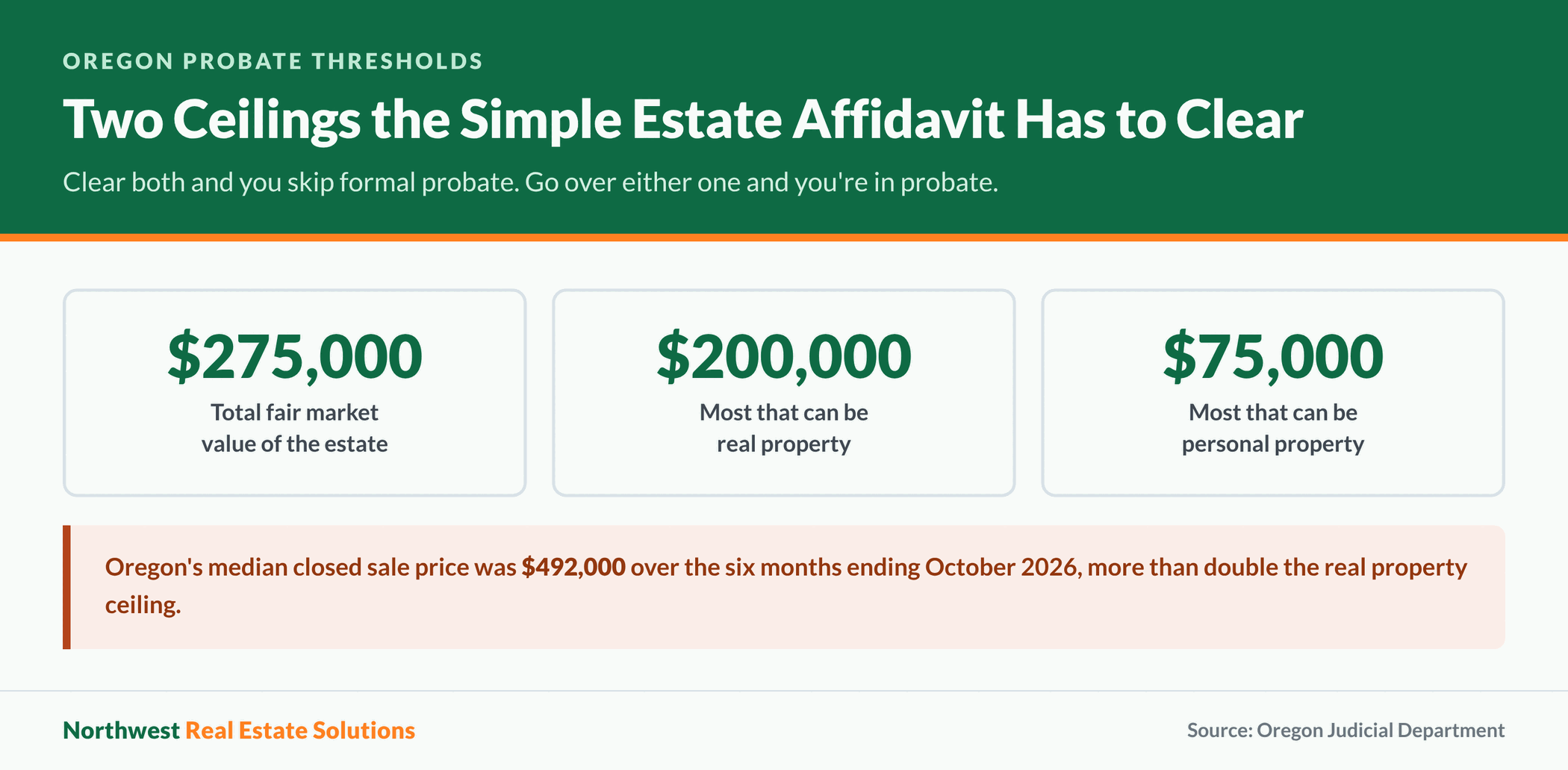
The math itself is simple. Oregon’s shortcut is called the simple estate affidavit, and it has two separate ceilings. The total fair market value of the estate must be $275,000 or less. No more than $200,000 can come from real property and no more than $75,000 from personal property, according to the Oregon Judicial Department. Clear both and you skip formal probate. Miss either one and you’re in probate.
Now hold that up against what Oregon houses list for. Oregon’s median listing price was $549,900 in October 2026, per Oregon listing data from FRED. That puts the typical Oregon home at more than double the real property ceiling on its own. In this state, most inherited houses trigger full probate on the house alone.
Think two columns, not one total. People add everything up, land under $275,000, and assume they qualify. Picture a $190,000 manufactured home in Sweet Home plus $90,000 in bank accounts. That totals $280,000. The house clears the $200,000 real property cap, but the accounts break the $75,000 personal property cap and push the total over $275,000.
One more number matters, though it has nothing to do with probate. Oregon’s estate tax applies to taxable value above $1 million, and the executor must file a return once the gross estate reaches that amount. The Oregon Department of Revenue publishes the data behind it. A paid-off Lake Oswego house plus a decent retirement account can cross that line without anyone feeling rich.
How Long Does the Probate Process Take in Oregon?
For years I told sellers that probate in Oregon ran about three months. The real number is closer to a year. Statute sets the floor, no matter how organized the family is.
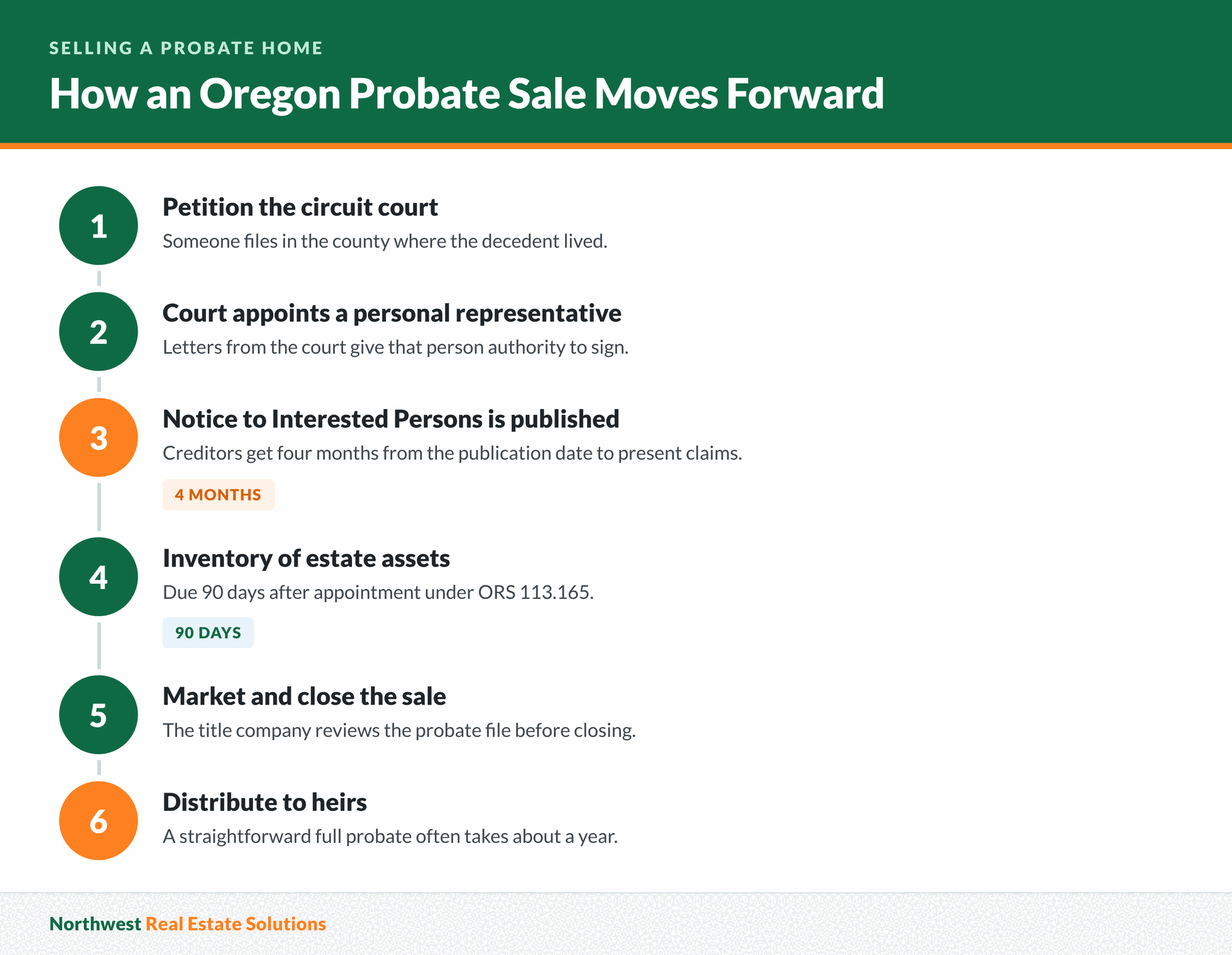
Once a personal representative is appointed, they publish a Notice to Interested Persons in a newspaper in the county where probate is pending. Creditors then get four months from that publication date to present claims. That clock starts at publication, which comes after the petition, after the appointment and after the paperwork clears the circuit court.
Add the practical steps and probate in Oregon rarely wraps up fast. A straightforward full probate often takes about a year. Part of that is personal representatives waiting out the creditor window before they finish distributions.
The simple estate affidavit route moves quicker, but it isn’t instant either. Claiming successors can’t file until at least 30 days after the decedent’s death. The affidavit also carries its own creditor window after filing.
So where does the time go? Mostly scheduling. Picture an heir in Bend waiting on an appraisal, an attorney waiting on a death certificate from the county, and a bank taking three weeks to release account balances for the inventory.
All that waiting has a price tag. Portland-area listings carried a median asking price of $580,000 in October 2026, per the St. Louis Fed’s FRED database. A house worth that much keeps costing the estate taxes, insurance and upkeep every month probate stays open. Heirs who get that stop blaming the agent. They start asking better questions about the court calendar.
I’ve watched families lose an entire selling season to probate paperwork that nobody was pushing.
What Are the Steps to Sell a Probate Home in Oregon?
“Why do I need a lawyer just to sell my own mother’s house?” I hear that one constantly. Until the probate court names someone, nobody has legal authority to sign a deed. Title companies won’t insure a transfer signed by a person who doesn’t hold letters from the court.
It starts when someone files a petition with the circuit court in the county where the decedent lived. The court appoints a personal representative and issues letters, and publication follows. An inventory of estate assets is due 90 days after appointment under ORS 113.165. That’s often when heirs first see the real numbers on paper.
Marketing the property can begin once the personal representative holds authority. Pricing is where probate sales tend to go sideways. An heir in Medford and an heir in Hillsboro will each push for the number that suits them. Meanwhile the house sits while they negotiate with each other instead of with buyers.
Keep paper, not memories. Save receipts for yard work, lock changes, utility bills and insurance premiums paid during probate. Those come back as reimbursable estate expenses at the final accounting.
Closing works like any other Oregon closing, with one extra step: the title company reviews the probate file. Some sales need court confirmation, depending on the will’s language and the authority granted. Your probate attorney should tell you which category you’re in before you accept an offer. That one question can save you weeks.
Sellers who want a single closing date without buyer financing contingencies often reach out to Northwest Real Estate Solutions at this stage. An estate with carrying costs gets nothing from a 45-day loan approval.
Can You Sell a House While It’s in Probate?
Yes, and you should probably start sooner than your family feels comfortable with. I’ve said that to plenty of people at a kitchen table in Gresham, with a stack of unopened mail between us.
Selling during probate is normal in Oregon. The personal representative signs, the estate receives the proceeds, and distribution waits for the court. What you can’t do is sell before appointment, or sell while three siblings argue about whether to sell at all.
Carrying costs are the quiet case for moving. Property taxes keep piling up. Homeowner’s insurance on a vacant house costs more than it did when someone lived there, and standard policies often exclude vacant dwellings entirely.
Outside Portland, the numbers shift but the timeline doesn’t shrink. Lane County’s median listing price was $510,000 in October 2026, nearly flat from a year earlier, per Lane County data from FRED. Listings there sat a median of 68 days that month. An estate property in Eugene or Springfield should plan for about two months on the market once it lists.
Should you list or sell direct? That depends on condition, and on how many heirs need to agree, since more signatures usually bring more opinions about price. A clean three-bedroom in Beaverton with updated systems belongs on the open market. A 1952 ranch in Klamath Falls with a failed foundation and forty years of accumulation doesn’t. List that one anyway and you’ll mostly collect inspection-based price cuts.
Buyers get nervous about probate timelines, so the court’s status comes up in every offer conversation. Being upfront about where you stand in probate weeds out buyers who can’t wait.
Should You Repair a Probate Property Before Selling?
That brings up the renovation question, and my answer tends to disappoint people.
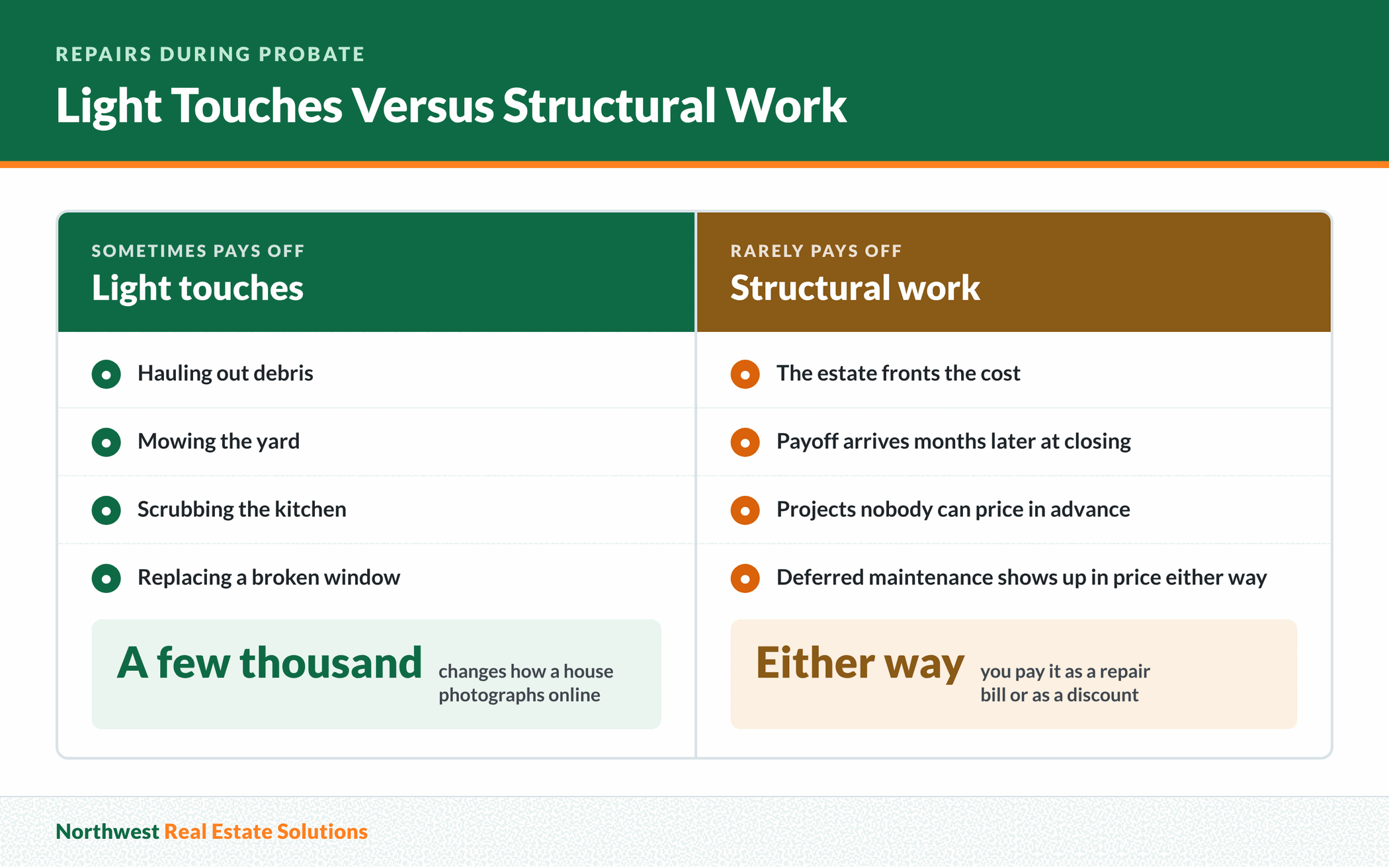
Start with who’s paying. The estate fronts the cost, sometimes out of heirs’ pockets if there’s no cash, and the payoff shows up months later at closing, split among everyone. Meanwhile the personal representative is coordinating contractors for a house they don’t live near.
Light touches can pay off. Hauling out debris, mowing the yard, scrubbing the kitchen and replacing a broken window run a few thousand dollars and change how a house photographs. Oregon buyers shop online first. A dark listing photo full of boxes kills showings before anyone walks through the door.
Structural work rarely pays during probate. Put a new roof on an Astoria house with dry rot in the sheathing and you’ve opened a project nobody can price ahead of time.
Deferred maintenance shows up in the sale price no matter what. You pay for it as a repair bill or you give it back as a discount.
I keep seeing the same thing: families spend six weeks and real money fixing a house, then accept an offer close to what they’d have gotten as-is.
Oregon’s older housing stock makes this sharper than it would be in a newer state. Think knob-and-tube wiring in a Sellwood bungalow, oil tanks buried in Northeast Portland yards and septic systems in rural Josephine County that predate current standards. Those are disclosure items. Probate sellers in Oregon get some relief there, because a personal representative who never lived in the property usually can’t speak to its condition.
What Does a Probate Sale Cost in Oregon?
Probate costs less than people fear and takes far longer than they guess. The dollars are rarely the real problem.
Court filing fees are reasonable, and they’re graduated by estate value. The simple estate affidavit route is cheaper still, with a flat statutory filing fee collected by the clerk. Your county circuit court clerk can give you the current figure before you file. The Oregon Judicial Department publishes the affidavit form and instructions.
Attorney fees are the bigger line. Oregon doesn’t tie probate attorney fees to a fixed percentage of estate value the way a few states do. The court reviews and approves them instead. For routine estates, hourly billing is common.
Then come the ordinary costs of selling: agent commissions, title and escrow charges, recording fees and any concessions you give a buyer. On an Oregon sale those usually eat a meaningful slice of the gross price, and most of it is commission.
Carrying costs during probate deserve their own line in your estimate. Four months of property taxes, insurance, utilities and lawn care on a vacant Salem house adds up to money nobody mentioned at the first family meeting. Salem’s median listing price was $499,999 in October 2026, per FRED data from the St. Louis Fed. Carrying a house at that value for a third of a year isn’t trivial.
Appraisal costs show up too, since the inventory needs values that hold up. Some personal representatives use a broker’s opinion for the inventory and order a full appraisal only if the estate tax return calls for one.
Families who want a cost comparison before they commit sometimes get a no-obligation as-is number from Northwest Real Estate Solutions alongside an agent’s listing estimate.
How Can You Avoid Probate in Oregon?
A widow in Tigard signed a living trust in March and funded it with her house that same week. When she passed two years later, her daughter transferred the property without ever filing a probate petition.
Trusts are the cleanest tool. A properly funded revocable living trust holds title, which leaves nothing for the probate court to administer.
For real property, beneficiary deeds give you a simpler option. Oregon recognizes transfer-on-death deeds for real estate, recorded during the owner’s lifetime, that pass the property straight to a named beneficiary at death. I’ve seen one of these deeds botched, so ask an Oregon estate planning attorney whether one fits your situation. The recording rules are strict, and a flawed deed sends the house right back into probate.
Joint ownership with right of survivorship works for spouses, and sometimes for parents and adult children.
Payable-on-death designations cover bank accounts. Retirement accounts and life insurance pass by beneficiary form, whatever a will says. An ex-spouse still listed on a 401(k) from 1998 inherits that money, will or no will.
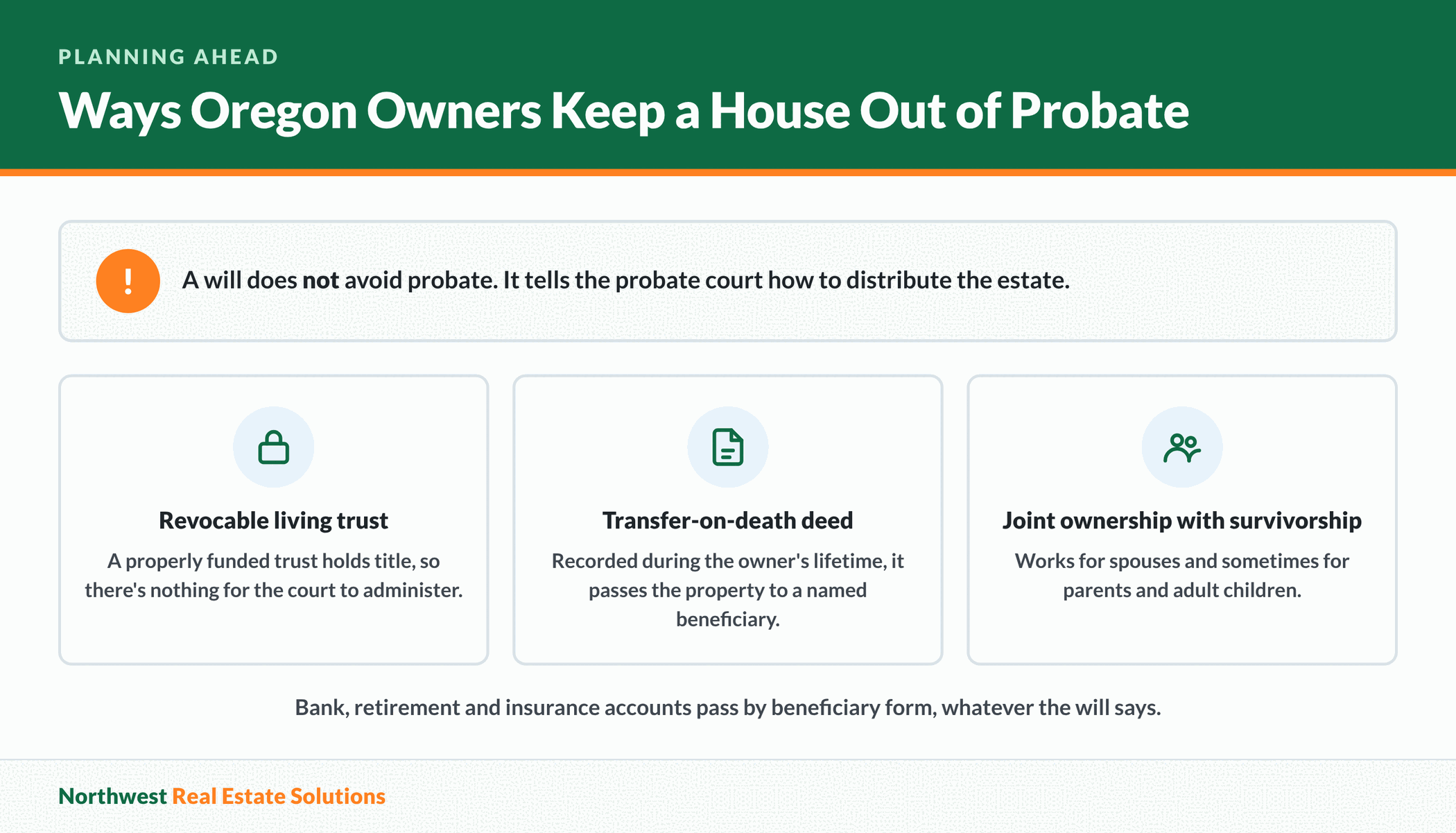
What a will does not do is avoid probate. A will tells the probate court how to distribute the estate. It’s an instruction manual for the court, not a way around it. No misunderstanding I run into costs Oregon families more time than that one.
An owner in Corvallis called me after taking a job transfer with five weeks to get out. The inherited house next door, left to him a year earlier, had never cleared probate because his attorney had quietly let the file go cold. We set up a sale on the house he lived in. We held off on the inherited one until his personal representative letters issued. He made his start date with the truck loaded and his boat still strapped to the trailer in the driveway.
Maybe you’re sitting on an inherited Oregon property and can’t tell whether you’re facing a simple affidavit or a full year in probate. We’re happy to walk through the numbers with you. We’ll tell you honestly what we think you should do, even if the answer is to list it with an agent. Reach out to Northwest Real Estate Solutions whenever you’re ready. No pressure, no obligation, and nobody will call you twice.
Frequently Asked Questions
How Much Should You Expect to Pay for Probate in Oregon?
Plan on court filing fees scaled to the size of the estate, attorney fees the court reviews and approves, publication costs for the creditor notice, and any appraisal work the inventory needs. Routine Oregon estates with cooperative heirs land at the low end. Contested probate, missing heirs or a property with title problems push the total up fast, so the state of the family often matters more than the condition of the house.
How Do You Know Whether Probate Is Required at All?
Start by listing what the decedent owned alone, in their own name, with no beneficiary designation. Assets held in a trust, titled jointly with survivorship, or carrying a payable-on-death beneficiary pass outside probate entirely. If what’s left falls under both of Oregon’s simple estate ceilings described earlier, the affidavit route may work. If the house alone clears the real property limit, you’re looking at full probate, so talk to an attorney before you sign anything.
Which States Have the Most Difficult Probate Process?
States with mandatory court supervision of every sale, long creditor windows, and attorney fees set as a percentage of gross estate value tend to be hardest on families. California and Florida both have reputations for slow, formal administration. Oregon sits mid-pack, mostly because its affidavit option reaches real property, which many states won’t allow.
What Happens If an Estate Stays Open for Years?
Nothing closes an Oregon estate automatically after a set number of years, but a personal representative who drags their feet has real exposure. Heirs can petition the court to compel an accounting or remove the representative. Meanwhile carrying costs on an idle property keep draining what’s left for everyone. The property deteriorates, insurance on a vacant structure gets harder to keep, and the eventual sale price reflects every month of neglect.
Can You Sell an Inherited Oregon House Before Probate Finishes?
You can market the home and go under contract once the court has issued letters to the personal representative, and closing can happen before the estate formally closes. What you can’t do is distribute proceeds to heirs before the creditor window has run, since the representative stays personally on the hook for valid claims. Your attorney will confirm whether your file needs court approval of the sale terms.
Inherited Homes Around Portland
Portland-area home prices sit far above the $200,000 real property limit for Oregon’s simple estate affidavit, so most inherited houses around Portland end up in full probate. We buy houses in Oregon in any condition, including homes still working through the court process.
You can sell to us with one closing date and no buyer financing to wait on. If you’d like the details first, here’s how our process works.
Talk Through Your Inherited Property
Every estate is different, and the right move depends on the house, the heirs and where the court file stands. If you’d like a second set of eyes on your options, contact Northwest Real Estate Solutions or fill out the form below. We’ll make you a fair cash offer, and you’re free to say no.
Helpful Oregon Blog Articles
- Who Is Responsible For HOA Fees At Closing In Oregon
- How to Find a Realtor in Another State Before You Move
- Who Pays Real Estate Agents in Oregon
- How Much Does an Estate Have to Be Worth to Go to Probate in Oregon
- Can You Cancel a Listing Agreement with a Real Estate Broker in Oregon
- How Long Does an Eviction Process Take in Washington