

A payoff statement is a cold piece of paper. It lists your principal, the interest accrued through a set date, any late fees, and a per diem that keeps ticking. For a lot of homeowners across Washington, that number now runs higher than what a buyer will pay. An underwater mortgage isn’t a personal failure. It’s arithmetic that went sideways, and there are real ways out.
What Does It Mean to Have an Underwater Mortgage in Washington?
Your lender never warns you when you cross the line. You find out when you try to sell or refinance, or when a neighbor’s house closes for less than you paid in 2022.
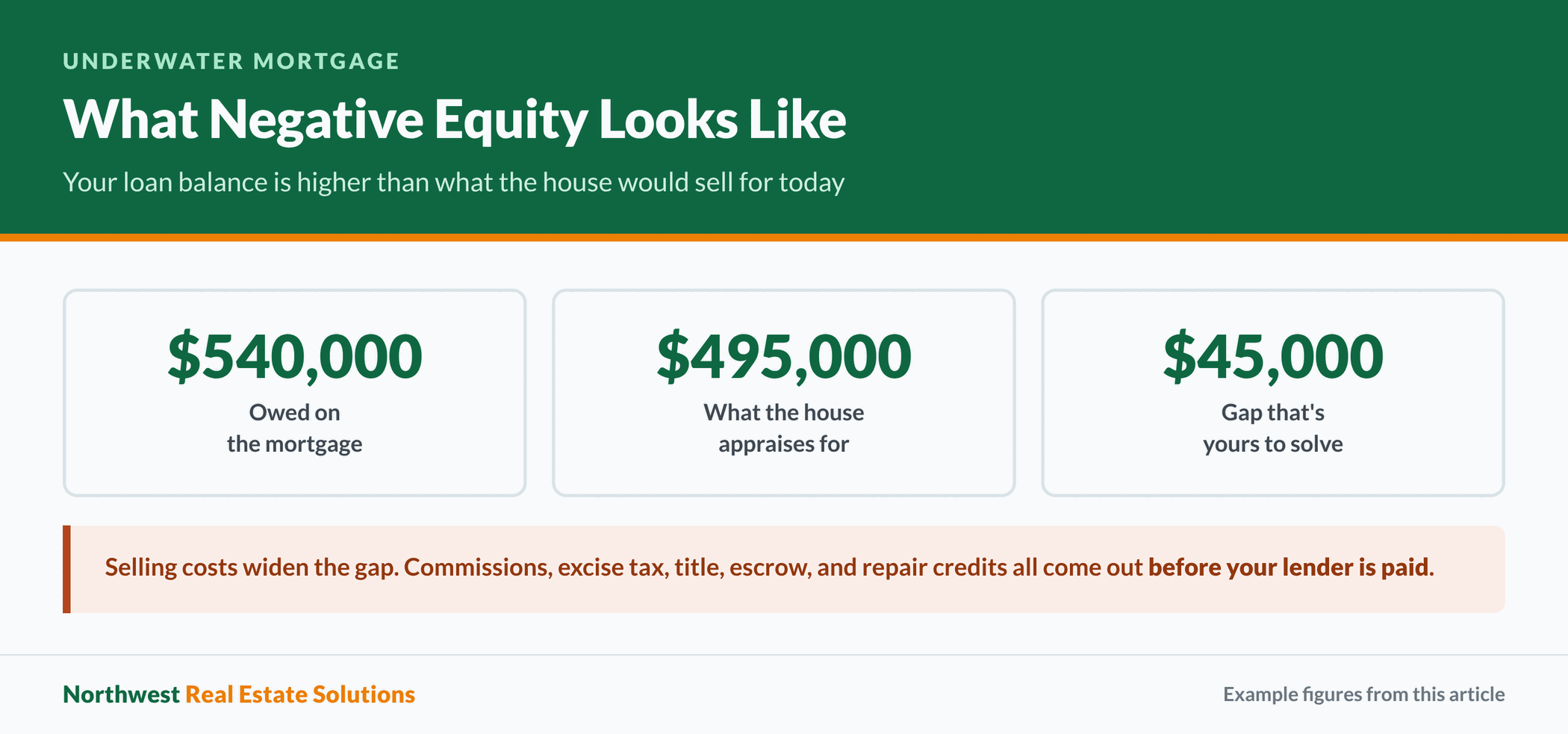
An underwater mortgage means your loan balance exceeds what the property would sell for today. People call it negative equity or being upside down, and the math is the same either way. Say you owe $540,000 and the house appraises at $495,000. You’re left with a $45,000 gap to solve.
Washington’s numbers show why this keeps coming up. Across the Northwest MLS region, the median sales price for homes and condos sold in October 2026 was $620,000, down 3.1% from $640,000 in October 2025. Condos took the harder hit, with the median falling 13.0% to $435,000 that month. Buy a Belltown or Kirkland condo near the peak with a small down payment, and you may have an underwater mortgage without doing anything wrong.
Most explanations leave out one piece: the gap isn’t just the loan balance minus the value. Selling costs count too, since agent commissions, excise tax, title and escrow fees, and any repair credits all come out of the proceeds before your lender gets paid. Even a homeowner with $10,000 of paper equity in Spokane Valley is functionally underwater once those costs land.
One heir I worked with had inherited a split-level with a boat trailer rusting in the side yard. She had no interest in flying out to manage repairs and wanted the whole thing handled cleanly. Her payoff was tight enough that every fee mattered.
How Does a Mortgage Become Underwater in the First Place?
In Washington, low down payments cause more negative equity than market crashes do.
Put three percent down on a conventional loan and you start with almost no cushion. At a 97% loan-to-value ratio, your LTV barely moves in the first few years because early payments go mostly to interest. Roll closing costs into the loan and you’re underwater on day one, and a flat market keeps you there.
Then there’s the refinance cycle. Homeowners who pulled cash out during the low-rate years to pay off credit cards or fund a remodel reset their principal higher. When prices soften, that bigger balance decides whether you end up with an underwater mortgage.
Price drops do their share. King County’s median fell 4.1% in October 2026 to $851,250, and its single-family median dropped 7.2% to $925,000. A seven percent slide in a year wipes out most of a 10% down payment for anyone who bought recently in Renton, Shoreline or Federal Way. Add selling costs, and that can leave an underwater mortgage behind.
Second mortgages and HELOCs stack on top of each other, too. Plenty of Washington homeowners carry a first and a second, and the second lienholder has to agree to anything you do. I’ve seen more sales stall over a $28,000 HELOC than over the primary home loan.
Deferred maintenance quietly does the same work. A Pacific Northwest roof holds up against the rain for about twenty years, and then it doesn’t. Your loan balance doesn’t shrink to match, so an underwater mortgage can appear simply because the house aged and the balance didn’t.
Rising Washington property taxes and insurance premiums create escrow shortages that push monthly payments up. Tight budgets lead to late payments, and late payments add fees to the payoff.
How Do You Calculate How Much You Still Owe on an Underwater Mortgage?

Sizing up an underwater mortgage is the part people guess at instead of calculating. Your online mortgage portal shows a balance. That balance is not your payoff.
Call your lender and ask for a written payoff quote good through a specific date, usually thirty days out. It’ll include unpaid principal, interest through that date, recording fees, and any escrow advances the servicer made for taxes or insurance. Miss a few payments and late charges show up too, along with attorney fees if a foreclosure has started.
Next, get an honest value, not a Zestimate. Ask two local agents for a comparative market analysis based on sales from the last ninety days within a mile of you. Home appraisals through a lender will land differently from what a cash buyer offers, so know which number you’re using.
Then subtract the costs of selling. Those include agent commissions on both sides, Washington’s real estate excise tax, escrow and title, and buyer concessions. Sellers across Washington have been giving up a little lately. Homes that sold in the rolling 90-day window ending October 7, 2026 went for 98.4% of list price on average, and they took a median of 29 days.
Run it as one equation: realistic sale price, minus selling costs, minus every lien on title. Any negative result confirms the underwater mortgage.
Pull a title report before you list. HOA liens in Sammamish and Issaquah master-planned communities, old contractor liens, unpaid utility balances in some jurisdictions and child support judgments can all surface at escrow and deepen the hole. Most homeowners skip this step, so the discovery hits at closing, the worst possible time.
What Happens If You Sell Your House for Less Than You Owe in Washington?
Sellers with an underwater mortgage often walk in believing the lender takes whatever the house brings and closes the file. It doesn’t work that way. Escrow can’t record a deed while liens remain unpaid. Somebody has to cover the shortfall, either you in cash at the table or the lender through a written approval that accepts less than the full payoff. That second path is a short sale.
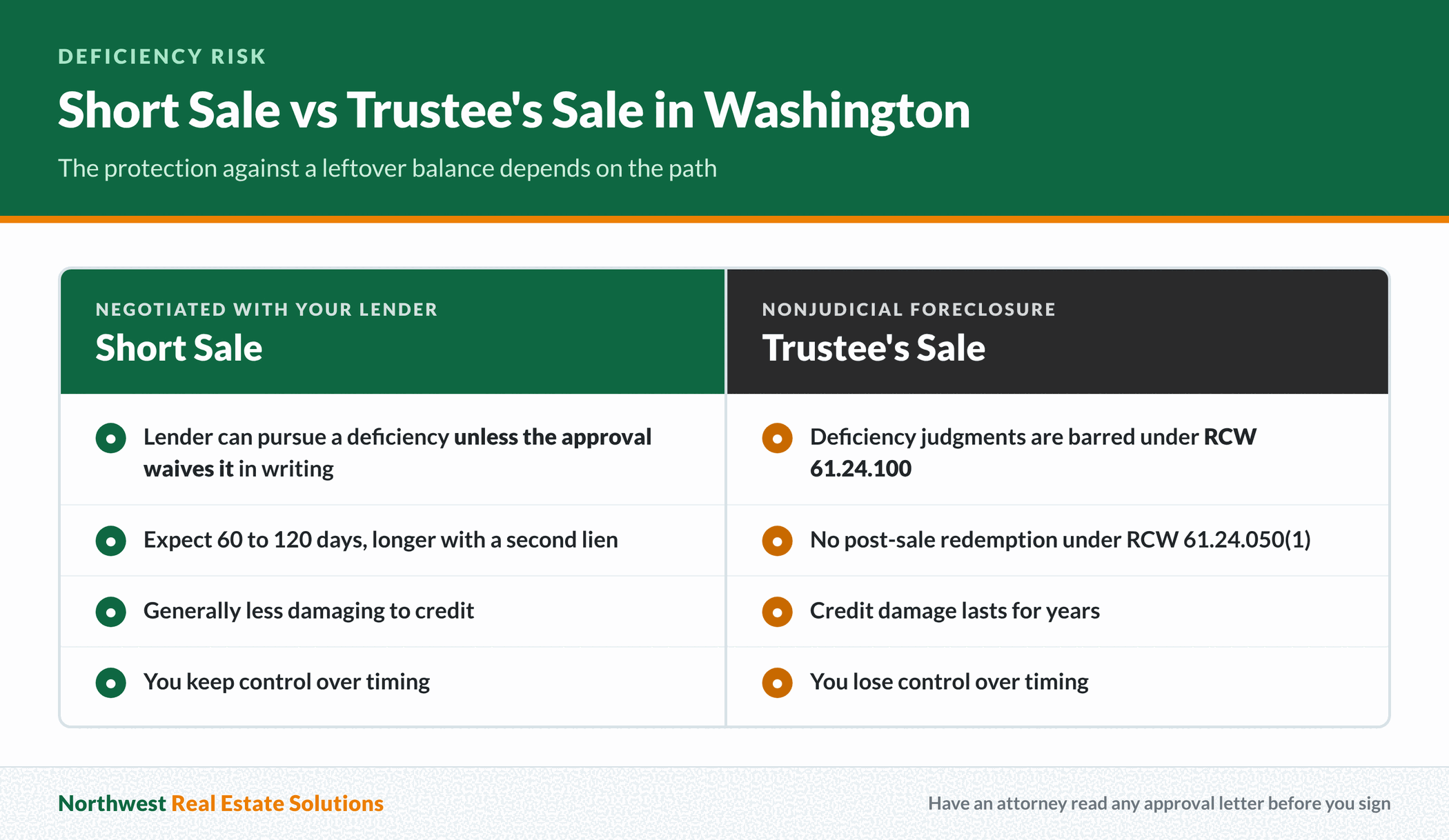
Washington’s deficiency rules decide almost everything here. Under RCW 61.24.100, a deficiency judgment can’t be obtained against a borrower, grantor or guarantor after a trustee’s sale. That’s strong protection, though it attaches to the foreclosure path, not to yours. Most residential foreclosures in Washington run as nonjudicial trustee’s sales under Chapter 61.24 RCW. The protection applies after a completed trustee’s sale and doesn’t automatically cover a negotiated short sale.
So a short sale carries a risk a trustee’s sale doesn’t. A Washington lender can pursue a deficiency judgment after a short sale unless the agreement is written to expressly state the lender waives its right to the deficiency. State regulators warn that a lender may reserve the right to collect the unpaid balance, including interest or penalties, unless the approval explicitly waives it. You can read that guidance at dfi.wa.gov/foreclosure.
My plain opinion: never sign a short sale approval letter on an underwater mortgage without a Washington real estate attorney reading the release language first. The gap between “released from the lien” and “released from the debt” is a few words, and it can be worth tens of thousands of dollars.
Taxes on a forgiven underwater mortgage shifted recently, and Washington homeowners should know about it. The IRS excluded canceled qualified principal residence indebtedness only for debt discharged before January 1, 2026, or under a written arrangement made before that date. Confirm your situation with a CPA and check irs.gov/taxtopics/tc431, since insolvency and bankruptcy exclusions still exist.
Can You Refinance a House When You Owe More Than It’s Worth?
Freddie Mac’s 30-year average running between 7.24% and 7.40% in October 2026 changed the math for a lot of Washington homeowners hoping to refinance their way out. The statewide median sold price over the trailing twelve months sat at $612,000 around the same time, down 2.1% year over year. Falling values plus higher borrowing costs make the worst combination for a refinance.
Conventional loans generally cap out around 80% loan-to-value for a standard refinance. With an underwater mortgage, your LTV sits above 100%.
Government-backed options exist. FHA and VA streamlined refinances can sometimes skip a new appraisal, though your existing loan has to already be FHA or VA, with a reasonably clean payment history.
A loan modification is the more realistic door. It changes the terms of your existing home mortgage by extending the term, adjusting the rate, or moving missed payments to the back of the loan. A modification won’t erase an underwater mortgage. What it does is make the payment survivable while values recover or your balance amortizes down.
Free help is available before you call anyone who charges. Washington’s Foreclosure Fairness Program offers free housing counseling at 1-877-894-HOME (4663), and counselors can refer eligible homeowners into the Mediation Program. Details live at commerce.wa.gov/homeownership. The Washington Homeownership Resource Center runs that same hotline for any Washington homeowner at risk of foreclosure tied to their mortgage, property taxes or HOA dues.
Would waiting two years for appreciation fix your underwater mortgage? If you’re relocating for work or going through a divorce, waiting isn’t an option.
What Happens If You Do Nothing About an Underwater Mortgage?
A landlord in Bremerton stopped responding to his servicer in the spring. By late summer, a notice of trustee’s sale was taped to the door. He’d assumed silence bought him time, and it bought him fees.
Interest keeps accruing on an underwater mortgage whether you engage or not. Late payments get reported to the credit bureaus, and scores fall fast once you’re sixty and ninety days behind. Servicers add inspection charges, legal costs and advances for force-placed insurance, and every one of those lands on your payoff.
Foreclosure in Washington follows a defined path, and the clock runs even after you stop opening mail. Housing counselors advise calling the hotline as soon as you receive a Notice of Default or a Notice of Trustee Sale. The window for a mediation referral narrows as the process moves forward. A housing counselor or attorney has to make the formal referral to the Washington State Department of Commerce for you, since homeowners can’t self-refer.
The hardest consequence comes at the end. No post-sale redemption exists after a trustee’s sale under RCW 61.24.050(1).
Doing nothing isn’t always irrational, and that’s worth saying plainly. Since Washington bars deficiency judgments after a residential trustee’s sale, some homeowners figure a foreclosure will cost them less than a short sale with an unwaived deficiency. It also wrecks your credit for years and ends your control over timing.
Left alone, an underwater mortgage also blocks life decisions. A job offer in Vancouver, aging parents in Yakima, a growing family squeezed into a two-bedroom near Green Lake: none of it moves while the lien sits there.
What Are Your Options for Selling a Home with an Underwater Mortgage?
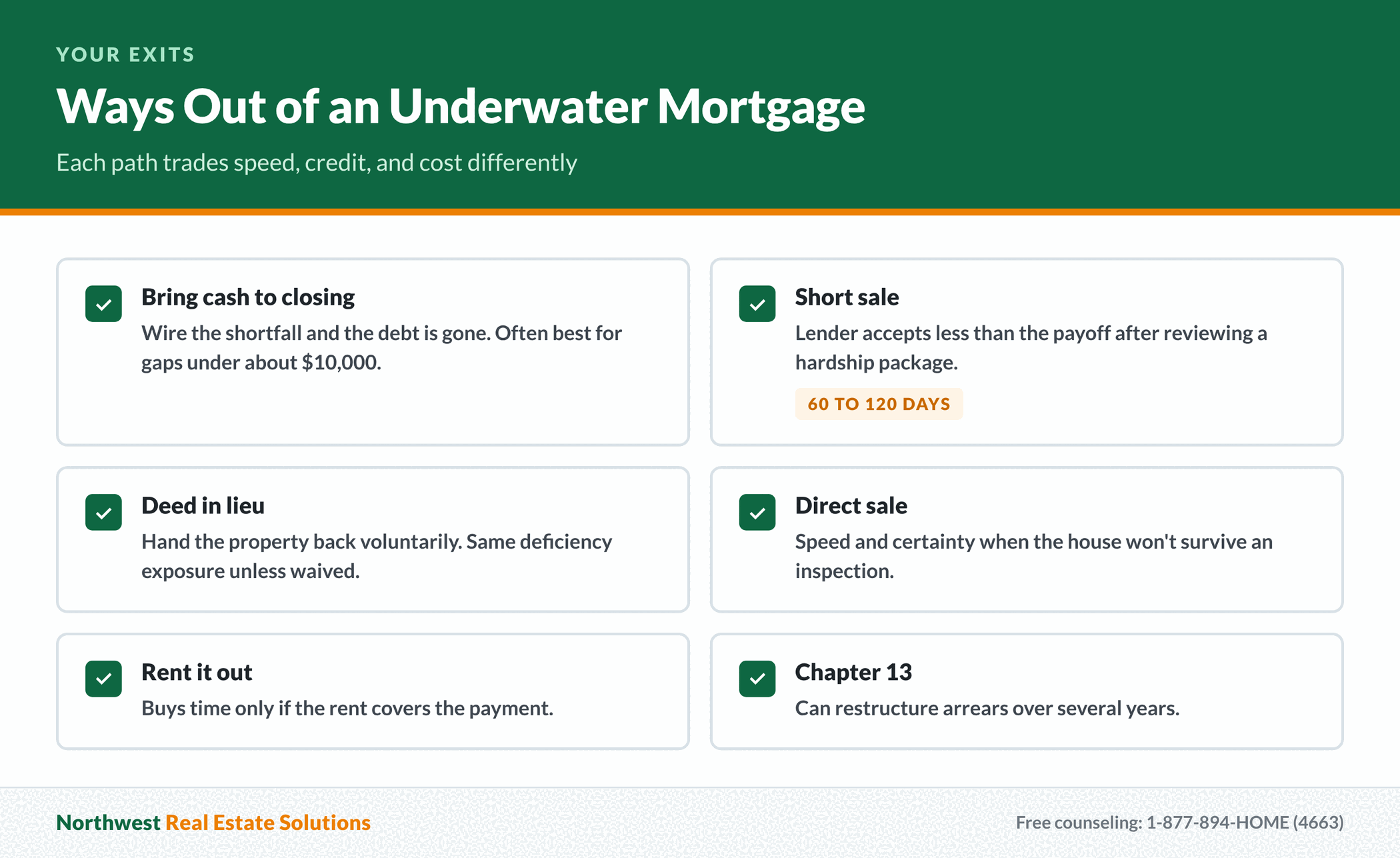
Bringing cash to closing is the cleanest exit from an underwater mortgage, if you can manage it. You wire the shortfall, the lien releases, and the debt is gone. For gaps under roughly ten thousand dollars, this often beats the credit damage of every other choice.
Short sales on an underwater mortgage work, and they take patience. Your lender reviews a hardship package, orders its own valuation, then approves or counters. Expect sixty to a hundred twenty days in Washington, longer if a second lienholder is involved.
A deed in lieu of foreclosure hands the property back voluntarily. It’s faster and a little gentler on credit than a completed foreclosure, though the same deficiency exposure applies as in a short sale unless the agreement says otherwise.
Selling directly to an investor solves a narrower problem: speed and certainty. When a Washington homeowner has a small gap and a house that won’t survive an inspection, a direct sale sometimes nets more than a listing does after concessions. Our team at Northwest Real Estate Solutions runs those numbers next to your payoff. We’ve seen plenty of cases where listing was the smarter move, and we’ll tell you so.
Renting it out buys time if the rent covers the payment. In Tacoma and Everett it sometimes does. Bellevue rarely works that way, and feeding a property every month in hopes of appreciation is a gamble, not a plan.
Bankruptcy deserves a mention. Chapter 13 can restructure arrears over several years, and in specific cases a wholly unsecured second lien gets stripped.
An heir in Centralia I worked with watched two agent listings expire back to back with zero offers. Both were priced to cover an underwater mortgage the market disagreed with. We bought it as-is, cluttered shop included, and coordinated the payoff shortfall with her lender directly.
Frequently Asked Questions
Getting the release language wrong on an underwater mortgage can turn a finished sale into a collection file two years later. Read every answer below against your own paperwork.
What Is It Called When You Sell Your House for Less Than You Owe?
It’s called a short sale. Your mortgage lender agrees to accept less than the full payoff and releases its lien so the closing can record. In Washington it’s a voluntary transfer, not a trustee’s sale, so the deficiency protection described earlier doesn’t automatically apply. Walking away clean depends on what the lender’s written approval says.
If I Sell and There’s Still a Balance Left, Do I Have to Pay It?
That depends on your approval letter and the type of sale. A shortfall left after a negotiated sale stays collectible unless the lender expressly waives it in writing, and a second lienholder can chase its own balance separately. Have a Washington real estate attorney review the documents before you sign. Ask specifically if you’re being released from the debt itself or only from the lien on the property.
Will a Short Sale Hurt My Credit as Much as Foreclosure?
Usually less, though neither one is pleasant. The missed payments leading up to the sale do much of the damage on their own, so a homeowner who stays current throughout takes a smaller hit. Mortgage lenders also weigh the reason and your recovery time when you apply again. Many borrowers in Washington qualify for a new home loan within a few years of a completed short sale.
Can I Sell a Washington House with Two Mortgages If I’m Upside Down?
Yes, as long as both lienholders sign off, and the second one has less reason to cooperate since there’s nothing left for it. Negotiators often get the first lender to set aside a few thousand dollars for the junior lien to secure the release. It adds time. Start those conversations early instead of waiting for an offer.
Is Forgiven Mortgage Debt Taxable in Washington?
Washington has no state income tax, so this is a federal matter. Canceled debt is generally treated as income unless an exclusion applies, and the exclusion that covered forgiven debt on a main home has the cutoff described above. Insolvency and bankruptcy exclusions may still help, depending on your balance sheet the day before the cancellation. Talk to a CPA before you sign a short sale approval.
Should I Keep Making Payments While a Short Sale Is Pending?
If you can afford to, yes, because your credit will thank you later. Some lenders move slower on a short sale when the loan is current, which frustrates sellers who feel punished for being responsible. Weigh the credit cost against the delay with a HUD-approved counselor before you decide. No single answer fits everyone, and it shifts with how deep the underwater mortgage runs.
How Fast Can I Sell If a Trustee’s Sale Date Is Already Set?
It can happen fast, though it’s tight. A direct cash buyer can often close in two to three weeks, and lenders will sometimes postpone a sale date when a signed sales contract and proof of funds land on their desk. The earlier you make that call, the more leverage you keep. Wait until the final week and you’ve lost nearly every option.
If you’re staring at an underwater mortgage and aren’t sure which path fits, we’re glad to walk through the numbers with you. There’s no pressure, no obligation and no judgment about how you got here. Reach out to Northwest Real Estate Solutions whenever you’re ready. If the right answer turns out to be a counselor, an attorney or an agent instead of us, we’ll tell you that too.
Underwater Homes in the Vancouver Market
Zillow put the typical Vancouver home value at about $501,700 through August 2026, down 0.1% from a year earlier. Flat prices like that mean Vancouver homeowners can’t count on appreciation to fix an underwater mortgage soon.
If you’re carrying an underwater mortgage anywhere in the state, we buy houses across Washington as-is and can run the payoff math with you.
Get a Straight Read on Your Payoff Gap
When you’re ready to talk through your underwater mortgage, contact our team and tell us what you owe and what the house needs. You can also fill out the form below, and we’ll follow up on your schedule.
Helpful Washington Blog Articles
- Sell a House with Water Damage in Washington
- How to Sell an Apartment in Washington
- How Long Does It Actually Take to Sell a House in Washington
- How To Attract Buyers For Distressed Property In Washington
- Selling a House in a Trust After Death in Washington
- Can Someone Take Over My Mortgage in Washington
- Can I Sell My House For Less Than Appraised Value In Washington State
- Can I Sell My House Below Market Value in Washington
- How to Sell a House That Needs Repairs in Washington
- Can You Sell a House As-is Without an Inspection in Washington
- How to Take Your House Off the Market in Washington
- How Much Do Realtors Charge to Sell a House in Washington
- Can I Sell My House with a Pending Insurance Claim
- Can One Owner Sell Jointly Owned Property in Washington