

Splitting a home during a divorce is one of the most stressful financial decisions a couple can face, and plenty of Oregon homeowners sign documents they only partially understand. A quitclaim deed shows up in nearly every divorce case involving real property. Most people still walk away from closing without knowing what it actually did or what it didn’t do.
What Is a Quitclaim Deed in Oregon?
A quitclaim deed is a legal instrument that moves whatever ownership interest the grantor holds in a piece of real property to a grantee, nothing more and nothing less. Oregon recognizes these transfers under ORS 93.865, the state statute that defines the form and effect of a quitclaim deed.

Unlike warranty deeds, which guarantee that the title is clear, quitclaim deeds make no such assurances. They simply pass along whatever interest the grantor currently possesses. That distinction matters more than most people realize. A retired couple in Tigard came to us after signing a quitclaim deed, only to discover it said nothing about three lots on a split parcel. They had assumed the paperwork covered everything. It did not. Getting the legal description right before anyone signs is the detail that trips people up most often. Homeowners who end up wanting cash home buyers in Tigard often call us at exactly that point, once the deed has raised more questions than has settled.
A quitclaim deed is best suited for transfers between people who already share trust. It’s commonly used to remove a former spouse from the title after a divorce or to transfer property into a living trust. For divorcing Oregon homeowners, it’s the standard starting point when dividing marital real estate, because the process is simple once both parties have already agreed on who keeps what.
What a Quitclaim Deed Covers and What It Does Not
A deed transfers ownership interest in real property, nothing more. The most common misunderstanding is that signing one also moves the home loan. A mortgage is a separate contract with the lender, and only a refinance or a written release from the lender removes a borrower. Someone can be off the deed and still be fully liable for the loan.
The departing spouse should never sign a quitclaim deed until refinancing is complete. Transferring title without removing mortgage liability leaves you responsible for a debt you no longer control. A bank will still call both original borrowers if payments stop.
Liens attached to the property do not disappear either. Unpaid taxes, contractor liens, or judgments recorded against the home travel with the real property regardless of whose name ends up on the new deed. Title companies also look harder at a chain of title that rests on a quitclaim deed alone, which can slow a later refinance or sale. So if the spouse receiving the home plans to refinance afterward, that’s a practical problem worth solving before signing anything. The team at Northwest Real Estate Solutions regularly works with divorcing homeowners who need a fast, clean exit. We can walk you through whether a sale makes more sense than a transfer.
Oregon Quitclaim Deed Legal Requirements
A deed that misses Oregon’s formatting rules can still be recorded, but the clerk adds a nonstandard document fee under ORS 205.327. It can also create complications during a title search. Get the paperwork right the first time.
Oregon requires a blank space for the recording label in the upper or lower right corner of page one, and the size varies by county. Commonly, it’s 4 by 2 inches, 4 by 1.5 inches, or 3.25 by 2.25 inches, so check your county’s standards before printing. Oregon deeds must also include a statutory warning about land use laws under ORS 93.040, and that warning matters most for transfers in farm and forest zones. If the required first-page information is missing, the clerk may request a cover sheet or apply the nonstandard fee.
The grantor must sign the deed and have that signature acknowledged before a notary public. Oregon does not require witnesses. State law sets no filing deadline for a deed itself, but record it promptly with the County Clerk’s Office in the county where the property sits. Failure to record promptly does not invalidate the deed. Under ORS 93.640, though, an unrecorded deed is void against a later good-faith buyer who records first, so a gap in recording can create real priority issues.
How to File a Quitclaim Deed in Oregon
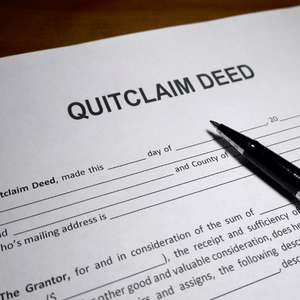
File with the County Clerk (Recording Division) in the county where the property is located, not where either spouse lives. Oregon has 36 counties, and most offices also accept e-recording through a submitting service, so you can often handle this without driving to a courthouse. Bring or submit three things:
- The signed, notarized deed, with the legal description checked against the last recorded deed
- The recording fee for your county, since schedules differ
- A cover sheet, if page one is missing any required information
Once signed and notarized, the transfer is legally effective between the parties. It becomes public record only after the county clerk processes it. In a divorce case, coordinate the recording date with your attorney so the timing aligns with the court’s dissolution decree. Recording before the decree is finalized can force you to redo the whole filing.
Oregon Quitclaim Deed Costs and Filing Fees
Recording fees are not the expensive part of a divorce. Attorney fees are. Counties set their schedules under ORS 205.320, so confirm the current numbers with your clerk before you submit.
| Cost | What to expect |
|---|---|
| Recording fee, first page | $86 in Multnomah and Washington counties, up to $113 in Clackamas |
| Each additional page | $5 |
| Cover sheet | $5, when page one is missing required information |
| Nonstandard document fee (ORS 205.327) | $20 |
| Statewide transfer tax | None |
| Washington County transfer tax | $1 per $1,000 of value |
Oregon has no statewide transfer tax, and only Washington County’s grandfathered tax survives. If your home sits in Washington County, including communities like Beaverton or Hillsboro, check whether your divorce transfer qualifies for an exemption. Common exemptions include gifts, inheritances, court-ordered transfers such as divorce, and foreclosure-related deeds. Formatting requirements are in ORS 205.232 and first-page content rules in ORS 205.234, so it’s worth double-checking both statutes before you submit anything.
How Oregon Quitclaim Deeds Work in Divorce Cases
Some people assume that signing the deed ends the financial relationship with their ex. Signing the deed ends the ownership relationship. The financial one is a different matter entirely.
Under Oregon Revised Statutes Chapter 107, property division follows equitable distribution principles, with courts presuming both spouses contributed equally to marital property acquisition. The family home is typically considered marital property if purchased during the marriage, even though only one spouse’s name may appear on the deed.
Mortgage liability does not automatically transfer when a court awards the house to one spouse. A quitclaim deed transfers title ownership but does not release your ex-spouse from the loan. Both parties remain legally responsible until refinancing occurs, so a missed payment by the receiving spouse still damages your credit. Oregon courts may set refinancing deadlines in the dissolution judgment, often 90 to 180 days.
When neither spouse can qualify for a refinance on a single income, selling the property outright and splitting the proceeds is often the cleanest option. Our We Buy Houses in Oregon program skips the listing process entirely. That helps when the court has set a specific timeline, because divorce decrees rarely give you much flex room.
Where to Get Legal Help for an Oregon Quitclaim Deed
A family law attorney cannot always help you prepare the deed itself. That’s conveyancing work, and some attorneys refer it out to a title company or real estate attorney. Knowing that upfront prevents you from paying for two separate consultations when one coordinated professional could handle both.

For the divorce side, Oregon’s family law framework under ORS 107.105 governs how courts distribute real property. An attorney familiar with that statute can structure the settlement so the quitclaim deed reflects what the court actually ordered. Mismatches between the dissolution judgment and the recorded deed create clouds on title, causing a buyer’s title company to flag the property years later when you try to sell.
A homeowner in Lake Oswego faced a standoff over renovation costs before listing. Neither spouse could afford the work, and neither agreed on who should pay, a situation we’ve seen stall closings for months. Selling the house as-is directly to us resolved the whole thing without a single renovation dollar spent. Our page for cash home buyers in Lake Oswego covers what an as-is offer looks like. If the home sits in the metro area, our Sell Your House Fast in Portland page walks through how that timeline works.
For deed preparation, a real estate attorney or title company familiar with Oregon’s recording requirements can prepare a document that meets county formatting standards. The Oregon State Bar’s attorney referral service is a practical starting point if you don’t already have representation.
Frequently Asked Questions
What Are the Disadvantages of a Quitclaim Deed?
The biggest drawback is what the deed doesn’t do. It carries no guarantees about title quality. If liens, unpaid taxes, or ownership disputes surface after the transfer, the person who received the deed has no legal recourse against the grantor through the deed itself. In a divorce, this risk is usually manageable because both parties know the property’s history. It’s still worth having a title search done before anyone signs.
Why Are Quitclaim Deeds Used in Divorce?
They’re fast and inexpensive to prepare, and courts accept them as a simple way to move ownership interest from one spouse to the other. An arm’s-length sale would require warranties that a divorce transfer doesn’t. Both spouses already know the property’s history and are operating under a court-ordered settlement, so the lack of title guarantees matters less here than in a sale to a stranger.
What Is a Husband Entitled to in a Divorce in Oregon?
Oregon courts divide marital property under an equitable distribution standard, meaning fairly rather than automatically equally. Either spouse can receive the home, a share of equity, or other assets of comparable value, depending on what the court determines is fair. Property one spouse owned before the marriage, or received as an inheritance, may be treated differently, but the court has broad discretion.
Can You Get a Divorce in Oregon Without Going to Court?
Oregon does allow uncontested divorces to proceed without a courtroom appearance in many cases, particularly when both spouses agree on property division, support, and any parenting arrangements. You still file the dissolution paperwork with the circuit court, and a judge reviews and signs the final decree. You may never need to appear in person. Your county circuit court clerk can tell you exactly what your local process looks like.
If you’re going through a divorce and trying to figure out what to do with the house, we’re here to help. That might mean a transfer, a buyout, or a clean sale so both of you can move on. No pressure, no obligation. Contact us whenever you’re ready.
Helpful Oregon Blog Articles
- Who Is Responsible For HOA Fees At Closing In Oregon
- Should I Replace My Roof Before I Sell My House
- Cost to List on MLS in Oregon
- How to Sell a House With Tenants Not Paying Rent in Oregon
- Quitclaim Deed Divorce in Oregon
- Can Medical Bills Take Your House In Oregon
- When Is It Too Late To Stop A Home Foreclosure In Oregon
- Cheapest Places to Live in Oregon
- How to Find a Realtor in Another State Before You Move
- Selling a House With Septic Tank Problems in Oregon
- How Oregon Families Can Sell a Parent’s House to Cover Care Costs