

Open the crawl space hatch in February and you’ll often hear it before you see it, a slow drip landing on plastic sheeting. Thousands of Oregon homes sit on crawl spaces. In a state that gets most of its rain between October and April, crawl space water isn’t a freak event. It’s a seasonal visitor. I’ve bought houses across Oregon with puddles standing under the floor joists, and I’ve seen sellers panic over something a contractor fixed in two days. I’ve also seen sellers hide it and lose a buyer at day 40. This guide covers both outcomes.
What Causes Water in Your Crawl Space in Oregon?
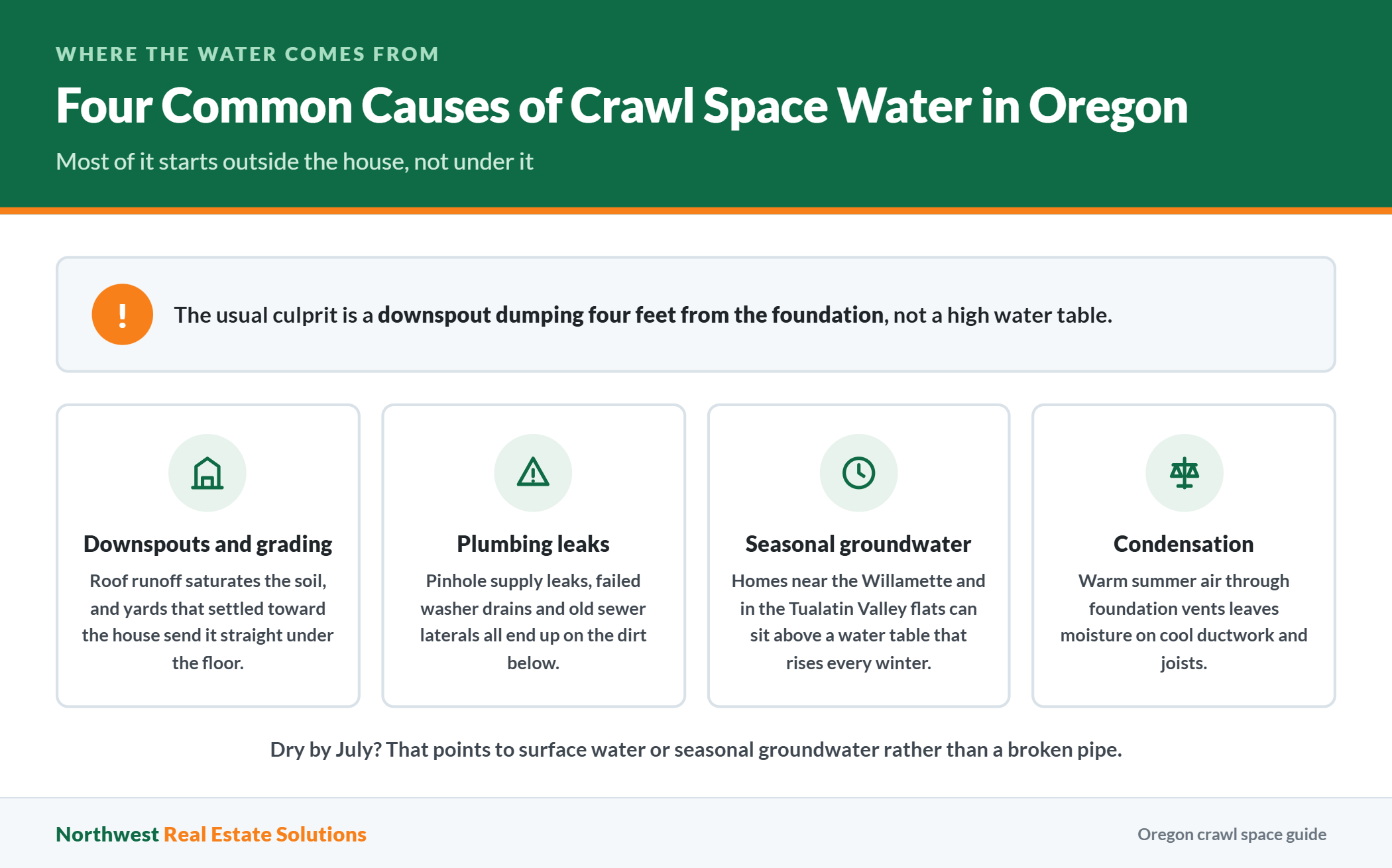
I used to blame the water table first, and most of the time I was wrong. The usual culprit is a downspout dumping runoff four feet from the foundation.
That soil gets saturated. Then it takes the easiest way in, through a crack or a vent well, and your crawl space turns into the drainage path the builder never planned. Grading matters just as much. Older Oregon neighborhoods (think 1940s bungalows in Southeast Portland or mid-century ranches around Salem) often have yards that have settled toward the house over seventy winters.
Plumbing ranks second. A pinhole leak in a supply line, a failed washer drain, or a sewer line giving out under a 1950s house all end up in the same place: the dirt below.
Groundwater comes third, and Oregon homeowners can’t landscape their way out of it. Properties near the Willamette, in low-lying parts of Eugene, or out on the Tualatin Valley flats can sit above a water table that climbs every winter.
A crawl space that dries out by July is a strong clue. It points to surface water and seasonal groundwater rather than a broken pipe.
Condensation is worth a mention too. In summer, warm air moves through the foundation vents, hits the cool surfaces underneath, and leaves moisture on ductwork and joists. Oregon’s code handles vapor retarders and ventilation together for that reason. The ground under the floor has to be covered with a Class I vapor retarder or other approved material, lapped at least 12 inches at the joints.
Will Buyers Still Want a House with Water in the Crawl Space?
Yes, plenty of them will. Oregon homes with crawl space water change hands every month, and buyers who take one on usually pay a lower price for it. The water by itself rarely decides anything. What matters is whether anyone knows the cause, how long it’s been going on, and what shape the wood underneath is in now.
Buyers who walk away are rarely afraid of the water itself. A clear cause with a clear fix is a negotiation. A mystery with no explanation is a reason to cancel.
Right now, Oregon’s market lets buyers be picky. Median days on market across Oregon reached 79 in October 2026, up from 66 in August, based on Realtor.com data tracked by the St. Louis Fed. A slower market means buyers push harder on condition.
A couple of years ago I sat down with a retired couple in Gresham. They’d moved to be near their grandkids and had quietly carried two mortgages for almost a year. Nobody wanted to touch the wet crawl space at their old house, so every Sunday they drove back across town to run a shop vac under the floor. We bought it as it sat, standing water and all, and that Sunday drive ended.
Investors and contractors treat crawl space water as one more line item. Retail buyers using FHA or VA financing often can’t, because appraisers flag visible moisture and active rot. That gap explains most of what happens next in your sale.
What Should You Do Before Selling a House with Crawl Space Water?
Hiding crawl space water is the worst financial move an Oregon seller can make. Full stop.
Oregon law leaves you no wiggle room. Sellers must give a Seller’s Property Disclosure Statement to any buyer who makes a written offer, and the form asks about water systems and structure directly. It has more than 50 questions. Your answers count as representations based on your actual knowledge, not warranties. The statutory form itself is posted at Oregon Public Law.
The form changed recently, so check which version you have. Senate Bill 83 from the 2025 session amended ORS 105.464 and the statutory disclosure form, effective July 24, 2025. If your agent gives you a form printed in 2023, ask for the current one.
Before anything else, crawl in with a flashlight and your phone. Take photos of the water line on the piers.
Next, gather your records. Old sump pump receipts, an insurance claim from a burst pipe, a plumber’s invoice from 2019: paperwork like that turns a scary unknown into documented history.
Then get written estimates from two crawl space contractors, not just one. Bids on the same crawl space in Oregon can differ by thousands of dollars, and that spread says a lot about scope creep in this trade.
Whether you list on the MLS or sell direct to a company like Northwest Real Estate Solutions, that packet shifts the conversation from fear to numbers.
Should You Get a Pre-inspection If Your Crawl Space Has Water?
The math is simple enough. A buyer’s inspector will find the same issues you would, only the buyer finds them on day 12 of escrow with a termination clause in hand. By then you’re negotiating from behind. A pre-inspection costs a few hundred dollars and puts you out in front.
I’ve seen Oregon sellers spend five figures on full waterproofing when the inspector would’ve called for a downspout extension and a new vapor barrier.
There’s a catch nobody likes to hear. Once you know, you have to disclose. If an inspection report names active crawl space water and fungal growth on the joists, it goes into your disclosure, so settle on a strategy before you order one.
Planning to sell as-is to a direct buyer? Then the pre-inspection matters less, since those buyers bring their own crew and price the house with that in mind. If you’re listing retail in a market where Oregon homes take two and a half months to go under contract, a pre-inspection usually pays for itself by heading off a renegotiation.
Specialized mold inspection is its own question. General home inspectors in Oregon will note visible mold growth, but most won’t do a mold assessment or air sampling. That assessment is a separate service, and I’d only order one if you can see surface growth or someone in the household reports symptoms.
If you do order one, have the inspector crawl the entire space. The dry corner by the access hatch tells you nothing about the far wall.
How Do You Fix Water in a Crawl Space Before Selling?
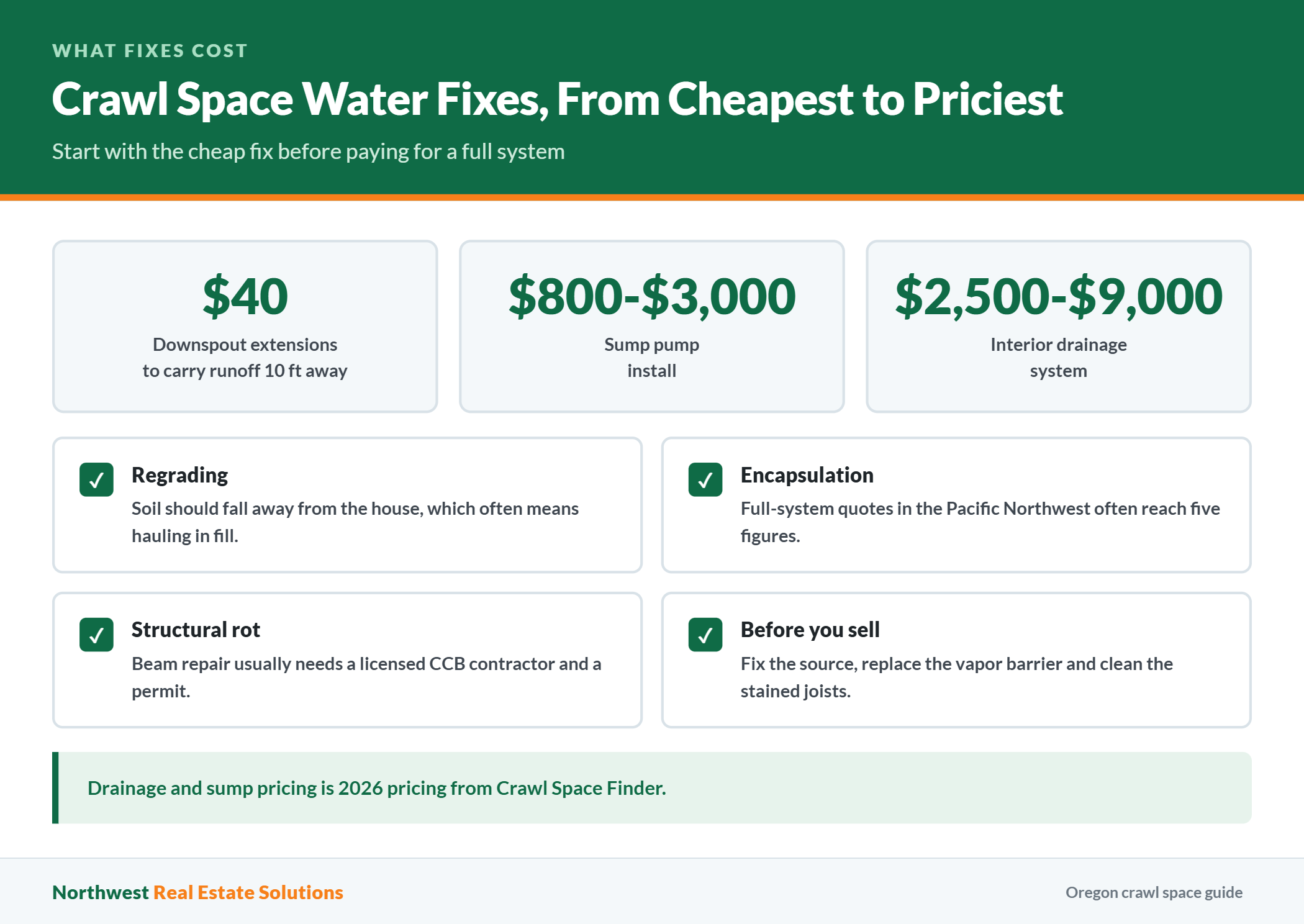
Begin with the $40 fix: downspout extensions that carry roof runoff ten feet from the foundation. A wet Oregon winter can drop more than 40 inches of rain on the valley floor. That one change clears up a surprising share of crawl space water complaints, and it’s usually the first thing I look at when I walk a property.
Regrading is next. Soil should slope away from the house, and in Oregon’s clay-heavy valley soils that often means bringing in fill and grading it over several feet.
Costs climb fast once you go mechanical. Interior drainage systems run roughly $2,500 to $9,000, and a sump pump install lands between $800 and $3,000, according to 2026 pricing from Crawl Space Finder. Encapsulation sits above either one. In the Pacific Northwest, the full-system bids I’ve seen on Oregon houses regularly reach five figures.
My take, and plenty of contractors disagree: don’t encapsulate a house you’re about to sell. You can’t seal over an active water problem, because the drainage has to be handled first, and you’ll rarely get the full cost back at closing. Fix the water source. Replace the vapor barrier and pull out the rotted insulation, then let the next owner decide whether a full encapsulation system is worth it.
Surface growth on joists can usually be cleaned and treated. Structural rot in a beam is different. It calls for a contractor and a permit, and in Oregon that work typically needs a licensed CCB contractor.
Sellers often fix the drainage and never clean up the evidence. Buyers spot black-stained joists and assume the worst. Clean the space, and leave the receipts in a folder on the kitchen counter.
Can You Sell an Oregon House as Is with Crawl Space Water?
An as-is clause in your contract doesn’t erase your Oregon disclosure duty. Selling as-is generally doesn’t free a seller from disclosing known material defects under the statute, as the real estate attorneys at Harris Sliwoski explain. Lots of Oregon sellers assume one cancels out the other. It doesn’t work that way.
You can absolutely sell as-is. Thousands of Oregon properties change hands that way every year, especially inherited homes, rentals, and houses the owner has already left behind.
The disclosure questions still need honest answers, and the buyer still gets what you know about the crawl space water.
Pricing is where as-is sellers get tripped up. A cash buyer’s discount covers more than repair cost. It also includes carrying time, the risk of unknowns behind the vapor barrier, and their own margin. Expect full market value minus a contractor bid, and you’ll be disappointed.
So what do you gain? Speed and certainty. You skip the repair negotiation, the appraiser flagging moisture, and the financing contingency that falls apart at day 25. An Oregon seller paying taxes and insurance on an empty house through another rainy season usually finds that trade worth real money.
Some sellers are exempt from the disclosure law entirely. Court-appointed personal representatives, trustees, conservators, and guardians don’t have to follow it, and neither do financial institutions selling after foreclosure. If you’re handling a probate sale in Oregon as a court-appointed representative, your obligations differ from a typical homeowner’s.
Sellers of as-is Oregon homes with crawl space water mostly hear from investors and locals who like a renovation project. It’s a smaller pool than the general market, but it’s a motivated one.
Will Listing with an Agent Work If There’s Water in the Crawl Space?
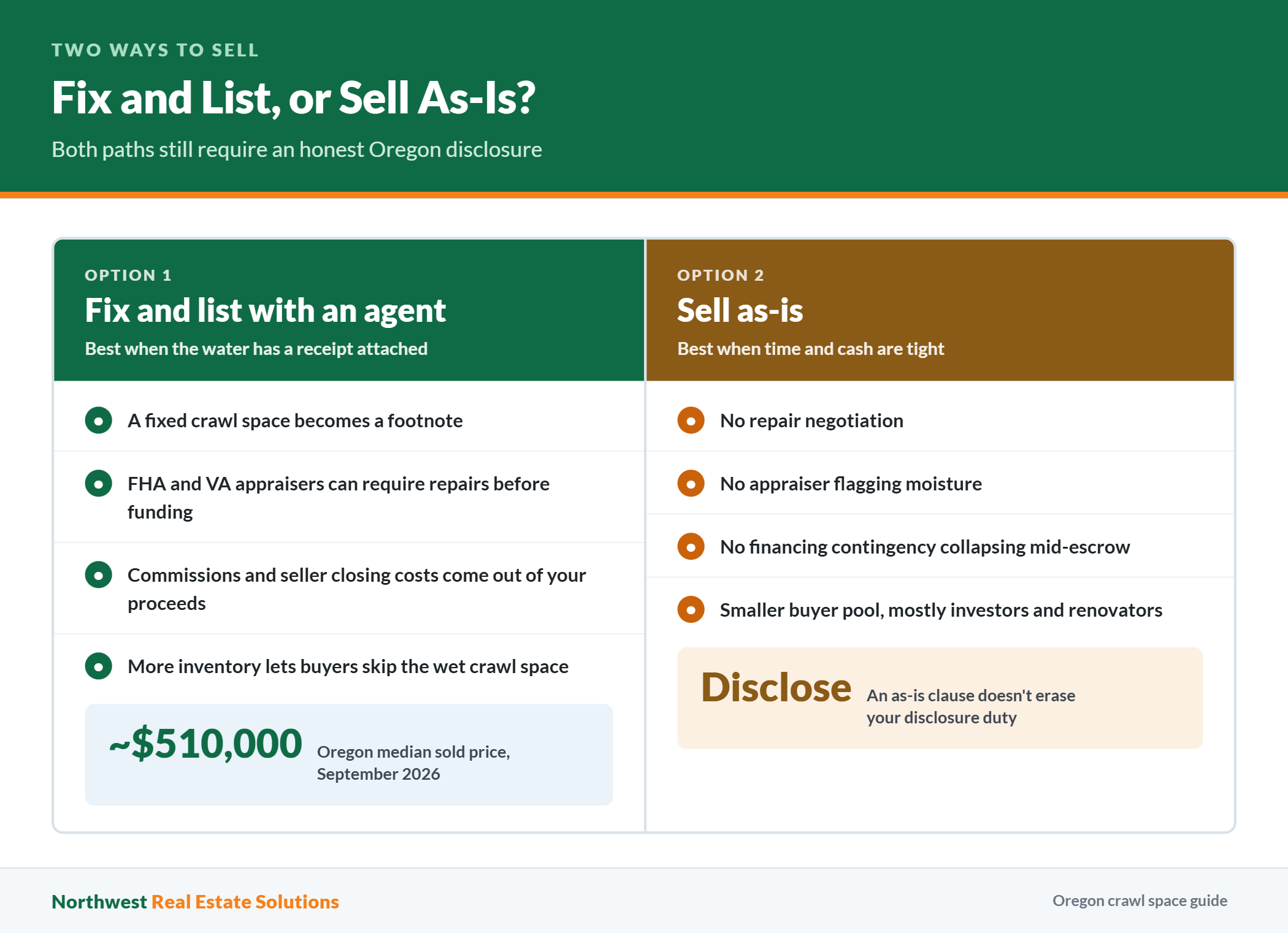
At the kitchen table, I tell sellers this: an agent is the right move if your crawl space water has a receipt attached to it.
List it. A good Oregon real estate agent will run a comparative market analysis and price it to match, and the fixed crawl space ends up a footnote instead of a headline.
Active water with no fix in sight is another story. Conventional buyers get nervous. FHA and VA appraisers can require repairs before the loan funds, which drops you back into contractor bids in the middle of escrow.
Market conditions belong in this decision too. Oregon’s median sold price sat near $510,000 in September 2026, down slightly year over year, while active listings rose 8 percent, per Norada’s Oregon market report. With more inventory, buyers can just pick the house that doesn’t have a wet crawl space.
In Eugene, the median home price was $467,900 in October 2026, down 6.4 percent from a year earlier. Softer prices like that hand buyers more leverage on condition issues.
Commission is the other piece. When you sell through an agent in Oregon, commissions and seller-side closing costs come out of your proceeds. If the house also needs a $6,000 drainage system, you’re paying for both.
Would you rather wait three months for the right buyer or close in three weeks at a lower number? Either path can work out. I’ve seen Oregon sellers do well both ways, and what usually decides it is how much time and cash they can spare.
How Do You Sell a House with Water in the Crawl Space, Step by Step?
A landlord in Milwaukie called me one Tuesday about a duplex he and his siblings had inherited and turned into a rental. Thirty years of a relative’s belongings filled it. The garage held four broken lawnmowers and a boat trailer with no boat. His siblings wanted a clean exit, nobody wanted to haul anything, and the winter rain had already worked its way under the back half of the floor.
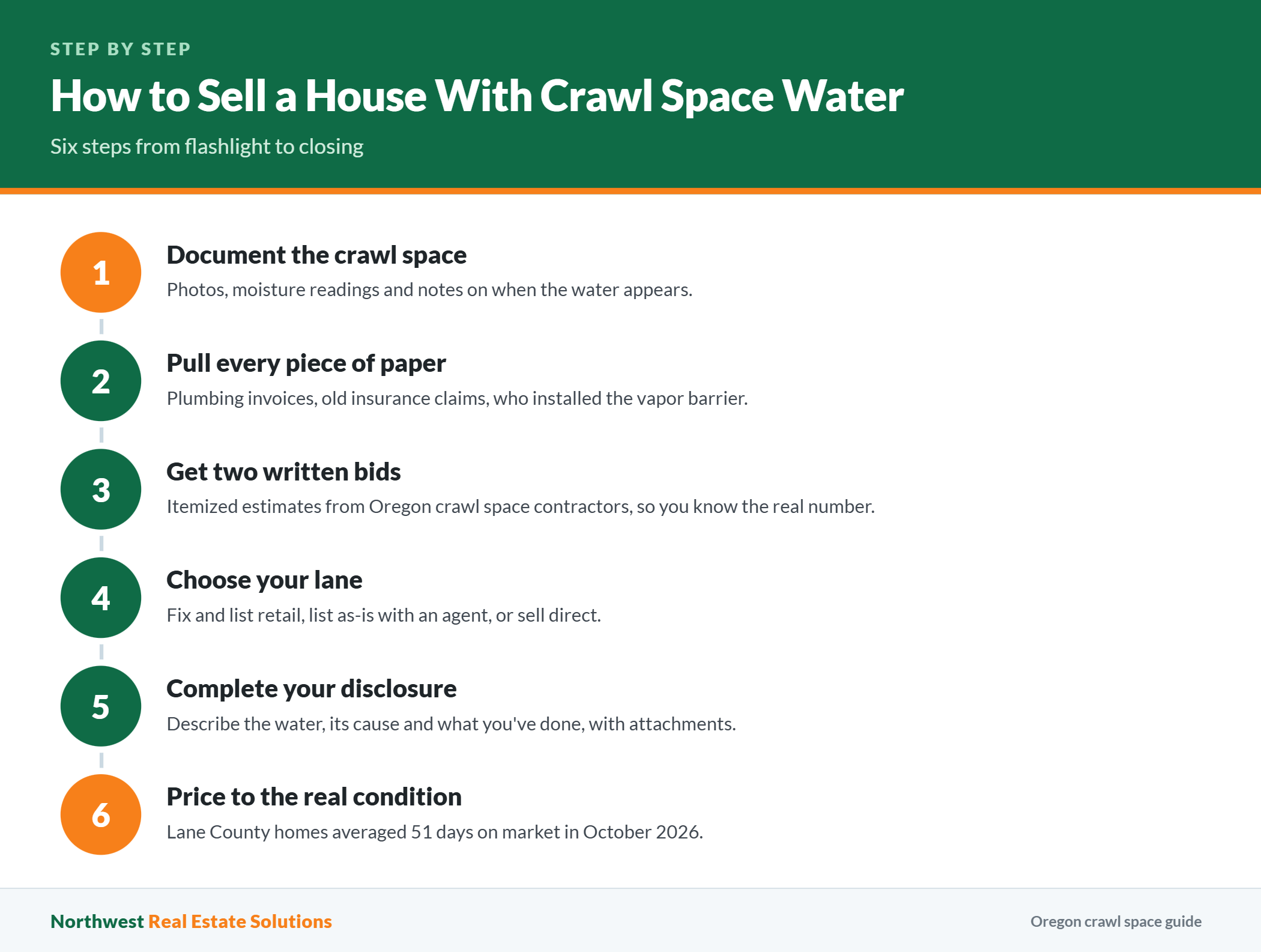
Step one is documenting the crawl space. Take photos, borrow a moisture meter if you can, and note when the water shows up.
Second, gather every piece of paper you have. That means past plumbing invoices, an old insurance claim, and the name of whoever installed the vapor barrier. Your insurance company can also tell you whether a prior claim is on record for the property, and buyers will find that out eventually anyway.
Third comes an honest cost estimate. Get two itemized written bids from Oregon crawl space contractors so you’re working from the real number, not a guess.
Step four is picking your lane. You can fix and list retail, list as-is with an agent, or sell direct.
Fifth, fill out your disclosure form carefully and attach your documents. Describe the crawl space water, what causes it, and what you’ve done about it. Vague answers invite buyer suspicion and legal exposure in Oregon.
Step six is pricing the house for the condition it’s actually in. Lane County homes averaged 51 days on market in October 2026, and 52.7 percent sold within 30 days. A house priced wrong for its condition misses that window and sits, since overpriced homes with known defects fall outside the fast-moving group.
For the Milwaukie landlord, we closed in under three weeks. The siblings split the proceeds, and nobody touched the lawnmowers. If that sounds like your situation, Northwest Real Estate Solutions buys Oregon properties in exactly that condition.
Frequently Asked Questions
Can You Sell an Oregon House If the Crawl Space Floods Every Winter?
Yes. Seasonal water is common here, since most of Oregon’s rain falls between October and April. A crawl space that’s wet in February and dry by July usually points to runoff or a rising water table, not a broken pipe. Write down when the water shows up and when it leaves, and put that pattern on your disclosure form. Then decide whether to fix the drainage first or sell as-is to a buyer who’ll handle it.
Should You Fix Old Water Damage in the Crawl Space Before You Sell?
Fix what buyers can see, and document what you’ve already fixed. Surface growth on joists can usually be cleaned and treated. Rotted beams are a bigger job that needs a licensed CCB contractor and often a permit. Keep every invoice, because repaired damage with paperwork reads as history to a buyer. Damage with no paper trail reads as a risk, and buyers price that risk into their offer.
Does Crawl Space Water Have to Be Disclosed When Selling in Oregon?
Yes. Oregon’s seller disclosure statement asks directly about water intrusion, drainage, and structural condition, and you have to answer based on what you actually know. Selling as-is doesn’t move that obligation off your plate. A plain description of the crawl space water, with your contractor estimates attached, protects you far better than hoping the buyer’s inspector misses it.
Will Insurance Cover Crawl Space Water in an Oregon Home?
Most standard Oregon homeowners policies cover sudden, accidental water events like a burst supply line. Most exclude groundwater seepage and long-term moisture. That line decides whether you’re filing an insurance claim or taking on a maintenance project. Call your insurance agent before you assume either way, and ask how a claim would affect your premium, since some insurers come down hard on water claims at renewal.
How Much Does Crawl Space Water Lower a Home’s Value in Oregon?
There’s no set percentage, because the hit depends on the cause and the condition of the wood above the water. Cosmetic moisture with sound framing might cost you a few thousand in negotiation. Rotted joists, a sagging floor, and mold growth reaching the living space can take a much bigger bite, sometimes more than the repair bid itself, because buyers price in uncertainty. Ask a real estate agent to run a comparative market analysis on both scenarios, and the gap gets a lot easier to see.
Selling a House With Crawl Space Water in Portland
Portland single-family listings had a median of 70 days on market in late October 2026, according to a Fidelity National Title market report. More than half of them, 52 percent, had cut their price at least once. A wet crawl space makes a slow listing even slower. If your house is in Southeast Portland, out toward Gresham, or anywhere the winter rain gets under the floor, Portland homeowners can sell it to us as it sits. There’s no need to pump it dry or line up a contractor first.
Get a Cash Offer for Your Oregon House With Crawl Space Water
If you’ve got crawl space water and aren’t sure which path fits your Oregon house, I’m happy to talk it through with you. We’ll go over your numbers, your timeline, and what the repair really costs, even if the answer ends up being a listing with an agent rather than selling to us. There’s no pressure and no obligation, and nobody will push you toward a decision you’re not ready to make.
Standing water, a soggy vapor barrier, or stained joists don’t have to stall your sale. Tell us about the house and what you’ve found underneath it, and we’ll make you a fair cash offer with no repairs and no showings. Contact Northwest Real Estate Solutions or fill out the form below to get started.