

A deed is a single page. You can download a blank quitclaim form, type in two names, sign it in front of a notary, and carry it to the recorder’s office for a fee smaller than a dinner out. That simplicity is exactly why adding a name to deed paperwork goes sideways so often. The form takes five minutes, and the consequences last decades.
I’ve bought houses from people still cleaning up a transfer their uncle made in 1994 with a blank form and a ballpoint pen. The paperwork was valid. The outcome just wasn’t what anybody had in mind.
Why Would You Add a Name to a Deed in the First Place?
Adding a spouse after the wedding feels like a formality, one more chore between the thank-you cards and the name change at the DMV. Then a refinance comes along. The title company flags a judgment against the new co-owner from a business that folded six years ago, and now that debt sits against the house.
Marriage is still the most common reason I see. Close behind it are parents who want a child to inherit the property without probate dragging the family through court for months. Adding a name to deed records does sidestep probate when the deed carries survivorship language. It also hands that child a live ownership interest today, not someday.
Estate planning drives plenty of these transfers. Refinancing and remarriage do too, and so does the moment an unmarried couple decides the person paying half the mortgage belongs on the title.
In most states, a competent adult can handle adding a name to deed records without a lawyer ever entering the room.
A couple of years ago I met a retired couple outside Vancouver, Washington who were three months behind on their home loan, with an auction date already on the calendar. Two years earlier they’d added their son to the title, thinking it would help. By the time they called me, the lender’s payoff involved all three of them, and a real estate lawyer had to unwind it before we could close.
The deed is a transfer document. It moves ownership, and that’s all it does. It doesn’t coordinate with your will or talk to your mortgage agreement, and it has no opinion about your tax bill.
Can Adding a Name to a Deed Affect Taxes or Ownership Rights?
Taxes are where the quiet damage shows up. Under federal law, giving someone a share of real property counts as a gift. For 2026, the IRS kept the annual gift tax exclusion at $19,000 per recipient, the same as 2025, and the lifetime gift and estate exemption sits at $15 million per individual. Half a house blows past the annual number in almost every market. A Form 709 filing usually follows, though an actual check to the IRS almost never does.
The basis problem is the one that costs real money. Gifted assets carry over the donor’s original basis, while inherited assets get a full step-up in basis, so a transfer timed wrong can cost heirs tens of thousands later. Deed half your home to your daughter today, and her starting point is half your 1991 purchase price. If she inherits it instead, Section 1014 resets the basis to fair market value on the date of death. That rule comes from IRS guidance in Publication 551, which you can read at irs.gov.
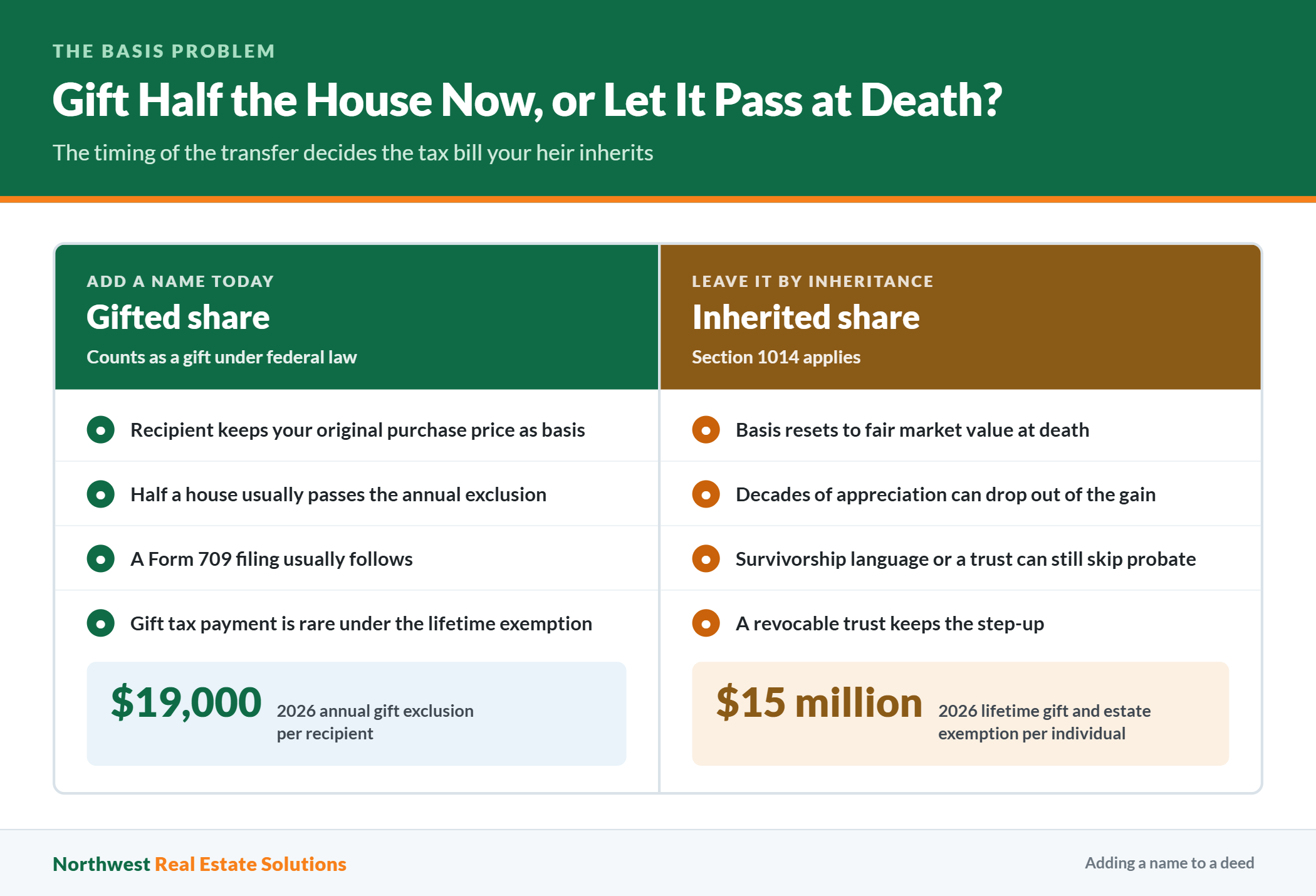
Now run that against today’s prices. NAR reported on November 12, 2026 that the median existing-home price hit $416,700 in October. A home bought three decades ago and gifted now can leave the recipient with a capital gains bill that inheritance would have wiped out entirely.
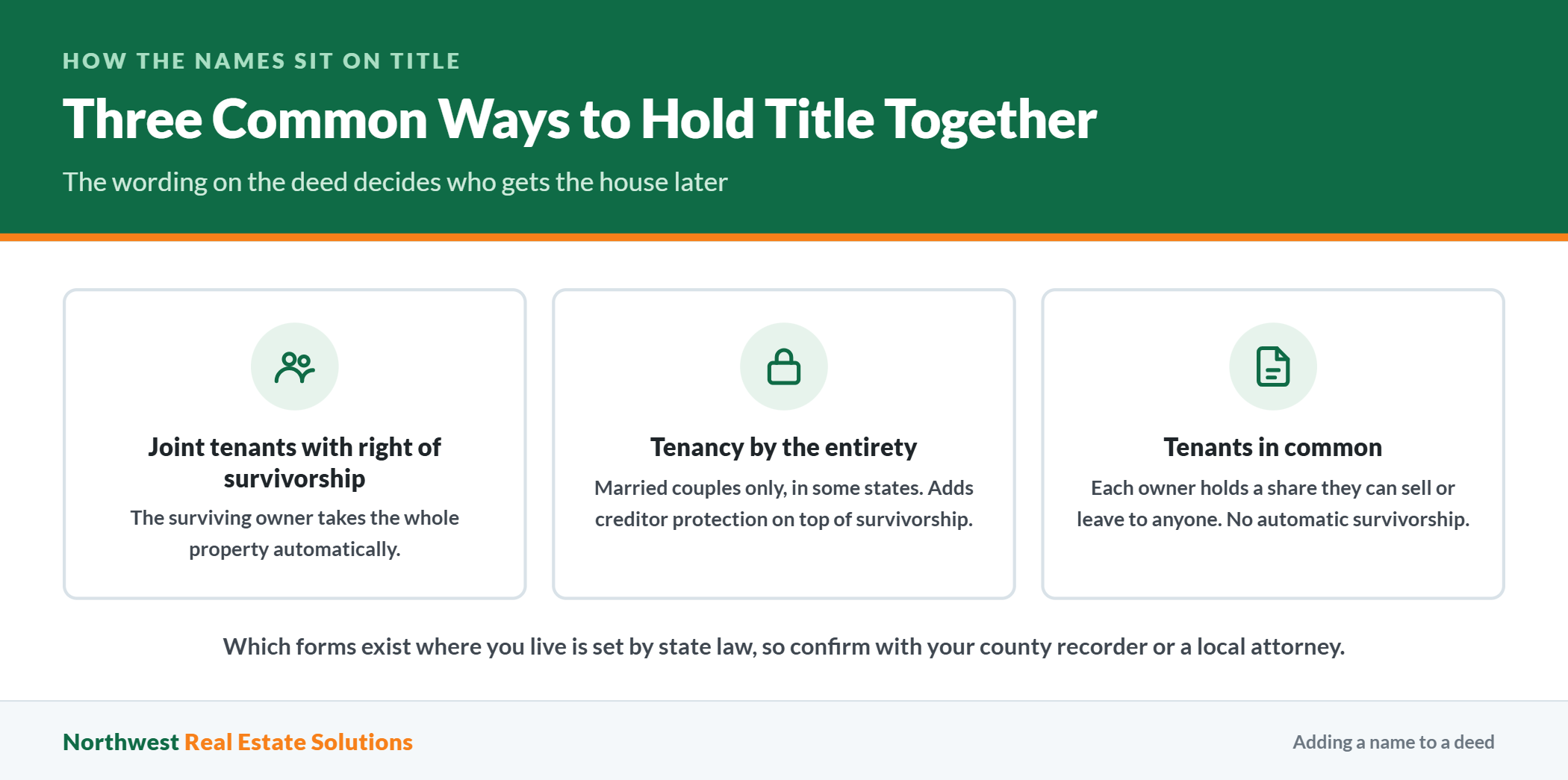
With joint tenants with right of survivorship, the survivor takes the whole property automatically. Tenancy by the entirety, open to married couples in some states, adds creditor protection on top of survivorship. Tenants in common splits the property into shares each owner can sell or leave to anyone, and that one catches families off guard when they assumed survivorship came built in. State law decides which of these forms exist where you live, so check your options with your county recorder or a local attorney.
Some states treat adding a name to deed records as a change of ownership and reassess; others exempt transfers between family members. Call your county assessor before you record, not after the new bill shows up.
What Happens If You Add a Name to a Deed Without a Lawyer?
A quitclaim deed conveys whatever interest you happen to own, with no warranty attached. Say a lien, an easement, or a forgotten sibling’s claim is hiding in the chain of title. The quitclaim deed hands all of it over quietly, and whoever receives it inherits the problem. A warranty deed makes promises about clear title. The quitclaim promises nothing.
Your lender deserves a phone call before adding a name to deed records. Nearly every mortgage has a due-on-sale clause that lets the bank demand full payoff when ownership transfers, though federal law blocks the lender in specific situations. Under 12 U.S.C. §1701j-3(d)(6), giving the property to a spouse or children, in full or in part, does not trigger the clause. A court order or settlement that makes a spouse an owner is covered too. Survivorship transfers to a joint tenant or tenant by the entirety fall under a separate subsection. You’ll find the full statute at govinfo.gov.
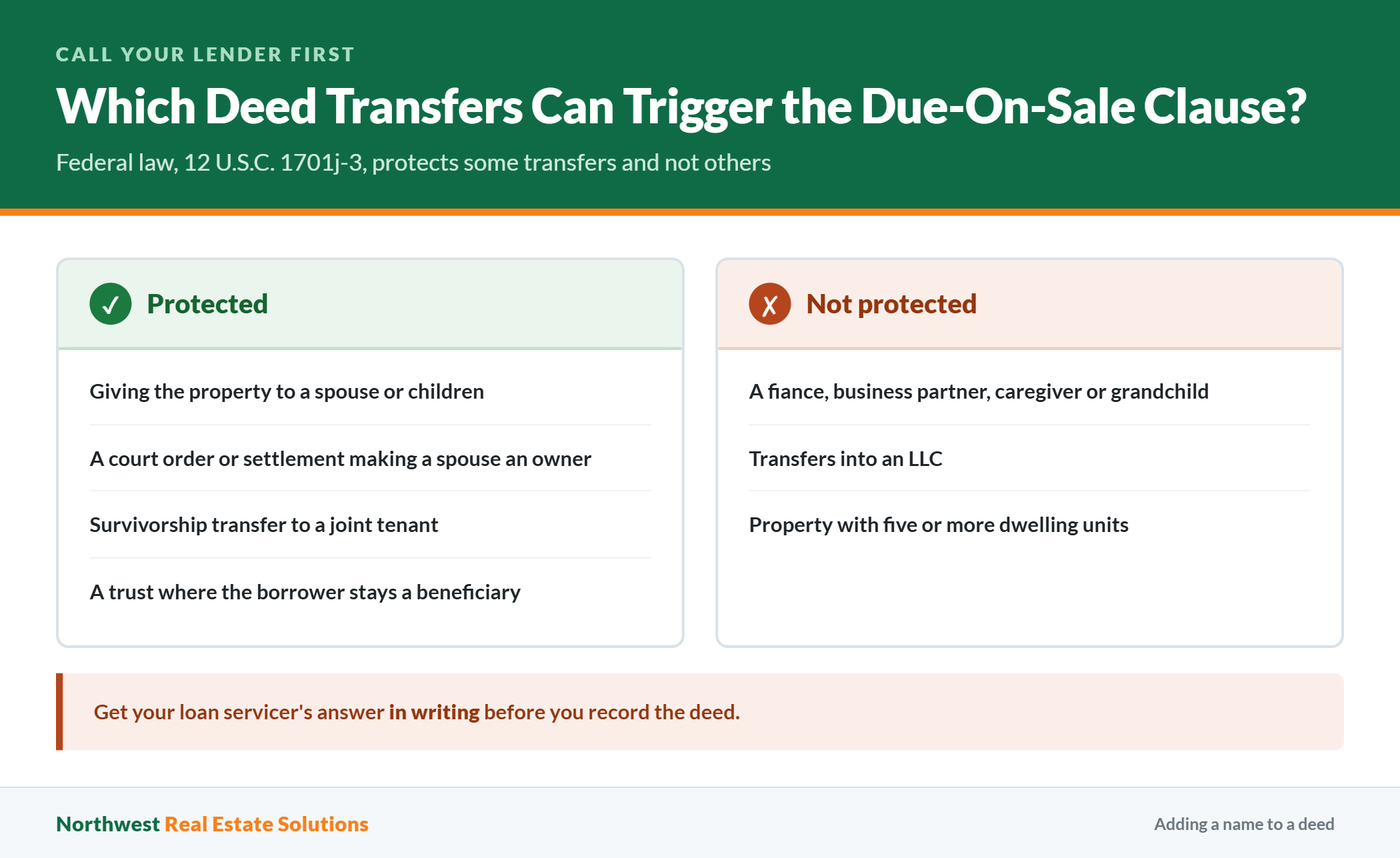
Adding a name to deed records for anyone outside that family circle gets no such protection, whether it’s a fiancé, a business partner, a caregiver, or a grandchild. Transfers into an LLC or similar ownership vehicle aren’t protected either, so your lender can still accelerate the loan. The protections also only cover residential property under five dwelling units.
Recording errors finish off the list of what goes wrong with adding a name to deed paperwork on your own. Think of a wrong legal description, a missing notary seal, or a grantor’s name that doesn’t match the prior deed. In a community property state, a spouse who needed to sign and didn’t is another. Any one of those can get the document sent back or leave a cloud on title that nobody notices until a buyer’s title company runs a search years later.
What Does a Lawyer Do When You Add a Name to a Deed?
“I’m just putting my wife on the house. Why am I paying someone hundreds of dollars for a one-page form?” Fair question. In a simple marital transfer with no mortgage complications, you may truly not need one. I won’t pretend otherwise.
When you’re adding a name to deed records, the form isn’t what you pay for. You’re paying for the title search and for the judgment call on which instrument fits your situation.
A real estate lawyer pulls the chain of title first, looking for liens, judgments, easements, and prior conveyances that contradict each other. Then the conversation turns to structure: joint tenancy, tenancy in common, tenancy by the entirety, or a revocable trust that keeps the property out of probate without giving anyone a present ownership interest. I’d steer most parents toward that trust route instead of adding a name to deed records outright, because I’ve seen families get into trouble the other way. A transfer into an inter vivos trust is protected from the due-on-sale clause when the borrower stays a beneficiary and occupancy rights don’t change. The property still gets the basis step-up at death, too.
Drafting comes next. The legal description is copied from the recorded source document, not from a tax bill. Survivorship language has to be worded to meet your state’s requirements. A few states void an intended joint tenancy when the magic words are missing.
Attorneys also handle what happens around the deed itself: transfer tax exemption forms, excise tax affidavits in states like Washington, and spousal consent. They’ll coordinate with your existing will so the two documents don’t contradict each other.
Some states expect an attorney to handle or review real estate closings, and others don’t. Your state bar association can tell you where your state lands.
Teams like Northwest Real Estate Solutions work with title companies and attorneys all the time, and they’ll tell you plainly when a situation calls for legal help and when it doesn’t.
How Much Does a Lawyer Cost to Add a Name to a Deed?
Skip the attorney on a complicated transfer, and the cleanup can cost more than ten times what prevention would have. Quiet title actions, probate petitions, and lien releases all run into real money and real months.
Flat-fee deed preparation is the usual setup for simple transfers like adding a name to deed records. Pricing swings by region and by how much title work the attorney includes, so I won’t give a national range that would mislead half my readers. Call two or three local firms. Ask whether the fee covers the title search, the recording, and the transfer tax forms, because those three items are where pricing splits apart.
Your county clerk or recorder posts a current fee schedule, usually online, and that’s the number to trust.
Transfer taxes are the line item that can dwarf everything else. Some states charge nothing on a transfer between spouses. Others tax the full value no matter who receives the interest. Your state revenue department publishes the exemption list, and reading it before you sign is worth an hour of your Saturday.
Adding a name to deed paperwork doesn’t automatically extend your existing owner’s policy to the new owner.
Now weigh that against the tax side of adding a name to deed records. NAR estimated that the average home has gained roughly $146,000 in value over the past seven years, though actual appreciation varies widely by location. A basis mistake on that kind of gain can produce a tax bill in the tens of thousands, which makes the stakes far bigger than they first look. For most families, legal fees for getting the structure right land in the low hundreds.
That math isn’t close.
Where Can You Find a Lawyer to Add a Name to a Deed?
A landlord I worked with wanted his longtime girlfriend on the title to a duplex he’d owned for eleven years. He first called the general practice attorney who’d handled his DUI in college. To his credit, that attorney said no and referred him to a property specialist.
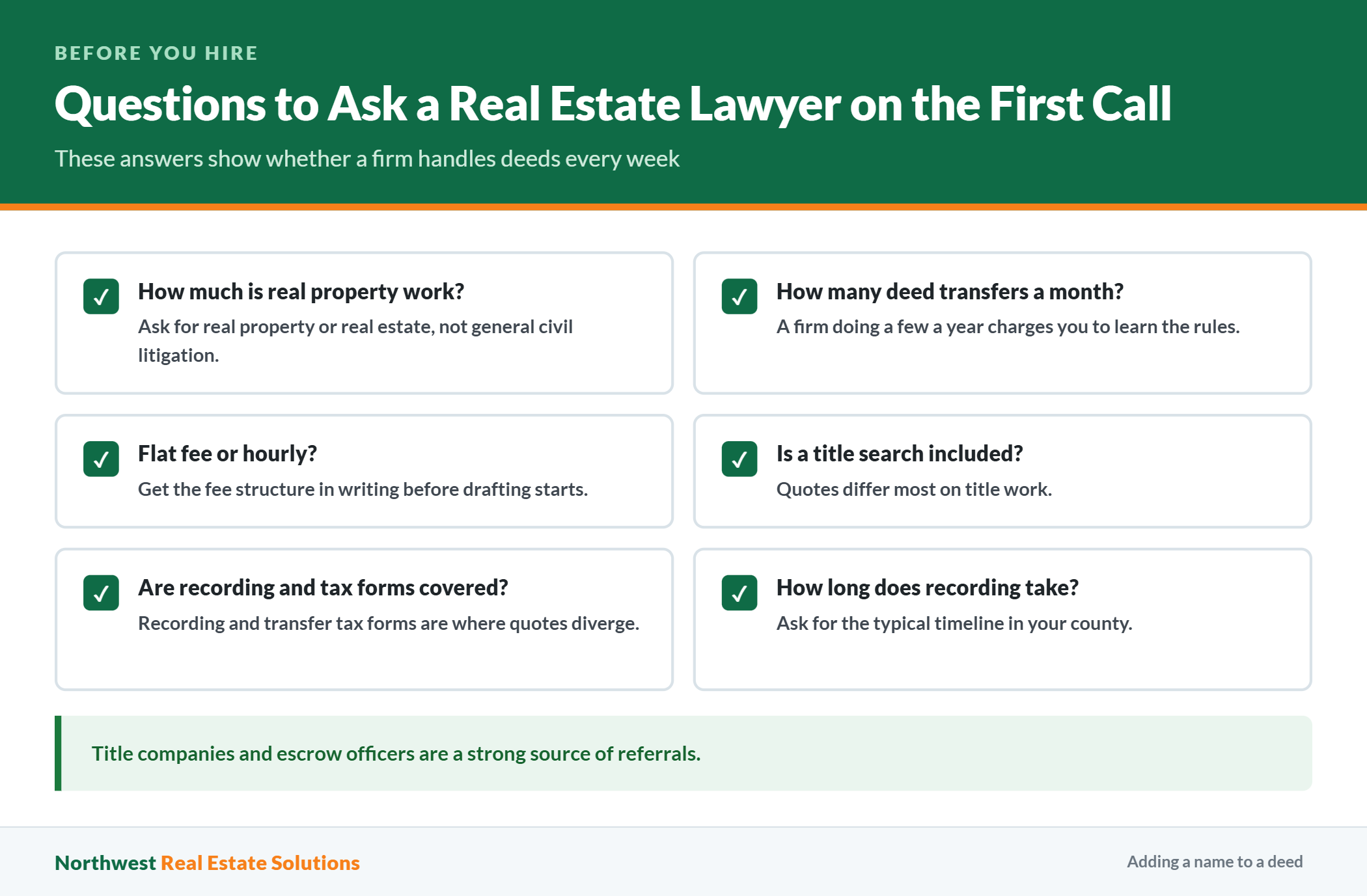
Start with your state bar association’s lawyer referral service. Every state runs one, most are free, and they screen by practice area. Ask for real property or real estate, not general civil litigation.
Title companies are another strong source when you’re adding a name to deed paperwork. They work with the same attorneys every week, so they know who returns calls, who hits recording deadlines, and whose documents come back from the county on the first try. Ask an escrow officer directly and you’ll usually get two or three names.
Your lender can help too, especially if the transfer touches your mortgage. Loan servicers keep approved attorney lists for exactly this reason.
On the first call, ask how many deed transfers the firm handles each month and whether the fee is flat or hourly. Then find out whether a title search is included and how long recording usually takes in your county. A firm that handles a few deeds a year will charge you while it learns your state’s rules.
Legal aid offices and limited-scope representation are two lower-cost routes. Neither fits every situation, and both deserve a phone call before you decide you can’t afford representation.
Local investors run into these situations constantly. Northwest Real Estate Solutions keeps relationships with title professionals and attorneys who do this work routinely, and a referral from someone who closes transactions every week beats a listing in an internet directory.
Skip the online deed-form services when adding a name to deed records matters this much. They don’t review your title or know your state’s survivorship language, and the fine print disclaims all responsibility.
How Do You Remove a Name From a Deed Later?
Two names went on a deed during a marriage. Four years later the marriage ended and the divorce decree awarded the house to one spouse. The deed still showed both names, because nobody filed anything.
Removing a name takes cooperation from the person whose name is coming off. They have to sign a deed conveying their interest back. Without that signature or a court order, the name stays.
In most states, divorce decrees don’t transfer real estate on their own. The decree orders a party to sign a deed, and somebody still has to prepare, execute, and record it. A surprising number of people assume the court took care of that.
When survivorship language is in place, the surviving owner records a certified death certificate and an affidavit, and title vests without probate. Tenants in common don’t get that. The deceased owner’s share goes through the estate.
If the remaining owner has a mortgage with both names on it, removing someone from title doesn’t remove them from the debt. That takes a refinance or a formal release from the lender. The two documents are independent, and I’ve watched sellers learn that at the worst possible moment.
A woman in Bend, Oregon called me while she was settling her father’s estate. Two agent listings had expired with zero offers. The garage was stacked to the ceiling with his woodworking equipment, and the title still carried her late mother’s name from a 1980s deed. We handled the paperwork on our end and closed in under a month.
Frequently Asked Questions
Can I Put Someone on My Deed While I Still Have a Mortgage?
You can, and adding a name to deed records will go through at the recorder whatever your lender thinks. Federal law shields certain family transfers from the due-on-sale clause covered earlier, but transfers to a friend, fiancé, or business entity get no such protection. Call your loan servicer first and get the answer in writing. A five-minute call beats an acceleration notice.
What Exactly Is a Warranty Deed?
A warranty deed is the strongest form of transfer document in American real estate. The grantor guarantees they own the property free of undisclosed liens and promises to defend the new owner’s title against past claims. A quitclaim deed, covered above, transfers whatever interest exists and guarantees nothing. Most sales between strangers use warranty deeds, while most family transfers use quitclaims, which is part of why family transfers hide problems.
How Do I Know If a Real Estate Lawyer Is Any Good?
Ask how much of the practice is real property work, and get the fee structure in writing before anything gets drafted. A good attorney will tell you when you don’t need them, and that honesty is the clearest sign you’ve found the right one. Referrals from title companies and escrow officers tend to beat online reviews, since those people see the finished work every week.
What Can Make a Deed Legally Invalid?
Several things can kill a deed. The list includes an inaccurate legal description, a missing or improper notarization, a grantor who lacked mental capacity at signing, and a transfer made under duress or fraud. Some states also void a deed that was never delivered to the grantee, even one that was signed and left sitting in a drawer. In community property states, a spouse’s missing signature can sink the whole transfer.
Does Adding a Name to Deed Records Protect the Property From Creditors?
Usually the opposite happens. Once you add a name to deed paperwork, that person’s creditors can reach their share of the property. An adult child’s tax lien or a co-owner’s judgment can end up attached to a house they never paid a dime toward. Tenancy by the entirety offers protection in states that recognize it, though only for married couples and only against one spouse’s individual debts.
Should I Use a Trust Instead of Adding Someone to the Title?
For estate planning, often yes. A revocable trust keeps the property out of probate without handing anyone a present ownership interest. It also preserves the basis step-up at death and lets you change your mind later. Adding a name to deed records is permanent unless the other person cooperates, and that one-way door is why I’d rather see families sit down with an estate attorney first.
If you’re staring at a title problem, an inherited property, or a deed situation you’d rather not untangle alone, we’re glad to talk it through. We can point you to the right help, whether that’s an attorney, a title officer, or an offer from us. There’s no pressure, no obligation, and no hard feelings if you decide to handle it yourself.
Deed and Title Problems on a Portland Home
Title trouble tends to show up at the worst time, often right when a house needs to sell. Portland single-family listings had a median of 70 days on market in late October 2026, according to a Fidelity National Title market report. A deed problem that delays closing can drag an already slow sale out even further. Portland homeowners with an old family deed, a name that never came off title, or an inherited house can talk with us before the paperwork gets worse.
Talk With Us About a House With a Deed Problem
If a name on the deed is holding up your sale, or you’re not sure whose name belongs there, we can help you sort through your options. We buy houses with title issues and work with local title companies to clear them before closing. Contact Northwest Real Estate Solutions or fill out the form below to get started.